
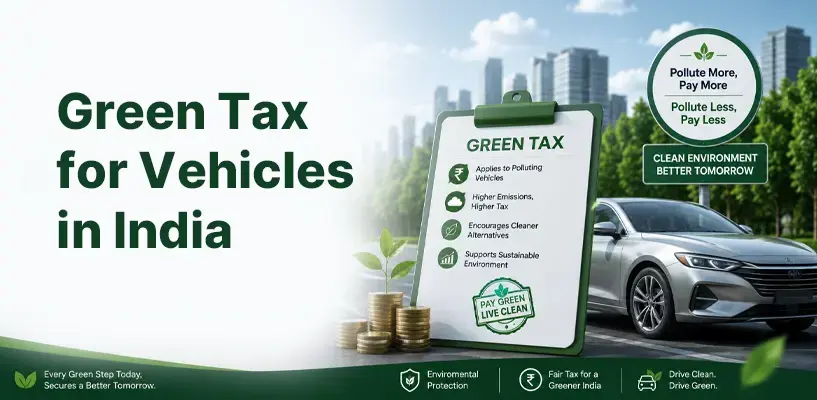
Green tax is an extra charge on older vehicles, added when you renew their registration or fitness certificate under the Motor Vehicles Act. It applies to private vehicles over 15 years old and commercial ones over 8 years, and usually works out to 10 to 25 percent of the road tax. Rates differ a lot by state, with Delhi-NCR charging up to 50 percent.
Cleaner vehicles, those running on CNG, LPG, electricity, ethanol, or strong hybrid systems, are exempt in most states. The point of the tax is not to raise money. It is to make holding on to an old, polluting vehicle cost more each year than moving to a cleaner one.
Which Vehicles Are Subject to Green Tax in India
Whether your vehicle attracts green tax depends on three things: how old it is, what type it is, and what fuel it runs on. The age limits are not random numbers.
They line up exactly with the fitness-testing schedule under India’s Vehicle Scrappage Policy 2021, and that is deliberate. The same year your vehicle starts needing regular fitness tests is the year green tax kicks in, so the two costs arrive together.
In practice, this lands when you renew a vehicle fitness certificate, the point at which the tax is assessed and collected.
| Vehicle type | Age limit | Typical rate |
| Private petrol | Over 15 years | 10 to 25 percent of road tax |
| Private diesel (most states) | Over 15 years | 10 to 25 percent of road tax |
| Private diesel (NCR) | Over 10 years | Up to 50 percent; NGT rules apply |
| Commercial vehicles | Over 8 years | 10 to 25 percent of road tax |
| Agricultural vehicles | Not applicable | Exempt in most states |
| Defence, police, emergency | Not applicable | Exempt in most states |
Because vehicle tax is a state matter, each state sets its own rates within this framework. For the exact figure on your vehicle, parivahan.gov.in is the reliable source.
Green Tax Rates Across Indian States
This is the part most articles on the subject skip past, listing one or two states and stopping. Rates actually vary widely, and where your vehicle is registered changes the bill significantly. The table covers the eight largest state markets.
Delhi-NCR is a special case. For end-of-life vehicles registered there, diesel over 10 years and petrol over 15 cannot legally run at all under NGT orders, so the rate is beside the point. The only real option for those vehicles is to retire them.
| State | Private rate | Commercial rate | Notes |
| Delhi-NCR | Up to 50 percent | Up to 50 percent | Highest; NGT enforcement |
| Maharashtra | 25 percent | 25 percent | At registration renewal |
| Karnataka | 10 to 20 percent | 10 to 15 percent | Varies by weight |
| Haryana | 10 to 15 percent | 10 percent | At fitness renewal |
| Tamil Nadu | 10 to 15 percent | 10 percent | At fitness renewal |
| Gujarat | 10 percent | 10 percent | Among the lowest |
| Uttar Pradesh | 10 percent | 10 percent | At registration renewal |
| West Bengal | 10 to 20 percent | 10 to 15 percent | Rises with vehicle age |
These rates change from time to time, so check your state transport portal for the current figure before relying on them.
Vehicles Exempt from Green Tax in India
The exemptions follow a clear logic: the tax penalises older, dirtier vehicles, so the cleaner the vehicle, the more likely it is to be let off. That is why the exempt list is built around fuel type and use rather than age.
- Electric vehicles, including plug-in hybrids, are exempt in most states because they produce no tailpipe emissions.
- CNG and LPG vehicles are exempt as cleaner-fuel alternatives that pollute far less than petrol or diesel of the same age.
- Ethanol-blended and flex-fuel vehicles qualify for exemption or partial relief in states following the national fuel-blending programme.
- Strong hybrids that run on electric power for a real distance are exempt; mild hybrids that only do start-stop usually are not.
- Tractors and farm equipment are exempt, as they sit outside the on-road tax framework.
- Defence, police, fire, and ambulance vehicles are exempt under service-vehicle rules in most states.
How to Pay Green Tax for Vehicles in India
There are three ways to pay, and the online route is quickest, since it gives you a receipt on the spot.
If, while paying, you realise the running costs no longer add up, it is worth weighing the benefits of scrapping the vehicle instead. Tax on top of fitness tests and rising upkeep often costs more than retiring the car.
On the Parivahan portal (parivahan.gov.in)
- Choose your state from the dropdown.
- Open Online Services, then Vehicle Related Services.
- Enter your registration and chassis number.
- Pick Pay Tax for a private vehicle or Fitness Renewal for a commercial one; the green tax shows alongside any road tax due.
- Pay by UPI, net banking, or card, and download the receipt.
On the mParivahan app
The app works on Android and iOS and connects to over 1,300 RTOs. Log in with your registered mobile number, open your vehicle, and the dues, green tax included, are ready to pay.
At the RTO counter
Bring your RC, a valid pollution certificate, insurance, and ID when you renew. The tax is calculated and collected there, and VAHAN is updated in the same visit.
Skipping payment has real consequences: your registration renewal gets rejected, late fees and penalties build up, and in some states it can lead to prosecution under the Motor Vehicles Act.
Green Tax and the Vehicle Scrappage Policy: How They Connect
Green tax does not work alone. It is one of three levers in India’s vehicle scrappage policy, and together they are built to make holding on to an old vehicle steadily less worthwhile.
The three levers work in sequence:
- Green tax raises the annual cost of keeping the vehicle on the road.
- Mandatory fitness testing adds a recurring expense and a real risk of failure.
- The Certificate of Deposit rewards you for retiring the vehicle instead.
Why Holding On Gets Expensive
The squeeze is intentional. Once a vehicle crosses the age line, several costs start climbing at the same time, and none of them ease off on their own.
- Green tax is added on top of the regular road tax bill.
- Fitness tests turn into a recurring cost, yearly for commercial vehicles.
- Insurance premiums rise as the vehicle is rated higher-risk.
- Repairs grow more frequent as the engine and parts wear down.
Stacked together, these make an ageing vehicle expensive to simply keep, well before you spend anything on actually driving it.
Why Scrapping Pays Off
The scrapping route is designed to clear all of those costs in one move. Scrap the vehicle at an authorised facility and you receive a Certificate of Deposit, which unlocks a set of benefits on your next vehicle:
- A 4 to 6 percent discount on the new vehicle.
- A registration fee waiver and a road tax cut of 15 to 25 percent in most states.
- A green tax waiver on the replacement for an initial period, in several states.
For commercial fleet owners the maths tips even faster. An ageing commercial vehicle carries green tax, yearly fitness tests, and the higher running costs of an old engine all at once, which usually turns it into a net drain within a year or two of crossing the threshold. That is why fleet operators tend to renew rather than hold.
Conclusion
Green tax is a signal, not just a charge: it tells you that an old, high-emission vehicle is going to cost more to keep with each passing year. For anyone nearing the 15-year mark on a private vehicle or the 8-year mark on a commercial one, the question worth asking is not the size of this year’s tax bill. It is whether the full cost of holding on, the tax plus fitness tests plus rising insurance and repairs, has overtaken what scrapping would return through the Certificate of Deposit and its waivers. For most ageing vehicles, it has, and retiring the vehicle at an authorised facility becomes the sensible move.
FAQs
What is green tax for vehicles in India?
An extra charge on older vehicles at renewal: 10 to 25 percent of road tax for private vehicles over 15 years or commercial ones over 8.
Who has to pay green tax in India?
Owners of private vehicles over 15 years, diesel vehicles over 10 years in NCR, and commercial vehicles over 8 years, paid at renewal.
Are electric vehicles exempt from green tax?
Yes, in most states, since they have no tailpipe emissions. Strong hybrids qualify too; mild hybrids that only do start-stop usually do not.
How do I pay green tax online?
On parivahan.gov.in, go to Vehicle Related Services and Pay Tax, enter your vehicle details, verify by OTP, and pay by UPI or card.
Is the green tax rate the same everywhere?
No. It ranges from about 10 percent of road tax in lower states to 50 percent in Delhi-NCR. Each state sets its own rate.
How is green tax different from road tax?
Road tax is the base charge every owner pays. Green tax is an added surcharge that applies only to older, more polluting vehicles.
Should I scrap my vehicle instead of paying green tax?
If the tax, fitness tests, and upkeep together cost more than the scrap return plus the Certificate of Deposit benefits, scrapping makes better sense.