

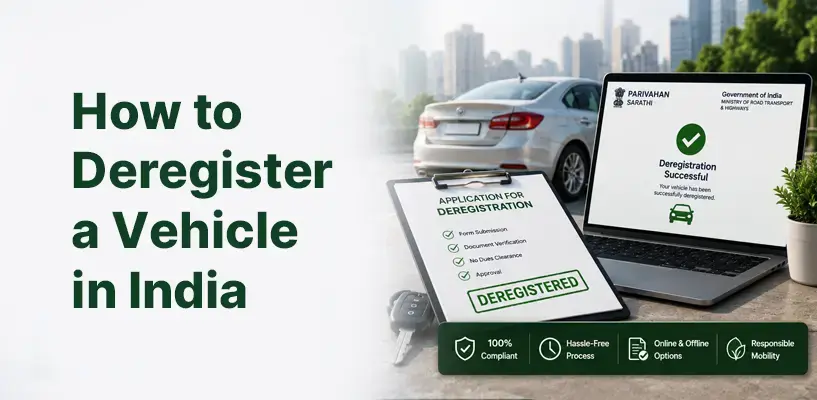
Deregistering a vehicle means formally cancelling its entry in VAHAN, the national database that holds every vehicle’s legal identity. You have to do this once a vehicle is scrapped, written off after an accident, exported, or retired for age. The process needs a Certificate of Deposit from an authorised scrapping facility, the original RC, and a submission either on the Vahan portal or at your RTO. The law gives you 14 days from scrapping to start it.
What Is Vehicle Deregistration and When Is It Required
As long as a vehicle’s record sits open in VAHAN, you are still its legal owner, no matter where the car is or what state it is in. A scrapped car that has not been deregistered still counts as a live, registered vehicle in your name.
That open record is the gap deregistration closes.
The Certificate of Deposit, or CoD, is the document that makes this possible. An authorised scrapping facility issues it once it has stripped and depolluted the vehicle to the AIS-129 standard. It is the proof that the car was retired properly, and no RTO will cancel a registration without it.
You are legally required to deregister in four situations:
- The vehicle was scrapped at an authorised Registered Vehicle Scrapping Facility.
- It was declared a total loss by your insurer after an accident.
- It was permanently exported out of India.
- It is an end-of-life vehicle that has crossed its mandatory retirement age.
The 14-day deadline matters because any fine, accident claim, or misuse of the number plate between scrapping and deregistration still lands on you as the registered owner.
Documents Required to Deregister a Vehicle
The Certificate of Deposit leads the list, since the RTO cannot process the cancellation without it. The rest of the set confirms your identity, clears any dues, and proves the car carries no loan or pending case.
Keep the full set ready before you start, whether you file online or at the counter.
| Document | Where it comes from |
| Certificate of Deposit | The scrapping facility, after scrapping |
| Original Registration Certificate | You |
| Form 29 (notice of disposal) | RTO or parivahan.gov.in |
| Form 30 (application for cancellation) | RTO or parivahan.gov.in |
| Affidavit (no dues, loan, or case pending) | Notarised by you |
| Identity proof (Aadhaar, PAN, voter ID) | You |
| Address proof | You |
| NOC from your bank | Needed if a loan is still recorded on VAHAN |
| Traffic police NOC | Confirms no pending challans |
| Insurance copy | For your premium refund |
| Chassis number plate | Cut and sealed by the facility; some RTOs ask for it |
One point trips people up: if a loan is still recorded against the car, the hypothecation must be cleared from VAHAN first. Both the portal and the counter will reject the application while it stays active.
How to Deregister a Vehicle Online via Vahan Portal
For a car with no loan still on record, the Vahan portal is the simpler route. It is fully digital in most states and gives you an acknowledgement straight away. The CoD reference number from your scrapping facility is a required field, so have it in hand before you begin.
- Go to vahan.parivahan.gov.in and pick your state from the dropdown, since fees and document requirements vary by state.
- Open Online Services, then Vehicle Related Services, then RC Cancellation.
- Enter the registration number and the last five digits of the chassis number to pull up the record.
- Verify yourself with the OTP sent to the mobile number registered against the RC.
- Choose Scrapped via RVSF as the reason and enter the CoD reference number.
- Upload the documents your state asks for, as PDF or JPEG within the size limit.
- Pay the cancellation fee, usually INR 100 to INR 500 by state, through UPI, net banking, or card.
- Download the acknowledgement with its reference number, which you can use to track the status.
- Once the RTO approves it, the cancellation shows on VAHAN within 7 to 15 working days.
If the mobile number on the RC has changed since you bought the car, the OTP will not reach you, and you will need the offline route instead.
How to Deregister a Vehicle Offline at RTO
The offline route is for cases the portal cannot handle: a state where the online flow is incomplete, a loan that needs clearing at the counter, or an RTO that wants the physical chassis plate. The same 14-day deadline under the vehicle scrappage policy applies either way.
- Visit the RTO where the car was first registered, carrying the full document set and the chassis plate in the facility’s sealed envelope.
- Submit Form 29 and Form 30 with the CoD, RC, affidavit, identity and address proof, and the bank NOC if a loan was recorded.
- The inspector matches the chassis plate against the VAHAN record and the CoD to confirm it is the same vehicle.
- Pay the fee at the counter and keep the receipt for any follow-up.
- Collect the acknowledgement. The cancellation reflects on VAHAN within 15 to 30 working days, and some states email a digital certificate once it is done.
In short, use the portal where your state’s online flow works and there is no loan to clear; use the counter when either of those conditions fails.
What to Do Next After Deregistration of Vehicle
Cancelling the VAHAN record closes the main legal exposure, but the car still has a few financial threads attached to its number. Tie these off so nothing keeps billing or tracking against a vehicle that no longer exists.
- Insurance: tell your insurer within 30 days. Most policies refund the unused portion of the premium once you show the deregistration certificate.
- FASTag: close it through the issuing bank and reclaim any balance, which is refunded within 5 to 10 working days.
- Auto-debits: cancel anything tied to the number, such as fuel cards or fleet subscriptions.
- The CoD: use it toward a new vehicle within its validity, usually two years, to claim the 4 to 6 percent discount and the registration and road tax waivers.
- The certificate: keep it for good. It is your proof that the car no longer exists in your name.
The common mistake is assuming scrapping alone ends it. Scrapping and deregistration are two separate steps, and stopping after the first leaves your name on the record.
Conclusion
Deregistration is not a formality you can let slide; it is a legal step with a 14-day clock attached. A registration left open in VAHAN keeps you on the hook for anything that happens under that number, long after the car is gone. The Certificate of Deposit is what unlocks the whole process, which is why scrapping at an authorised facility and deregistering immediately after is the cleanest way to close the file for good. Start it the day the CoD reaches you, and the liability window never opens.
FAQs
What is vehicle deregistration in India?
It is the formal cancellation of a vehicle’s VAHAN record, which removes it from the registry and ends your legal ownership of it.
Is deregistration mandatory after scrapping?
Yes. The law requires you to start it within 14 days. A scrapped car left registered stays legally active in your name.
What documents do I need to deregister a vehicle?
The Certificate of Deposit, RC, Form 29, Form 30, an affidavit, identity and address proof, and a bank NOC if a loan is recorded.
What does deregistration cost in India?
Between INR 100 and INR 500, depending on your state and vehicle type, paid on the Vahan portal or at the RTO counter.
How long does deregistration take?
The online route takes 7 to 15 working days. The offline route at the RTO takes 15 to 30 working days from submission.
Can I deregister a vehicle that still has a loan?
Not until the loan is cleared. You first remove the hypothecation from VAHAN using a no-objection certificate from your bank.
What if I never deregister my scrapped vehicle?
The record stays live in VAHAN, leaving you answerable for any fine, accident claim, or misuse linked to that number plate.
Last Updated on: June 17, 2026