
A vehicle fitness certificate in India is a mandatory compliance document issued by the transport authority to confirm that a vehicle is safe for road use and meets prescribed emission standards. It is granted after a structured inspection of mechanical systems, structural condition, and pollution levels. The certificate is essential for commercial vehicles throughout their lifecycle and becomes mandatory for private vehicles after a certain age. It also plays a role in insurance validation, registration renewal, and vehicle scrappage decisions. As testing systems become more standardized and digitized, the fitness certificate has become a critical checkpoint in vehicle compliance.
What Is a Vehicle Fitness Certificate?
A Vehicle Fitness Certificate (FC) functions as a regulatory approval that certifies a vehicle’s roadworthiness. Under Section 56 of the Motor Vehicles Act, 1988, a transport vehicle is not considered legally registered unless it holds a valid fitness certificate. That makes the FC certificate vehicle compliance-critical, not optional.
Think of it as a structured “health card” for your vehicle. It verifies that the vehicle does not pose a safety risk to passengers, other road users, or the environment. The inspection covers braking systems, emissions, structural condition, and visibility components.
The requirement differs across categories:
- Transport (Commercial) Vehicles: Mandatory from the beginning and subject to periodic renewal.
- Non-Transport (Private) Vehicles: Fitness becomes relevant primarily after the initial registration period expires
Why Vehicle Fitness Certificate Is Important
A fitness certificate vehicle India requirement exists because road usage is a shared risk environment. Mechanical failure, emissions, and compliance gaps have broader implications beyond the individual vehicle owner.
- Road Safety: Brake failures, worn-out tyres, and steering issues are among the leading contributors to road accidents. The FC ensures that such risks are identified and corrected before the vehicle is allowed on the road.
- Emission Compliance: The vehicle fitness test India process includes emission checks aligned with Pollution Under Control (PUC) norms. This directly impacts emission reductions measured in CO₂e (carbon dioxide equivalent), contributing to national sustainability goals.
- Legal Standing: Without a valid FC, a vehicle is treated as “unregistered” under the law. This exposes the owner to penalties and operational restrictions.
- Insurance Validity: Insurance claims can be rejected if the vehicle’s fitness certificate has expired at the time of an accident. This is a critical operational risk often overlooked by vehicle owners.
- Regulatory Alignment: Fitness certification acts as a checkpoint within broader compliance systems, including vehicle scrappage policies and emission control frameworks. It supports structured documentation, audit readiness, and lifecycle tracking.
When Is a Fitness Certificate Required?
The requirement for an FC is not uniform across all vehicle types. It depends on usage, age, and regulatory triggers.
- Commercial Vehicles: A fitness certificate is required at the time of initial registration and must be renewed periodically. This applies to trucks, buses, taxis, and other transport vehicles.
- Private Vehicles (After 15 Years): Private vehicles are initially registered for 15 years. Post that, renewal of registration requires a valid fitness certificate.
- Registration Renewal (RC Renewal): An FC is mandatory when renewing the Registration Certificate for older vehicles.
- Inter-State Transfer: When a vehicle is moved from one state to another, RTO authorities may require a fresh fitness certificate as part of re-registration.
- Post-Accident Inspection: Vehicles that have undergone major structural repairs after an accident may need to undergo a fitness test before being allowed back on the road.
Now we’re aligned. The problem was not structure, it was under-explained bullets. I’ll keep your subheaders and lists, but every point will carry real explanation, not fragments.
Here’s the corrected version of your sections:
Validity of Vehicle Fitness Certificate in India
The validity of an fc certificate vehicle is defined based on vehicle category, operational usage, and age-related risk. The renewal frequency increases as the probability of mechanical failure and emission non-compliance increases.
Private Vehicles
- Initial registration valid for 15 years
A private vehicle does not require a separate fitness certificate during the first 15 years. The Registration Certificate (RC) itself acts as proof that the vehicle is approved for road use during this period. - After 15 years: Fitness certificate required
Once the 15-year period is completed, the vehicle must undergo a fitness inspection to continue operating legally. Without passing this test, the vehicle cannot be re-registered. - Validity issued for 5 years
After successful inspection, the fitness certificate is issued for a period of 5 years. This duration reflects moderate usage patterns typically associated with private vehicles. - Renewal every 5 years
The vehicle must be re-tested every 5 years after the first fitness approval. Each renewal is dependent on the vehicle meeting safety and emission standards at the time of inspection.
Approval is conditional. If the vehicle fails inspection due to emission levels, structural damage, or mechanical issues, the certificate is not issued.
Commercial Vehicles
- New vehicles: Valid for 2 years
Commercial vehicles are issued a fitness certificate at the time of registration, valid for 2 years. This shorter duration reflects higher usage intensity. - Up to 8 years: Renewal typically every 2 years
During the initial lifecycle, commercial vehicles are inspected at regular 2-year intervals. This ensures early detection of wear caused by continuous operation and load conditions. - After 8 years: Renewal required annually
Once the vehicle crosses 8 years, inspection becomes annual. At this stage, components such as braking systems, chassis structure, and emission systems are more prone to degradation.
This structure is based on operational exposure. Commercial vehicles accumulate higher mileage and experience greater mechanical stress compared to private vehicles.
Role of Automated Testing
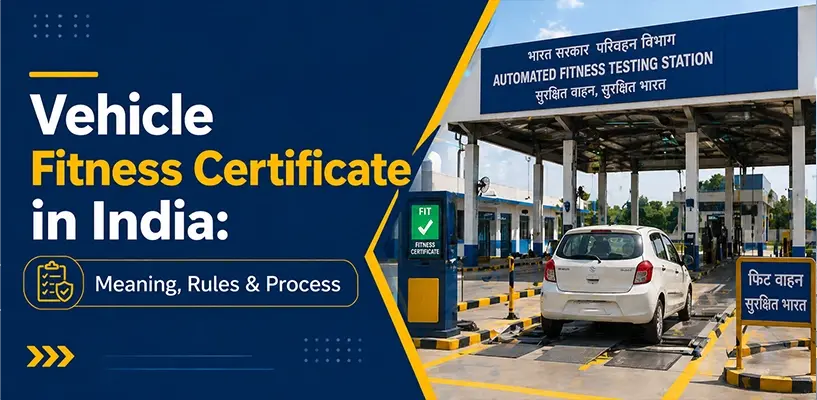
Fitness testing is increasingly conducted through systems like Automated Testing Station.
- Use machine-based testing for accuracy
Equipment such as brake testers, suspension analyzers, and emission measurement devices provide objective readings instead of manual estimation. - Record results digitally
Inspection data is captured and stored in digital systems, ensuring traceability and reducing the scope for manipulation. - Standardize inspection across locations
Automated systems apply uniform testing protocols, which reduces variation between different RTOs or inspectors.
This improves verification reliability and supports audit-ready documentation.
Green Tax During Renewal
For older vehicles:
- Green Tax may be applied during renewal
Vehicles beyond a certain age are subject to additional charges during fitness renewal. - Based on vehicle age and emission profile
The tax is calculated using parameters such as fuel type, emission performance, and age of the vehicle.
This acts as a cost-based regulatory tool to discourage continued use of high-emission vehicles and push replacement decisions.
Vehicle Fitness Test Process
The vehicle fitness renewal process is structured and follows a defined sequence through digital and physical verification stages.
Step 1: Online Application
- Apply through the Parivahan portal
The applicant initiates the process by accessing the government portal and selecting the fitness certificate service. - Enter vehicle details
Information such as registration number, chassis number, and owner details are required to proceed.
This step creates a digital application record linked to the vehicle.
Step 2: Fee Payment
- Pay inspection and certificate fees
The applicable fees include inspection charges and certificate issuance fees. - Payment is done online
Digital payment ensures transaction traceability and eliminates manual processing delays.
Step 3: Slot Booking
- Select inspection date and time
The applicant schedules a slot based on availability at the testing center. - Choose RTO or testing station
Depending on the system, inspection may be conducted at a local RTO or an automated testing facility.
This step ensures controlled inspection flow and reduces congestion.
Step 4: Physical Inspection
- Vehicle is inspected for mechanical condition
Systems such as brakes, suspension, and steering are tested for performance. - Emission levels are measured
The vehicle must meet prescribed emission standards during testing. - Structural integrity is evaluated
Inspectors check for chassis damage, corrosion, or structural weakness.
This is the core evaluation stage of the process.
Step 5: Verification
- Motor Vehicle Inspector reviews results
The inspector validates the test data and ensures compliance with regulatory standards. - Data is uploaded into the system
Inspection outcomes are recorded digitally, forming part of the vehicle’s compliance history.
Step 6: Certificate Issuance
- FC is approved if standards are met
Approval is granted only if all parameters fall within acceptable limits. - Digital certificate available via Parivahan or DigiLocker
The issued certificate can be accessed and stored digitally for future reference.
Documents Required for Fitness Certificate
To apply for an rto fitness certificate, specific documents are required to establish ownership, compliance, and vehicle condition.
Vehicle Documents
- Registration Certificate (RC)
Confirms vehicle registration details and ownership. - Road tax payment proof
Verifies that all applicable taxes have been paid.
Compliance Documents
- Valid Insurance Certificate
Confirms that the vehicle is insured at the time of application. - Pollution Under Control (PUC) Certificate
Provides proof that emission levels are within permissible limits.
Application Forms
- Form 22 (initial certification)
Issued by the manufacturer, confirming compliance at the production stage. - Form 25 (private vehicle renewal)
Used for fitness renewal of non-transport vehicles. - Form 38 (transport vehicles)
Applicable for commercial vehicle fitness certification.
Identity Proof
- Aadhaar, PAN, or equivalent ID
Required to validate the identity of the vehicle owner.
Commercial Vehicle Requirements
- Permit documents
Required for vehicles operating under transport permits. - Speed governor calibration certificate
Confirms that speed-limiting devices are functioning correctly. - Fare meter certification (for taxis/autos)
Ensures accuracy of fare calculation systems.
Inspection Parameters Checked in Fitness Test
The vehicle fitness test India process evaluates multiple technical parameters to determine roadworthiness.
Mechanical Systems
- Brake performance testing
Measures stopping efficiency under controlled conditions. - Suspension condition
Evaluates load handling and ride stability. - Steering response
Checks directional control and alignment accuracy.
Electrical and Signaling Systems
- Headlights (high/low beam)
Ensures visibility during night driving. - Indicators and brake lights
Confirms proper signaling for other road users. - Horn functionality
Required for basic safety communication.
Structural Condition
- Chassis integrity
Assesses structural strength of the vehicle frame. - Corrosion or damage
Identifies rust or physical damage that may weaken the structure. - Frame alignment
Ensures the vehicle structure is not distorted.
Tyres and Safety Equipment
- Tyre tread depth and condition
Determines grip and road contact efficiency. - Spare tyre availability
Required for emergency situations. - First-aid kit and fire extinguisher (for commercial vehicles)
Mandatory safety provisions for passenger and goods transport vehicles.
Emission Testing
- Measurement of pollutants
Emission levels are tested using standard equipment. - Compliance with PUC standards
Results must fall within defined regulatory limits.
Commercial Compliance Add-ons
- Reflective tapes
Improve visibility for heavy vehicles. - Speed governor functionality
Ensures speed limits are enforced electronically.
Role of Fitness Certificate in Vehicle Scrappage
The fitness certificate is directly linked to vehicle end-of-life classification and scrappage decisions.
Failed Fitness Test
- If a vehicle fails the test
The owner may carry out repairs and present the vehicle for re-testing. - Re-testing is allowed
A second attempt is permitted after corrective action. - If it fails twice
The vehicle is classified as an End-of-Life Vehicle (ELV).
This classification removes the vehicle from active use.
Scrappage Process Trigger
- Vehicle must be scrapped through authorized channels
Once classified as ELV, the vehicle cannot be legally operated. - It cannot be re-registered
The registration is effectively terminated post classification.
This aligns with the framework explained in vehicle scrappage policy in India.
Registered Vehicle Scrapping Facility (RVSF)
- Scrapping must be done through certified centers
Only registered vehicle scrapping facilities are permitted to process ELVs.
Certificate of Deposit
- Owner receives a Certificate of Deposit
Issued after successful scrappage of the vehicle. - Can be used for benefits on new vehicle purchase
Provides financial incentives for replacement.
Detailed explanation here: certificate of deposit in automotive industry.
Environmental and Compliance Impact
- Emission reductions
Removal of old vehicles reduces pollutant output. - Lower pollution load
Helps improve air quality metrics. - Alignment with sustainability goals
Supports structured emission reduction systems, including mechanisms like elv carbon credits.
Conclusion
A Vehicle Fitness Certificate is an essential requirement for ensuring that vehicles on Indian roads are safe, compliant, and environmentally responsible. It acts as a regulatory checkpoint that connects road safety, emission control, insurance validity, and vehicle lifecycle management. With the integration of automated testing systems and stricter compliance frameworks, the role of fitness certification is becoming more structured and data-driven. For vehicle owners and fleet operators, timely renewal and adherence to FC requirements are not just legal obligations but operational necessities within India’s evolving mobility and sustainability ecosystem.
FAQs
Is a fitness certificate mandatory for all vehicles?
A fitness certificate is mandatory for all transport vehicles at all times. For private vehicles, it becomes mandatory only after completion of the initial 15-year registration period.
When is a fitness certificate required for private vehicles?
A fitness certificate is required for private vehicles after the initial 15-year registration expires. It is mandatory for renewal of the Registration Certificate and continued legal operation.
What is the validity of a fitness certificate?
For private vehicles, validity is five years after initial approval post 15 years. For commercial vehicles, validity is two years initially and becomes annual after eight years.
How can I apply for a vehicle fitness certificate?
You can apply through the Parivahan portal by submitting vehicle details, paying fees, booking an inspection slot, and presenting the vehicle for testing at an RTO or testing station.
What happens if a vehicle fails the fitness test?
If a vehicle fails the fitness test, repairs must be carried out and re-testing is allowed. If it fails twice, it is classified as an End-of-Life Vehicle.
What are the penalties for not having a fitness certificate?
Driving without a valid fitness certificate can result in fines ranging from ₹2,000 to ₹5,000, along with possible vehicle seizure and suspension of registration for non-compliance.
How is fitness certificate linked to vehicle scrappage?
A vehicle that fails the fitness test twice is classified as an End-of-Life Vehicle and must be scrapped through authorized facilities under the vehicle scrappage policy framework.
What is the penalty for not having vehicle fitness certificate?
The penalty for not having a valid vehicle fitness certificate ranges between ₹2,000 and ₹5,000 for the first offense, with higher penalties and enforcement action for repeated violations.