

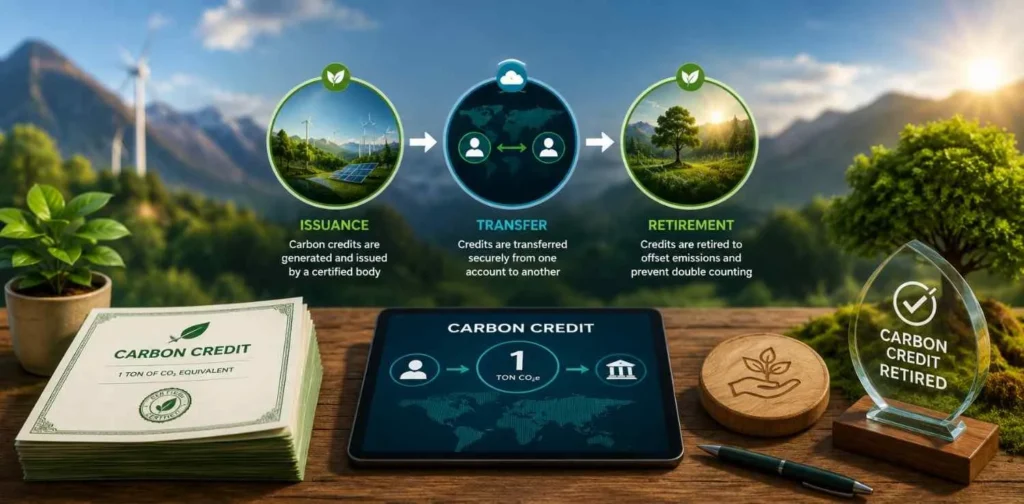
Every carbon credit follows a simple journey before it delivers climate value.
It is issued after verified emission reductions are achieved, transferred between buyers and sellers as a tradable asset, and finally retired when someone uses it to make an environmental claim.
Understanding these three stages is essential because buying a carbon credit does not automatically mean emissions have been offset. A credit only represents a completed climate action after it has been permanently retired.
This article explains each stage in simple terms, highlights the differences, and shows how they fit together in the lifecycle of a carbon credit.
What is Carbon Credit Issuance
Carbon credit issuance is the process by which a carbon registry creates carbon credits after confirming that a project has achieved real, measurable, and independently verified emission reductions or removals. Before issuance, the project follows an approved methodology, monitors its emission reductions, undergoes third-party verification, and is reviewed by the registry.
Once approved, the registry issues carbon credits, each carrying a unique serial number and representing one tonne of CO₂ equivalent (tCO₂e) reduced or removed. At this stage, the credit becomes a tradable asset, but no environmental claim has yet been made. Issuance simply marks the beginning of a carbon credit’s lifecycle.
What is Carbon Credit Transfer
Carbon credit transfer is the movement of an issued carbon credit from one account holder to another. This usually occurs when credits are bought, sold, or transferred between organisations, traders, or investors.
A transferred credit remains active and can be traded multiple times before it is eventually retired. Importantly, ownership changes, but the environmental benefit is not yet claimed. The registry records every transfer, ensuring transparency and traceability throughout the credit’s lifecycle.
What is Carbon Credit Retirement
Carbon credit retirement is the process of permanently utilizing the carbon credit and removing it from circulation after it has been used to offset greenhouse gas emissions, ensuring it cannot be traded or claimed again.Once retired, the credit can no longer be sold, transferred, or reused, ensuring that its environmental benefit is claimed only once.
Retirement is the final stage of a carbon credit’s lifecycle and is required when an organisation or individual uses the credit to support an environmental claim. The registry records the retirement details and issues a retirement certificate, providing transparent proof that the credit has been permanently used.
The Carbon Credit Journey
Every carbon credit follows the same three-stage journey:
Issuance– A registry creates verified carbon credits after confirming eligible emission reductions.
Transfer– The issued credits are traded or transferred between market participants while remaining active.
Retirement– The final owner permanently utilizes the credits and removes them from circulation to support an environmental claim.
Understanding this sequence helps distinguish ownership from usage. A credit can be transferred many times, but it is issued only once and retired only once. A simple way to remember the difference is:
Issuance creates the credit. Transfer moves the credit. Retirement utilizes the credit.
Why These Three Stages Matter
Issuance, transfer, and retirement each play an important role in maintaining the integrity of carbon markets. Issuance ensures that only verified emission reductions become carbon credits. Transfer enables transparent trading and directs finance towards climate projects. Retirement prevents double counting by ensuring that every carbon credit supports only one environmental claim.
Together, these stages create a transparent and trustworthy system for tracking carbon credits from creation to final use.
Conclusion
Every carbon credit follows a clear lifecycle: issuance, transfer, and retirement. While issuance creates verified carbon credits, transfer changes ownership, and retirement permanently applies the environmental benefit to a specific claim.
Understanding these stages helps organisations and individuals participate in carbon markets with confidence, ensuring that climate claims remain transparent, credible, and protected against double counting.
FAQs
What is carbon credit issuance?
Carbon credit issuance is the process through which a registry creates verified carbon credits after confirming that a project has achieved measurable and independently verified emission reductions or removals.
Can carbon credits be transferred more than once?
Yes. An issued carbon credit may be transferred multiple times between different account holders before it is retired.
What happens after a carbon credit is retired?
Once retired, the credit is permanently utilized and removed from circulation and cannot be traded, transferred, or reused.
Can a carbon credit be transferred after retirement?
No. Retirement permanently locks the credit in the registry, making it non-transferable.
Does buying a carbon credit mean my emissions are offset?
No. Purchasing a carbon credit only gives you ownership of the credit. The environmental benefit can only be claimed once the credit has been retired.
Who issues carbon credits?
Carbon credits are issued by recognised carbon registries after an independent third-party verifier confirms that a project has generated eligible emission reductions or removals.