

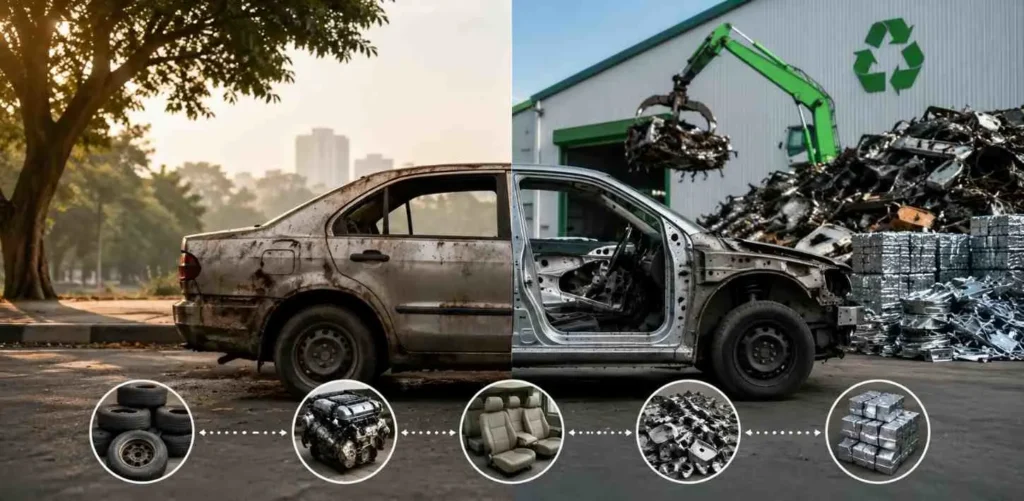
When a private car turns 15 in India, its Registration Certificate (RC) expires under the Central Motor Vehicle Rules (CMVR), and continuing to drive without action becomes illegal. The owner has two legal paths: pass a fitness test at an Automated Testing Station (ATS) and renew the RC for another 5 years, or scrap the vehicle at a Registered Vehicle Scrapping Facility (RVSF) and claim a Certificate of Deposit (CoD) with new-vehicle incentives. In Delhi’s National Capital Region (NCR), re-registration is not permitted, leaving only scrapping or out-of-state transfer.
Rules for a 15-Year-Old Car in India
The 15-year mark is governed by the Central Motor Vehicle Rules and reinforced by a Ministry of Road Transport and Highways (MoRTH) notification effective April 2023, which made renewal mandatory rather than optional for private vehicles older than 15 years.
The same age threshold appears across the Vehicle Scrappage Policy 2021 and state-level enforcement programmes. The table below summarises which rule applies to which vehicle type.
|
Vehicle category |
Age threshold |
What the law requires |
| Private petrol car | 15 years from first registration | Pass a fitness test and renew RC for 5 years, or scrap at an RVSF |
| Private diesel car | 15 years (10 years in Delhi NCR) | Renewal allowed outside NCR; in NCR, only scrappage or out-of-state transfer |
| Two-wheeler | 15 years from first registration | Same as private cars: renew via ATS or scrap |
| Commercial vehicle | 8 years for fitness, 15 years for scrappage if fitness fails | Mandatory ATS test; scrap on failure |
| Government and PSU vehicle | 15 years | Mandatory scrappage; no renewal option permitted |
Private cars can be renewed every 5 years until they reach 15 years from first registration, after which scrapping becomes the only legal route under the MoRTH framework.
Delhi NCR and Other Strict Regional Rules
Delhi NCR has the country’s tightest restrictions on old vehicles, originating from a 2014 National Green Tribunal (NGT) order and reinforced by the Supreme Court’s 2018 ruling in M.C. Mehta v. Union of India. Diesel vehicles older than 10 years and petrol vehicles older than 15 years cannot ply in the region, and re-registration is not permitted.
Enforcement was paused in August 2025 after a Supreme Court interim order halted coercive action, and a follow-on order in December 2025 shifted enforcement focus toward Bharat Stage (BS) emission norms rather than age alone. The legal restriction itself stands. Owners in Delhi NCR have two practical routes: scrap at an authorised RVSF, or transfer the vehicle out of state with a No-Objection Certificate (NOC).
Driving a 15-year-old vehicle without renewal or scrappage carries real consequences:
- Penalty under Section 192 of the Motor Vehicles Act for driving an unregistered vehicle, with the vehicle liable to impounding at the point of stop.
- Insurance claim rejection in case of accident, because most motor policies attach to a validly registered vehicle and an expired RC voids coverage.
- Continued exposure of the registered owner to traffic e-challans, accident First Information Reports (FIRs), and court summons until the vehicle is formally deregistered from the VAHAN database.
- Penalties under state-level pollution rules where the vehicle fails its Pollution Under Control (PUC) check, including fines and refusal of fuel at certain pumps in NCR.
How to Renew or Scrap Your 15-Year-Old Car
Two legal pathways exist: renew the RC after a fitness test, or scrap the vehicle at an authorised RVSF. The right choice depends on where you live, the condition of the car, and whether you plan to replace it soon.
Option 1: Renew the RC for Another 5 Years
This route is available outside Delhi NCR and in states that permit re-registration after fitness testing.
- Take the vehicle to an Automated Testing Station for a mandated fitness check covering emissions, braking, steering, lights, tyres, and structural condition.
- Submit Form 25 at the Regional Transport Office (RTO) with the original RC, valid insurance, PUC certificate, road tax receipt, and PAN card copy.
- Pay the re-registration fee (around Rs 5,000 for private cars under the MoRTH notification effective April 2023) plus the applicable green tax, which most states set at 5 to 20 percent of the vehicle’s depreciated value, though a few states apply higher slabs for older vehicles.
- On approval, the RC is renewed for 5 years; the cycle can repeat once more, taking the vehicle up to its 20-year limit.
Option 2: Scrap the Car at an Authorised RVSF
A Registered Vehicle Scrapping Facility is a MoRTH-authorised centre licensed to depollute, dismantle, and process end-of-life vehicles under Automotive Industry Standard 129 (AIS-129). Scrapping a 15-year-old car here gives the owner three forms of return:
- Scrap value payout from the RVSF, typically 4 to 6 percent of the ex-showroom price of an equivalent new vehicle.
- Certificate of Deposit (CoD), a tradable instrument entitling the holder to a 4 to 6 percent discount on a new vehicle from participating Original Equipment Manufacturers (OEMs), plus waivers of 15 to 25 percent on registration fees and road tax in most states.
- VAHAN deregistration completed within 14 days of scrappage, formally removing the vehicle from RTO records and ending the registered owner’s legal liability.
Renew or Scrap: How to Decide
For owners outside Delhi NCR, the choice usually comes down to economics. Renewal makes sense if the car passes fitness on the first attempt, maintenance costs are under 25 percent of current market value, and you plan to keep the vehicle for at least three more years. Scrappage makes sense if the car has failed fitness, repairs in the past year exceeded 40 percent of market value, or you are buying a new vehicle anyway and want to claim CoD benefits.
As a rule of thumb: if total renewal cost exceeds 50 percent of the scrappage benefit, scrap. The scrap vs sell decision framework applies where the vehicle is still saleable. For NCR owners, renewal is closed by regulation; the practical choice is between scrapping at an authorised RVSF and out-of-state transfer, with the latter carrying compliance risks at NCR entry points.
Conclusion
When your car turns 15, doing nothing is not an option: the RC expires by operation of law, and continued driving exposes you to penalties, impounding, and insurance failure. Outside Delhi NCR, the renew-versus-scrap call is an economic one, decided by maintenance costs and replacement plans. NCR owners face a narrower choice between scrapping and out-of-state transfer. Whichever route applies to you, act early; delay narrows options and adds penalties.
FAQs
What happens if my 15-year-old car fails the fitness test?
If the vehicle fails the Automated Testing Station fitness check, it is automatically classified as an End-of-Life Vehicle (ELV) under the MoRTH framework, and the RC cannot be renewed. Scrappage at an authorised Registered Vehicle Scrapping Facility becomes the only legal option. Re-testing is sometimes allowed within a defined window if the failure relates to a specific repairable defect.
Can I transfer my 15-year-old car from Delhi NCR to another state?
Yes, by obtaining a No-Objection Certificate (NOC) from the Delhi Transport Department and re-registering the vehicle in a state that permits 15-year-old vehicles after fitness testing. The destination state’s own rules apply, and several states are tightening their thresholds. Buyers should be cautious, since enforcement cameras at NCR entry points now flag transferred vehicles attempting to return.
Does the 15-year rule apply to electric vehicles?
The 15-year RC expiry under the Central Motor Vehicle Rules applies to all private vehicles regardless of fuel type, including electric vehicles and CNG-fuelled vehicles. However, electric vehicles are generally exempt from green tax under most state schemes, and the Delhi NCR age-based fuel ban does not apply to EVs because they do not refuel at petrol pumps.
What is the penalty for driving a car with an expired RC?
Driving with an expired RC attracts a penalty under Section 192 of the Motor Vehicles Act, with fines varying by state and the vehicle liable to impounding on the spot. Separately, any accident involving the vehicle exposes the registered owner to claim rejection by the insurer, since motor policies typically require a valid RC for coverage to attach.
Can I sell my car privately before it turns 15 years old?
Yes, until the 15-year mark the vehicle remains saleable and a buyer can re-register it normally. After 15 years, a private sale becomes complicated because the buyer cannot drive the vehicle without first renewing the RC themselves. In Delhi NCR, where renewal is not permitted, post-15-year private sale for road use is effectively closed.
Will I get back any insurance premium when I scrap my car?
Most general insurers allow a partial premium refund when the vehicle is formally scrapped at an authorised RVSF and deregistered from VAHAN. The refund covers the unused portion of the policy period, after deducting administrative charges. Submit the Certificate of Deposit and VAHAN deregistration confirmation to the insurer to claim it.
How is scrappage verified and reported to VAHAN when I scrap my old car?
An authorised RVSF, licensed by MoRTH, processes the vehicle under AIS-129 standards, captures depollution and dismantling data, issues the Certificate of Deposit, and updates the VAHAN database within 14 days of scrapping.