
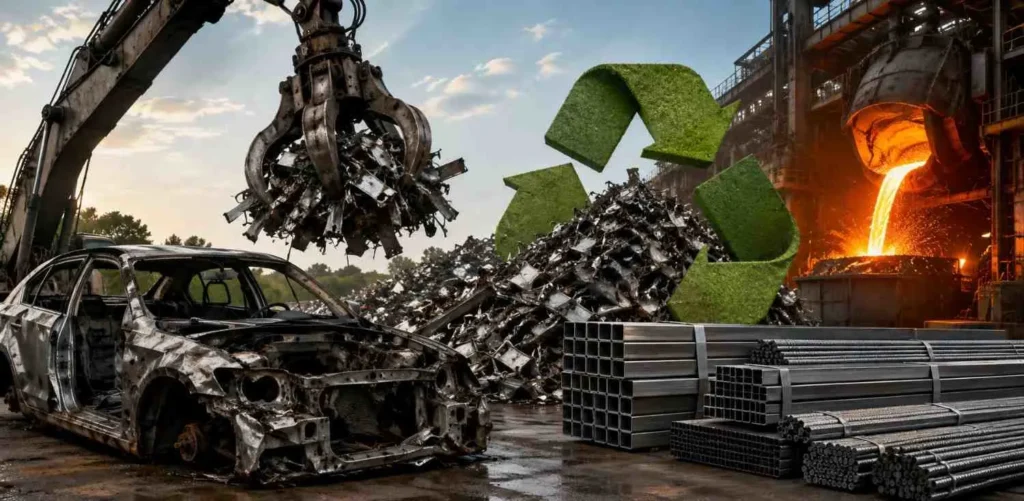
Steel is the single largest material recovered when a vehicle is recycled, with around 75% of the steel in a modern car recoverable. At a Registered Vehicle Scrapping Facility (RVSF), end-of-life vehicles are depolluted, dismantled, shredded, and passed through magnetic separation to extract ferrous steel. The recovered steel is melted in electric arc furnaces and returned to manufacturing as new vehicle panels, appliances, and construction material. In India, vehicle steel recycling is central to the Environment Protection (End-of-Life Vehicles) Rules 2025.
Why Steel Is the Most Recycled Material in Vehicles
Steel makes up the largest share of a vehicle by weight, dominating the body, frame, chassis, engine block, and structural components. Around 75% of the steel in a modern car is recyclable, and steel can be melted and reshaped repeatedly with no loss in strength or quality. This material property makes vehicle steel functionally infinitely recyclable, putting it at the centre of automotive circular economy thinking.
The scale in India is substantial. According to the Society of Indian Automobile Manufacturers (SIAM), India is expected to generate around 22.5 million end-of-life vehicles, yielding nearly 5 million tonnes of steel scrap, along with approximately 1.2 million tonnes of aluminium and 0.2 million tonnes of copper.
Recycled steel consumes far less energy than producing steel from virgin iron ore. The lower energy intensity translates into lower embedded emissions per tonne. India’s steel output rose sharply while scrap use stayed low, so the government is pushing recycled steel to support its 2030 steel goals.
How Steel Recycling from Vehicles Works
The journey from an end-of-life vehicle to mill-ready steel scrap moves through six structured stages inside an RVSF. The detailed flow is covered in what happens to a car after it is scrapped.
- Depollution: Hazardous fluids, the battery, and airbags are safely removed first, preventing soil and groundwater contamination.
- Dismantling: Reusable parts and non-steel components are removed for separate routing, leaving a steel-rich shell ready for size reduction.
- Shredding, shearing, or baling: The shell is compressed and broken down using ferrous shears, balers, or shredders; in India, shears and balers play a significant role given the structure of the local scrap market.
- Magnetic separation: Overhead magnets pull ferrous steel and iron from the mixed fragment stream, isolating clean scrap from non-ferrous metals, plastics, glass, and inert waste.
- Sorting and grading: Recovered steel is sorted by grade and cleaned of contaminants to meet input requirements of secondary steel plants.
- Melting and reuse: Graded scrap moves to secondary steel mills, undergoes melting in electric arc furnaces, and is cast into new steel products that re-enter the manufacturing chain.
The quality of recovered scrap depends on clean separation. Authorised facilities under AIS-129, the Automotive Industry Standard governing depollution and dismantling, recover higher-value steel than informal dismantlers. Informal scrapping loses value through cross-contamination and incomplete depollution.
Benefits of Recycling Steel from Vehicles
Recovering steel from end-of-life vehicles delivers environmental gains tied to lower energy and resource use, and economic gains tied to value retention, import substitution, and regulatory compliance.
Environmental Benefits
The energy and resource savings of recycled steel relative to primary production drive the environmental case for vehicle steel recovery.
- Energy savings: secondary steel production uses far less energy than producing steel from iron ore, with proportionally lower emissions per tonne.
- Resource conservation: recovered steel reduces the need for iron ore mining and the associated land, water, and ecosystem impact.
- Lower embedded emissions: recycled steel reduces the embedded emissions of new vehicles and consumer goods that incorporate it.
Economic Benefits
The economic case rests on value retention inside the country and reduced exposure to imported scrap and virgin material flows.
- Import substitution: domestic vehicle steel scrap reduces reliance on imported scrap, strengthening supply-chain resilience for steel producers.
- Value-chain economics: steel contributes the largest material volume recovered from an ELV, generating both the primary per-vehicle revenue stream for RVSFs and the EPR certificate supply that automakers use to meet steel-recovery obligations under India’s ELV Rules 2025.
- Reporting support: recycled steel from authorised RVSFs lowers the embedded emissions of new vehicles, it can support OEMs with verifiable inputs for Scope 3 Category 1 (Purchased Goods and Services) accounting and voluntary sustainability disclosures .
Steel Recycling from Vehicles and ELV EPR Targets in India
Vehicle steel recycling has become a regulatory cornerstone under the Environment Protection (End-of-Life Vehicles) Rules 2025, effective 1 April 2025. Automakers carry Extended Producer Responsibility (EPR) obligations tied to scrapped vehicle steel, with progressive targets across compliance cycles. A 27 March 2026 draft amendment tightened eligibility so that only steel from scrapped vehicles counts toward targets.
Steel-Recovery Target Phases
Targets are set as a percentage of the steel equivalent of vehicles sold years earlier: 20 years prior for private vehicles, 15 years prior for commercial vehicles. The minimum target rises across three phases over the first decade of the regime.
| Phase | Period | Steel-Recovery Target |
| Phase 1 | FY26 to FY30 | 8% of steel equivalent |
| Phase 2 | FY31 to FY35 | 13% of steel equivalent |
| Phase 3 | FY36 onward | 18% of steel equivalent |
Certificate Mechanism
The compliance mechanism converts steel into a tradable instrument: 1 kg of steel recovered at an RVSF generates 1 kg of EPR certificate. Automakers purchase these certificates to offset their annual target, with pricing set between automaker and RVSF rather than fixed centrally.
Current Compliance Reality
The constraint on the system is supply: not enough end-of-life vehicles reach authorised facilities to support sector-wide targets.
- The auto sector reportedly missed its FY26 scrappage target by around 70%, mainly due to limited ELV inflow into authorised facilities.
- The 27 March 2026 draft amendment for ELV Rules removed open-market industrial scrap from EPR eligibility, increasing dependence on vehicles processed at RVSFs.
- More vehicles need to move from informal dismantlers to authorised RVSFs for steel-recovery targets to be achievable.
Conclusion
Steel is the heart of vehicle recycling: the largest, most valuable, infinitely recyclable material recovered from an end-of-life vehicle. Recovering it through authorised facilities saves energy, cuts embedded emissions, reduces import dependence, and feeds India’s growing demand for recycled steel.
Steel is where all three players in India’s ELV story converge. Automakers need the certificates, mills need the feedstock, RVSFs need volume through the yard. None of them get there without formal recycling capacity growing, which is why the next phase will be shaped as much by throughput as by target rates .
FAQs
How much steel can be recovered from a car?
Around 75% of the steel in a modern car is recoverable at an authorised RVSF. The recovery rate depends on vehicle age, model, and the quality of separation equipment during shredding and magnetic extraction. Authorised facilities consistently outperform informal dismantling.
Is recycled vehicle steel as strong as new steel?
Yes. Steel retains its mechanical properties through recycling and can be melted and reshaped repeatedly without loss of strength or quality. This material property is the technical basis for the circular steel supply chain and Rule 9A recycled-content targets in new vehicles.
How is steel separated from other materials in a scrapped car?
Steel separation relies on magnetic extraction after the vehicle has been shredded or sheared into fragments. Overhead magnets pull ferrous metals from the mixed stream, leaving non-ferrous metals, plastics, glass, and inert waste behind for further sorting through eddy-current separators and manual processes.
How much energy does recycling steel save?
Producing steel from recycled scrap consumes significantly less energy than producing it from iron ore through primary smelting. Industry estimates place secondary steel energy use at a fraction of primary production, with the proportional saving translating directly into lower emissions per tonne.
What is the ELV EPR steel target for automakers?
The Environment Protection (ELV) Rules 2025 set a steel-recovery target of 8% of the relevant steel equivalent in the first phase (FY26 to FY30), rising to 13% in the second phase and 18% in the third. The baseline references vehicles sold 20 years prior.
Where does recycled vehicle steel go?
Graded steel scrap from RVSFs moves to secondary steel mills with electric arc furnaces, where it is melted and recast into new steel products. End-uses include vehicle body panels, household appliances, construction rebar, and structural sections that re-enter manufacturing as secondary raw material.
How do MMCM-supported RVSFs handle steel recovery for EPR compliance?
MoRTH and CPCB-authorised RVSFs running MMCM’s AutoLoop platform follow AIS-129 standards and capture 40+ dMRV data points per vehicle, recording steel-recovery weights that feed verified EPR certificates and Cercarbono-certified ELV Carbon Credits (Carboncers) for OEMs with Scope 3 reporting obligations.