
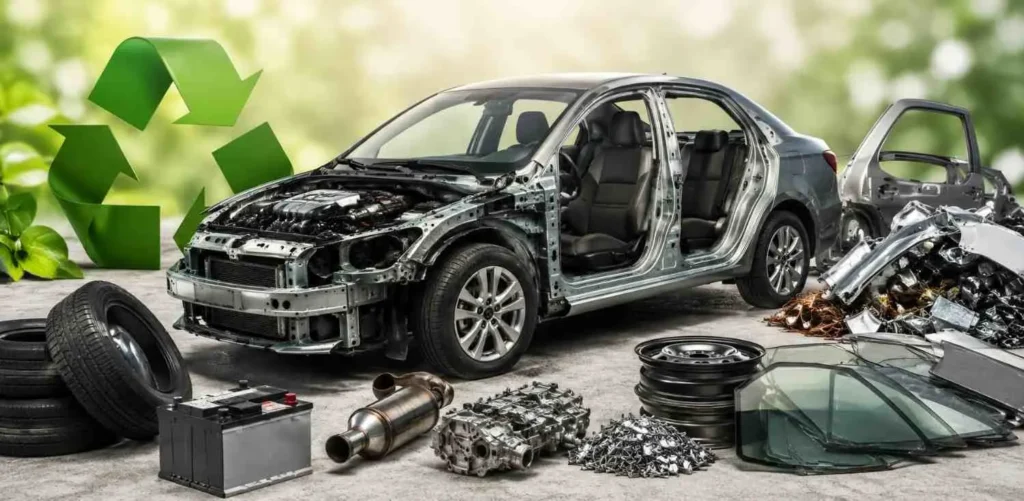
Up to about 90 percent of a car’s material weight can be recovered and recycled at an authorised facility, depending on the vehicle and the recovery process used. Metals such as steel, aluminium, and copper account for most of that recovered weight and are the easiest to recycle. Batteries, glass, tyres, plastics, and fluids each follow their own recovery route and their own set of rules, since most of these materials fall outside the End-of-Life Vehicle framework itself. Knowing which parts of a car can be recycled helps explain why a scrapped vehicle is treated as a resource rather than simply waste.
Metals: The Most Recyclable Part of a Car
Metal is the largest share of a typical car by weight, and it is also the most completely recyclable. Steel forms the body, chassis, and many structural components, while aluminium appears in wheels, engine blocks, and increasingly in body panels on newer models. Copper runs through the wiring harness and electric motors, and small amounts of platinum, palladium, and rhodium sit inside the catalytic converter. This recoverable metal content is one reason end-of-life vehicles in India are increasingly treated as a resource stream rather than discarded waste.
| Part | Material | What it becomes |
| Body panels, chassis | Steel | New steel sheet, rebar, automotive steel |
| Engine block, wheels | Aluminium | New aluminium castings, wheels |
| Wiring, motors | Copper | New copper wire, electrical components |
| Catalytic converter | Platinum, palladium, rhodium | Recovered precious metals for new converters |
| Radiator, AC components | Aluminium, copper | Recycled metal stock |
These metals are recoverable because they survive shredding and separation without losing their material properties, which is why recyclable car parts built from steel and aluminium can be melted down repeatedly without degrading. The recovery process at an authorised facility generally follows this sequence.
- Depollution removes fluids and hazardous components before any cutting or shredding begins.
- The vehicle is dismantled, and reusable parts and high-value metals such as the catalytic converter are removed by hand.
- The remaining shell is shredded, and magnetic and eddy-current separation sort ferrous steel from non-ferrous metals such as aluminium and copper.
- Recovered metal is sold as scrap to steel mills and foundries, where it re-enters new production.
Car Batteries: Lead-Acid and Lithium-Ion Recycling
Conventional Lead-Acid Batteries
A standard 12-volt lead-acid battery is one of the most reliably recycled parts of any vehicle, regardless of whether the car runs on petrol, diesel, or electric power. The lead plates, plastic casing, and sulphuric acid electrolyte are each recovered separately at specialised facilities. Lead is reclaimed and reused in new batteries at a very high rate, and the plastic casing is shredded and recycled into new battery housings.
Electric Vehicle Lithium-Ion Batteries
Lithium-ion battery packs from electric vehicles require a different and more specialised process, since they contain valuable metals such as lithium, cobalt, nickel, and manganese alongside safety risks if damaged or punctured.
Specialised recyclers dismantle the pack, then use mechanical shredding or chemical processes to recover these metals for reuse in new battery cells. This is a fast-growing area as EV battery recycling scales up to match the rising number of electric vehicles reaching end of life, a volume that the broader vehicle scrappage policy in India is also pushing toward formal recovery channels.
Battery recycling in India sits under the Battery Waste Management Rules, 2022, rather than the End-of-Life Vehicle Rules, since batteries are governed as a separate waste stream with their own producer responsibility requirements.
Glass: Windshields, Windows, and Mirrors
Automotive glass is recyclable, but it follows a narrower path than metal because windshields are laminated with a plastic interlayer that must be separated before the glass itself can be reprocessed. Side and rear windows are typically tempered glass without this interlayer, which makes them easier to recycle directly.
Recovered automotive glass is generally repurposed in one of these ways.
- Crushed and used as an additive in construction aggregate or asphalt.
- Reprocessed into fibreglass insulation when the glass type and purity allow it.
- In some cases, reused as raw material for new container or specialty glass products.
Mirrors present an added step, since they are glass bonded to a reflective metal coating, so they are typically separated and processed through the glass recovery stream once the coating is dealt with at the recycling facility.
Tyres and Rubber: Recovery Options
Tyres are technically excluded from the End-of-Life Vehicle Rules and fall instead under the Hazardous and Other Wastes Rules, since they are regulated as a separate waste category in India. Despite that separation, tyres recovered from a scrapped vehicle are still highly recyclable through dedicated rubber-recovery channels.
Old tyres are most commonly processed into one of the following.
- Crumb rubber for playground surfacing, running tracks, and rubberised flooring.
- Material input for road surfacing in select rubber-modified asphalt projects.
- Tyre-derived fuel, used as an alternative energy source in cement kilns and similar industrial processes.
- Retreading, where the existing tyre casing is fitted with a new tread layer for continued use rather than full material recovery.
Because tyres carry steel belting inside the rubber, the recovery process also separates and recovers that embedded steel as a secondary metal stream.
Plastics and Interior Materials
Plastics and interior materials make up a meaningful share of a modern car’s weight, covering the dashboard, bumpers, seat foam, carpeting, and door panels. Recovery is more complex here than with metal, since a single component often blends several plastic types or combines plastic with foam and fabric, which makes clean separation harder. Composite and multi-layer parts in particular may not be economically recoverable with current sorting technology, which is the honest limit on how much of a car’s plastic content actually gets recycled.
Where recovery is feasible, the process generally works as follows.
- Bumpers and panels made from a single identifiable plastic, such as polypropylene, are shredded and reprocessed into new plastic components.
- Seat foam and fabric are sometimes separated for use in lower-grade applications such as carpet padding or insulation.
- Mixed or contaminated plastic waste that cannot be cleanly separated is more often sent for energy recovery than material recycling.
Plastic components removed from a vehicle fall under the Plastic Waste Management Rules, 2016, rather than the ELV Rules, separate from the Extended Producer Responsibility obligations that apply to a vehicle’s steel content, which is part of why plastic recovery rates trail behind metal recovery.
Fluids: Safe Disposal and Recycling
Every vehicle carries fluids that must be removed before dismantling can safely proceed, and this depollution step is one of the most important parts of vehicle recycling materials handling at an authorised facility. Engine oil, transmission fluid, coolant, brake fluid, and fuel are all drained first, both to prevent contamination of the metals being recovered and to keep these substances out of soil and water.
- Used engine oil and transmission fluid are filtered and re-refined into base oil or used as an industrial fuel.
- Coolant is treated and can often be reprocessed for reuse.
- Fuel remaining in the tank is drained and reused or disposed of safely rather than left in the vehicle.
- Refrigerant from the air-conditioning system is recovered to prevent its release into the atmosphere.
These fluids fall under the Hazardous and Other Wastes Rules, 2016, given their potential to contaminate soil and groundwater if handled improperly.
Conclusion
Most of a car, by weight, can be recovered and put back into use, with metals leading the way and batteries, glass, tyres, plastics, and fluids each following their own specialised recovery path and their own regulatory framework. Understanding which parts of a car can be recycled also clarifies why car recycling India still has room to improve, since plastics and composite materials remain the hardest fraction to recover cleanly.
As EV adoption grows and lithium-ion battery volumes rise, the next gains in what percentage of a car is recyclable will likely come from better battery and plastics recovery rather than from metals, where recovery is already close to its practical ceiling. Working with a properly authorised Registered Vehicle Scrapping Facility remains the surest way to ensure a vehicle’s materials are actually recovered rather than lost.
FAQs
Which parts of a car cannot be recycled?
Composite and multi-layer plastic parts that combine several plastic types, foam, or fabric are the hardest to recycle, since clean separation is often not economically viable. Some of this material ends up in energy recovery rather than material recycling. A small residual fraction across any vehicle also remains genuinely unrecoverable with current processing methods.
Are car batteries recycled along with the rest of the vehicle?
Batteries are removed early in the depollution stage and recycled through their own specialised stream rather than alongside the vehicle’s metal body. Lead-acid batteries have a long-established, high-recovery process, while lithium-ion batteries from electric vehicles use newer recovery methods to reclaim lithium, cobalt, nickel, and manganese.
What happens to a car’s tyres when it is scrapped?
Tyres are removed during dismantling and processed separately, since they fall under hazardous waste rules rather than the End-of-Life Vehicle Rules. Common outcomes include crumb rubber for flooring and playground surfaces, tyre-derived fuel for industrial kilns, or retreading, with the embedded steel belting recovered as a separate metal stream.
Why is plastic harder to recycle than metal in a car?
Plastic components often blend multiple plastic types with foam, fabric, or metal inserts, which makes clean separation difficult and costly. Metal, by contrast, can be shredded and sorted using magnetic and eddy-current separation without losing its properties. This difference is the main reason plastics trail metals in overall recovery rates.
Is glass from a scrapped car recycled?
Yes, though windshields need an extra step to remove their plastic interlayer before the glass can be reprocessed. Side and rear windows, which are typically tempered glass without that layer, are easier to recycle directly. Recovered glass is commonly used in construction aggregate, asphalt, or fibreglass insulation.
What happens to the fluids removed from a car before recycling?
Engine oil, coolant, brake fluid, and fuel are drained during depollution, the first step at an authorised facility, to prevent contamination and protect soil and groundwater. Oil and coolant are often filtered or treated for reuse, while refrigerant is recovered separately to prevent its release into the atmosphere.