
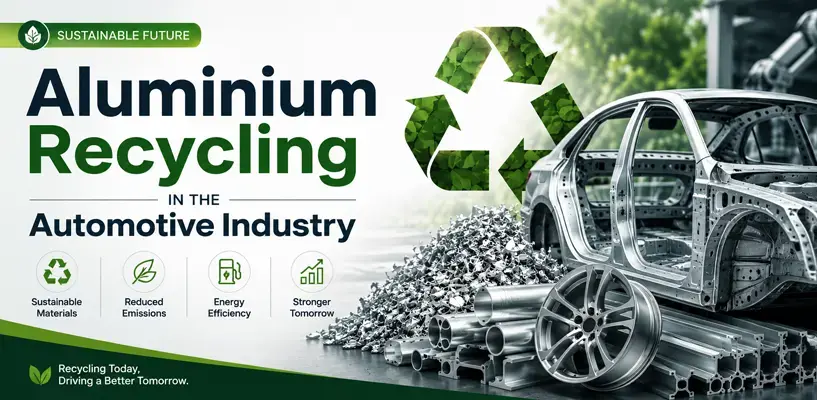
Aluminium recycling in the automotive industry recovers aluminium from end-of-life vehicles and production scrap, processes it through shredding, alloy sorting, and re-melting, and returns it as secondary aluminium feedstock for new vehicle components.
According to the International Aluminium Institute secondary aluminium production requires approximately 5 percent of the energy used to produce primary aluminium from bauxite, and modern automotive sorting routes achieve recovery rates above 90 percent of incoming aluminium content. Average aluminium content per passenger vehicle is projected to reach approximately 250 kg by 2030, driven by lightweighting in internal combustion vehicles and structural battery enclosures in electric vehicles.
How Aluminium Is Used in Modern Vehicles
Aluminium has become a niche component within modern vehicle design. Its strength-to-weight ratio, corrosion resistance, and crash energy absorption profile make it the preferred substitute for steel in body, chassis, and powertrain assemblies.
1. Body and Closure Panels
Body-in-white aluminium use has expanded from premium luxury platforms into mainstream passenger vehicles, with closure panels often leading the substitution and structural body components following as casting and joining technologies mature.
2. Chassis and Powertrain
Chassis and powertrain aluminium use covers components where stiffness, thermal performance, and fatigue resistance matter as much as mass reduction. The alloy mix here is more diverse than body panel use because the application range spans high-pressure die castings to forged structural arms.
3. Electric Vehicle Specific Applications
Electric vehicles use more aluminium per unit than equivalent internal combustion vehicles, with the additional content concentrated in battery system structures, thermal management, and high-voltage conductors. According to Ducker Carlisle’s EV content analysis, platforms designed natively for electric drivetrains often push aluminium content well above 350 kg per vehicle.
Within the EV material stack, aluminium sits alongside lithium, cobalt, nickel, copper, and the wider set of critical minerals for electric vehicles. Its scale and reuse loop run deeper than any single mineral category, which is why aluminium dominates ELV material accounting by mass even where critical mineral recovery dominates the policy conversation.
How Automotive Aluminium Recycling Works
Automotive aluminium recycling is a six-stage industrial process that begins with an end-of-life vehicle at a Registered Vehicle Scrapping Facility and ends with re-melted secondary aluminium ingots ready for downstream casting or wrought processing. Each stage carries its own technical specification and its own loss point, which is why total recovery rate is the most useful measure of plant performance rather than any single-stage yield.
1. ELV Intake and Mechanical Separation
Intake processing receives the deregistered vehicle, depollutes it of fluids and hazardous components, and dismantles the high-value sub-assemblies before the hulk enters the shredder. The ELV intake stage governs how much aluminium is recovered as clean dismantled scrap versus how much enters the mixed shredder stream.
As specified under ARAI’s Automotive Industry Standard AIS-129, the de-pollution sequence drains coolant, engine oil, transmission fluid, brake fluid, refrigerants, and fuel, then removes the battery, airbag modules, catalytic converter, and tyre assemblies. Wheels are typically dismantled separately because cast aluminium wheels are sold as clean-grade scrap at a premium over mixed twitch under ISRI’s Scrap Specifications Circular.
2. Shredding and Material Separation
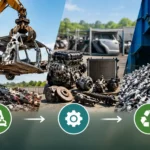
Shredding reduces the hulk to fist-sized fragments and separates ferrous from non-ferrous material through magnetic and air-density extraction. The non-ferrous fraction, classified as twitch or zorba under ISRI’s Scrap Specifications Circular, contains aluminium alongside copper, brass, zinc, and stainless steel.
From the twitch stream, as documented in the Bureau of International Recycling (BIR) and European Aluminium technical literature on non-ferrous recovery, several sorting technologies typically run in sequence to recover and segregate the aluminium:
- Eddy current separators using induced magnetic fields to pull non-ferrous metals off the conveyor stream
- Sink-float density separation in dense-media tanks to segregate aluminium from heavier non-ferrous metals
- X-ray transmission sorting reading atomic density signatures at the particle level
- Laser-induced breakdown spectroscopy reading elemental composition at the piece level for alloy-grade segregation
3. Alloy Sorting and Re-Melting
The clean aluminium stream is sorted by alloy family before re-melting. Mixing wrought aluminium scrap with cast aluminium scrap produces a hybrid melt that meets neither wrought nor cast specifications cleanly, which is the central technical problem facing automotive aluminium circularity.
As per IAI lifecycle inventory data, the energy demand for secondary aluminium production sits at approximately 5 percent of the primary route, which is the foundation of the recycling sustainability case. Aluminium recovery and EV battery recycling in India run on parallel industrial logic, even though the chemistry, plant economics, and downstream products are entirely different.
Sustainability Benefits of Aluminium Recycling in Vehicles
Aluminium recycling delivers some of the largest verifiable emissions and energy savings available in automotive material recovery. Unlike many circularity claims, the benefits sit on engineered substitution ratios and published lifecycle assessments rather than aspirational framing.
The measurable benefit set, paired to its mechanism:
- Energy intensity for secondary aluminium production at approximately 0.6 to 0.8 MWh per metric ton, against primary aluminium at 13 to 17 MWh per metric ton from bauxite, a reduction of approximately 95 percent
- Embedded carbon footprint at approximately 0.5 to 0.8 tons of CO2e per ton of secondary aluminium, against 8 to 16 tons of CO2e per ton for primary aluminium depending on the electricity grid mix
- Recovery yield above 90 percent of incoming aluminium content in modern automotive sorting routes, against industry recovery rates of 50 to 65 percent a decade earlier
- Closed-loop pathways returning automotive scrap directly into automotive alloy specifications, preserving wrought-grade material rather than downgrading it to cast applications
- Avoided bauxite mining and red mud generation upstream, with each ton of secondary aluminium displacing roughly 4 tons of bauxite ore and the associated tailings
- Reduction in the embedded Scope 3 emissions of new vehicles when secondary aluminium replaces primary aluminium in supply contracts, providing OEMs a measurable reporting lever
- Lifecycle emissions of an aluminium-intensive vehicle improving over a steel-intensive equivalent only when secondary aluminium content is high, with primary-aluminium-intensive vehicles capable of underperforming steel on cradle-to-gate
Each of these benefits maps to a specific point in the automotive lifecycle emissions profile: the upstream displacement at primary aluminium, the in-use intensity from vehicle mass, and the end-of-life recovery rate at scrappage. Treating any one of them in isolation misses the trade-off across the full asset cycle.
Aluminium Recycling and ELV Scrapping in India
India’s aluminium recycling capacity for automotive applications is anchored to the Registered Vehicle Scrapping Facility network mandated under the Vehicle Scrappage Policy 2021 and the Motor Vehicles (Registration and Functions of Vehicles Scrapping Facility) Rules 2021. RVSFs are the primary upstream collection point for ELV aluminium feedstock.
RVSF Output and Downstream Aluminium Recovery
RVSFs depollute and dismantle ELVs under AIS-129, recovering dismantled aluminium sub-assemblies and feeding shredded hulks into the secondary aluminium pipeline. Each ELV processed at an RVSF yields between 70 and 180 kg of recoverable aluminium depending on vehicle type and generation.
AutoLoop, MMCM’s cloud-based RVSF operating system, supports the operational, compliance, and dMRV data capture workflow that the recycling pipeline downstream of the RVSF relies on for material traceability. The owner-facing entry into this system runs through the regulated vehicle scrapping process in India, which begins with Form 1 deregistration and ends with the Certificate of Deposit.
Conclusion
Aluminium recycling in the automotive industry is a high-leverage circularity activity, measured in energy savings, recovery yield, and verifiable embedded emissions reduction. The technical work happens at shredders, sorters, and re-melters; the policy work happens at RVSF authorisation, ELV regulation, and OEM Scope 3 reporting.
India’s secondary aluminium pipeline is now structurally connected to the RVSF network under the Vehicle Scrappage Policy 2021, with Registered Vehicle Scrapping Facilities operating as the upstream collection layer that downstream sorters and re-melters depend on for clean, segregated aluminium feedstock.
FAQs
1. What is aluminium recycling in the automotive industry
Aluminium recycling in the automotive industry recovers aluminium from end-of-life vehicles and production scrap, processes it through de-pollution, shredding, alloy sorting, and re-melting, and returns it to vehicle manufacturing as secondary aluminium feedstock. The process operates at the RVSF, the shredder yard, the eddy current and spectroscopy sorter, and the re-melt furnace, with each stage governed by technical specifications that determine final alloy quality.
2. How much aluminium is in a modern car
A modern passenger car contains roughly 180 to 220 kg of aluminium on average, with the figure projected to reach approximately 250 kg by 2030. Electric vehicles often carry 350 kg or more because of battery enclosure structures and mega-casting platforms. Aluminium is distributed across body panels, structural castings, wheels, engine and transmission housings, chassis components, and thermal management systems.
3. How much energy does aluminium recycling save
Aluminium recycling requires approximately 5 percent of the energy used to produce primary aluminium from bauxite ore. Primary aluminium production uses 13 to 17 MWh of electricity per metric ton, while secondary production uses 0.6 to 0.8 MWh per metric ton. The corresponding carbon footprint drops from 8 to 16 tons of CO2e per ton of primary aluminium to roughly 0.5 to 0.8 tons of CO2e per ton of secondary aluminium.
4. What is closed-loop aluminium recycling in automotive
Closed-loop aluminium recycling in automotive returns aluminium scrap from end-of-life vehicles directly into the alloy specifications used for new vehicle manufacturing, preserving wrought-grade material rather than downgrading it to cast applications. As outlined in BIR’s alloy sorting technical guidance, the system requires piece-level alloy sorting using laser-induced breakdown spectroscopy or prompt gamma neutron activation analysis to separate 5xxx sheet, 6xxx extrusion, and 3xx cast streams cleanly.
5. What is horizontal aluminium recycling
Horizontal aluminium recycling produces secondary aluminium of the same grade as the input scrap, allowing wrought sheet scrap to return as wrought sheet aluminium. The conventional alternative is vertical or cascading recycling, in which higher-grade wrought scrap mixes into lower-grade cast alloy applications.
6. Where does ELV aluminium go after scrapping in India
ELV aluminium recovered at Registered Vehicle Scrapping Facilities under AIS-129 enters the secondary aluminium supply chain through two routes. Clean dismantled aluminium sub-assemblies such as wheels, engine blocks, and transmission cases sell as graded scrap to re-melters.