
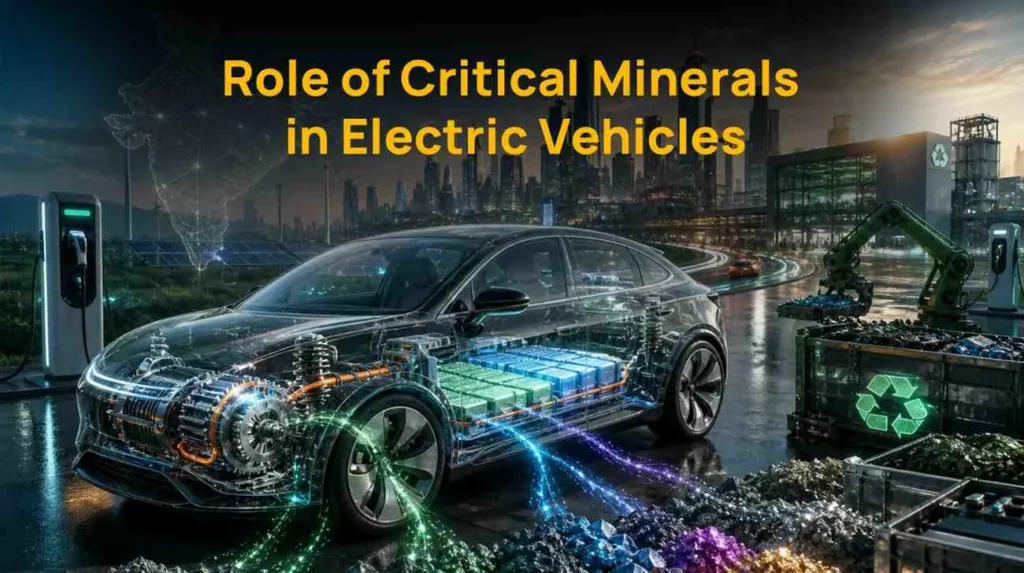
Critical minerals are the naturally occurring elements that clean energy technologies cannot run without. They have no viable short-term substitutes and they sit under heavy supply concentration risk.
For electric vehicles specifically, the role of critical minerals in electric vehicles centres on five battery inputs (lithium, nickel, cobalt, manganese, and graphite), the rare earth elements that drive the electric motor (notably neodymium and dysprosium), and copper and aluminium for wiring and charging infrastructure. A typical EV requires roughly 6 times more critical minerals than a conventional car, which makes secure and affordable access to these materials a central constraint on the global EV transition.
For India the stakes are sharper than the global average. The country imports more than 80 percent of its critical mineral requirements, and the EV30@30 target of 30 percent EV penetration by 2030 will significantly increase that demand across the next decade.
The National Critical Minerals Mission 2025, the ACC Battery PLI scheme, and a parallel push on domestic recycling all signal how seriously the response is being taken. Alongside mining and imports, there is a third lever that gets less attention: recovering critical minerals for EV batteries India already has on the road, through authorised end-of-life vehicle scrapping.
What Critical Minerals Are and Why EVs Need Them
A critical mineral is one that is economically and strategically important, has limited substitutability, and is exposed to supply concentration risk. Definitions vary slightly by jurisdiction, but the substance is consistent across the IEA, the US Geological Survey, and India’s Ministry of Mines list of 30 critical minerals, which is the foundation of any critical minerals EV India conversation.
The reason EVs change the criticality conversation is concentration of demand. The IEA notes that an EV requires about six times the mineral inputs of a conventional vehicle, and an onshore wind plant requires about nine times the inputs of a gas-fired plant. The energy transition is not eliminating resource dependency; it is relocating it from hydrocarbons to minerals. In a Paris-aligned scenario, the IEA projects total mineral requirements for clean energy technologies could quadruple by 2040.
Concentration risk separates these minerals from oil. Several minerals are dominated by one or two countries for both extraction and processing. Cobalt mining concentrates in the Democratic Republic of Congo, lithium processing concentrates in China, and rare earth refining is over 90 percent China-controlled. A short-term supply shock in any of these chains hits EV economics directly.
Which Critical Minerals Power an Electric Vehicle
The mineral footprint of an EV splits between the battery and the motor. The table below covers the lithium cobalt nickel for electric vehicles set plus the supporting elements.
| Mineral | Function | Where in the EV |
| Lithium | Charge carrier in cells | Battery cathode and electrolyte |
| Nickel | Energy density | Battery cathode (NMC, NCA chemistries) |
| Cobalt | Cell stability | Battery cathode (NMC chemistries) |
| Manganese | Cathode structure | Battery cathode |
| Graphite | Electron transport | Battery anode |
| Copper | Wiring and current collection | Motor windings, battery, charger |
| Aluminium | Lightweighting | Battery casing, body, wiring |
| Neodymium | Permanent magnets | Electric motor |
| Dysprosium | Heat resistance in magnets | Electric motor |
LFP (lithium iron phosphate) chemistry now supplies almost half the global EV market, up from less than 10 percent in 2020. LFP eliminates cobalt and nickel from the cathode but still needs lithium, and LFP cell manufacturing is over 98 percent concentrated in China. Switching chemistry reduces some risks while concentrating others.
India’s Critical Mineral Supply Challenge
India’s position on the India critical mineral supply chain is structurally exposed. Three dimensions matter: import dependency, demand growth, and the policy response now in motion.
Import Dependency
India imports more than 80 percent of its critical mineral requirements, and 100 percent for the three core lithium cobalt nickel for electric vehicles inputs. Domestic supply at scale does not exist for these three. Potential reserves sit in the Northeast, Chhattisgarh, Rajasthan, and Maharashtra, but less than 20 percent has been explored, and battery-grade refining capacity is still being built.
- Over 80 percent import dependency across the critical minerals list
- 100 percent import dependency on lithium, cobalt, and nickel
- Less than 20 percent of identified domestic reserves explored to date
EV Targets and Growing Demand
EV30@30 raises battery demand substantially across the next decade. The ACC Battery PLI scheme has committed Rs 18,100 crore toward 50 GWh of domestic battery manufacturing capacity, but manufacturing capacity without raw material security creates a structural vulnerability that policy planners are still solving for.
- 30 percent EV penetration target by 2030 under EV30@30
- 50 GWh domestic battery capacity targeted under ACC PLI
- Indian EV market projected to reach USD 31 billion by 2026 with strong CAGR
Policy Response
The National Critical Minerals Mission, launched in 2025, anchors the government’s response. Customs duty has been abolished on 25 critical minerals, exploration has been opened to private players, and bilateral agreements with Australia, Chile, and Canada are in motion through the Quad and the Minerals Security Partnership. The Economic Survey explicitly treats recycling as a domestic critical mineral source, not an afterthought, which connects this conversation directly to the circular economy in automotive industry framework.
How Recycling and ELV Scrapping Save Critical Minerals
Recycling does not replace primary mining; it reduces pressure on it. The IEA estimates that by 2040, recycled lithium, nickel, cobalt, and copper from spent EV batteries could reduce combined primary supply requirements by around 10 percent globally. For minerals where supply is geographically concentrated in a handful of countries, even a 10 percent domestic recovery rate carries strategic value disproportionate to the headline percentage.
The volume of spent EV batteries reaching end-of-first-life is expected to surge after 2030. India’s growing EV fleet means the EV battery mineral recycling India pipeline is building right now, before most of the volume arrives.
The infrastructure choices made over the next two to three years determine how much value gets recovered domestically versus exported as feedstock, which directly shapes the India critical mineral supply chain in the second half of the decade.
Recycling only works if four conditions are met. Collection has to flow through authorised, structured scrapping channels rather than informal dismantlers. Traceability has to connect a retired vehicle to its battery, which is what DigiELV records and formal RVSF processes provide.
Processing has to happen at certified facilities that can extract usable mineral content, which is the next infrastructure layer being built. And policy alignment under the Battery Waste Management Rules 2022 has to anchor the regulatory backbone, with rising recycling targets and recycled content mandates now in force. The technical pathway is detailed in EV battery recycling in India.
How Authorised Vehicle Scrapping Supports Critical Mineral Recovery
Every EV battery recovered through an authorised Registered Vehicle Scrapping Facility enters a traceable, compliant end-of-life pathway, which is the starting point for any meaningful mineral recovery. Informal scrapping, which still accounts for a significant share of vehicle retirement in India, results in batteries dismantled without protocol, recoverable mineral content lost, and environmental hazards introduced. RVSFs operating under the vehicle scrappage policy in India are required to handle batteries in compliance with regulatory standards, including segregation, second-life testing, and transfer to authorised recyclers.
The Certificate of Deposit issued by an RVSF provides the formal record of the vehicle’s end-of-life, which is what allows battery materials to re-enter the supply chain with provenance. Some packs route to second-life EV batteries for stationary storage, while packs below second-life threshold proceed to material recovery. As India’s EV fleet grows, the volume passing through RVSF channels will scale proportionally, and the scrapping infrastructure built today determines mineral recovery capacity a decade from now.
Conclusion
Critical minerals are not a background concern for India’s EV transition. They are the central constraint. Lithium, cobalt, nickel, graphite, and the rare earth elements define what batteries cost, how long they last, and whether India can scale EV manufacturing without remaining permanently dependent on imports. Mining, international partnerships, and domestic exploration are the long-game responses; recycling and ELV recovery are the near-term opportunity already inside the country.
Recycling only works, however, when end-of-life vehicles flow through authorised, structured scrapping where batteries are properly recovered and tracked. The infrastructure choices made today, including who scraps a vehicle and how, have consequences that extend all the way into India’s broader end of life vehicles in India ecosystem and the critical minerals EV India supply chain it ultimately feeds.
FAQs
What are critical minerals in electric vehicles?
Critical minerals in electric vehicles are elements essential to battery cells, electric motors, and wiring that have no short-term substitutes and face supply concentration risk. The set includes lithium, nickel, cobalt, manganese, graphite, copper, aluminium, neodymium, and dysprosium.
Which minerals are used in EV batteries?
The critical minerals for EV batteries India needs include lithium as charge carrier, nickel and cobalt for energy density and stability in NMC chemistries, manganese for cathode structure, and graphite for the anode. LFP batteries replace cobalt and nickel with iron and phosphate but still need lithium and graphite.
What is India’s critical mineral challenge for EVs?
India imports more than 80 percent of critical mineral requirements and 100 percent of lithium, cobalt, and nickel. Less than 20 percent of identified reserves have been explored. The EV30@30 target plus 50 GWh of planned battery manufacturing creates rising demand on a thin domestic supply base.
Does India have lithium reserves?
India has identified lithium reserves in Jammu and Kashmir, Rajasthan, and Karnataka, but commercial extraction is at early stages. Less than 20 percent of broader critical mineral reserves have been explored. Battery-grade refining capacity is being built but does not yet meet battery manufacturing demand.
How does EV battery recycling help reduce critical mineral imports?
EV battery mineral recycling India recovers lithium, nickel, cobalt, and copper from end-of-first-life packs, reducing the primary mineral volume that must be mined or imported. The IEA estimates that by 2040, recycled inputs could cut combined primary supply requirements by around 10 percent globally.
What is the National Critical Minerals Mission India?
The National Critical Minerals Mission, launched in 2025, is India’s response to critical mineral supply risk. It funds domestic exploration, abolishes customs duty on 25 critical minerals, opens exploration to private players, and supports partnerships through the Quad and the Minerals Security Partnership.
How does vehicle scrapping support critical mineral recovery?
Authorised Registered Vehicle Scrapping Facilities recover EV batteries through traceable, compliant processes, segregating packs for second-life testing or material recovery. The Certificate of Deposit creates a formal provenance record. Informal scrapping bypasses these steps, which loses mineral content and undermines downstream recycling capacity.