
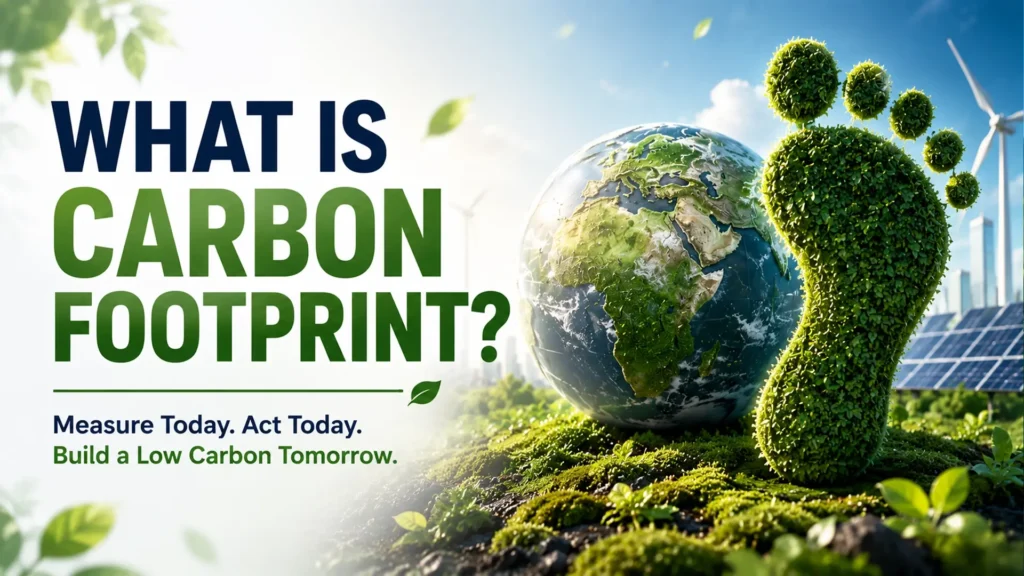
Every activity leaves behind a measurable emission trail. That trail is called a carbon footprint. It captures the total greenhouse gas emissions generated across energy use, transportation, industrial processes, and consumption patterns.
Measured in CO₂e, it converts different gases into a single comparable unit using global warming potential. This standardization allows businesses and governments to move from abstract climate discussions to structured emissions accounting. Carbon footprint acts as a baseline for sustainability reporting, regulatory preparedness, and long term decarbonization strategies across operations and supply chains.
What Is Carbon Footprint?
Clarity around carbon footprint starts with its role in measurement, not definition alone. It quantifies total emissions linked to an activity, system, or organization across both direct and indirect sources.
Direct emissions come from controlled operations such as fuel combustion in vehicles or industrial plants. Indirect emissions extend across purchased electricity and deeper into the value chain, where most emissions often sit.
Carbon footprint definition becomes more actionable when structured into reporting categories. Organizations classify emissions into scope 1 2 3 emissions, ensuring clear separation between operational emissions and supply chain impact.
A lifecycle perspective strengthens this further. In sectors like automotive, calculating automotive lifecycle emissions connects raw material extraction, manufacturing, usage, and disposal into one continuous emissions view.
Major Sources of Carbon Footprint
Emissions do not come from a single system. They are distributed across interconnected sectors. Understanding sources of carbon footprint helps identify where reduction efforts actually deliver results.
Where emissions concentrate the most
1. Energy systems
Electricity generation dominates emissions due to reliance on fossil fuel based grids. Continuous demand from industrial plants, commercial infrastructure, and households compounds this impact. Grid emission factors determine how carbon intensive each unit of electricity becomes.
2. Mobility and logistics
Transportation emissions are driven by fuel combustion across vehicles, aviation, and shipping. The impact extends beyond usage into manufacturing and disposal.
Policy and lifecycle management play a role here. The vehicle scrappage policy in India targets high emission vehicles, while managing end of life vehicles in India ensures proper material recovery.
Operational improvements define how to reduce automotive carbon emissions through electrification and recycling systems.
3. Food and agriculture systems
Methane from livestock and nitrous oxide from fertilizers significantly increase emissions due to their higher global warming potential. Food supply chains add layers of energy consumption through processing and logistics.
4. Industrial production and consumption
Manufacturing generates process emissions alongside energy use. Materials such as steel, cement, and chemicals carry high embedded emissions. Supply chain complexity makes these emissions harder to track but critical to reduce.
5. Waste systems
Landfills release methane due to organic decomposition. Weak waste segregation and recycling systems increase leakage and reduce recovery potential. Structured waste management aligns with circular economy models.
6. Digital infrastructure
Data centers and cloud systems contribute indirectly through continuous energy demand. Streaming, storage, and communication infrastructure form a growing share of emissions in modern economies.
How Is Carbon Footprint Measured?
Measurement converts activity into numbers that can be tracked, verified, and acted upon. Without this step, emissions remain invisible and unmanaged.
How the calculation actually works
Every activity produces data. Electricity consumption in kWh, fuel usage in litres, and logistics in distance travelled. These inputs are multiplied by emission factors to calculate CO₂e. Frameworks such as the Greenhouse Gas Protocol define boundaries, methodologies, and classification systems. Scope based reporting ensures emissions are not double counted and remain aligned with ESG disclosures.
What makes the data credible
Measurement alone is not enough. Validation and verification ensure accuracy. Independent auditors review methodologies, monitoring protocols, and documentation workflows. Concepts such as additionality, leakage, and permanence become relevant when emissions reductions are linked to carbon markets. Registry systems track issuance, transfer, and retirement of carbon credits, ensuring traceability.
Types of Carbon Footprint
The scope depends on what is being assessed and how far the boundary extends.
Four practical lenses
1. Personal footprint
Daily activities such as commuting, electricity use, and consumption patterns define individual emissions. Small changes here scale significantly when aggregated.
2. Product footprint
A product carries emissions across its entire lifecycle. Life cycle assessment captures this from raw material extraction to disposal. Circular models shift this toward reuse and recovery.
3. Corporate footprint
Organizations measure emissions across operations, energy use, and supply chains. Scope 3 emissions often dominate, making supplier engagement critical.
4. Event footprint
Events generate emissions through travel, logistics, and energy consumption. Temporary setups still create measurable environmental impact.
| Type | Description | Example |
| Personal | Lifestyle emissions | Travel, electricity |
| Product | Lifecycle emissions | Vehicles, electronics |
| Corporate | Operational and supply chain emissions | Manufacturing plants |
| Event | Event based emissions | Conferences |
Why Carbon Footprints Matter
Carbon footprint acts as a decision framework rather than just a metric. It connects emissions data with action across policy, operations, and markets. Organizations rely on it for sustainability reporting, emissions disclosure, and regulatory alignment. It supports participation in compliance carbon markets and voluntary carbon markets.
Measurement is the starting point for how companies achieve net zero targets. Without baseline data, reduction strategies lack direction. Residual emissions require balancing mechanisms. Businesses engage with carbon credits as market based tools to offset unavoidable emissions. Operational transformation extends further. Adopting a circular economy in automotive industry reduces material dependency and lowers embedded emissions.
Carbon footprint ultimately links environmental performance with financial, regulatory, and operational decision making.
How to Reduce Carbon Footprint
Reduction strategies work best when applied across systems rather than isolated actions. Energy, mobility, manufacturing, and supply chains need coordinated changes.
Where reduction actually happens
1. Energy transition
Shifting to renewable sources reduces dependence on fossil fuel based electricity. Energy efficiency upgrades lower overall consumption.
2. Mobility shift
Cleaner transport systems reduce emissions intensity. Electrification and optimized logistics improve efficiency at scale. Individuals also benefit from structured policies. The benefits of vehicle scrapping in India include lower emissions and better fuel efficiency.
3. Waste and material systems
Recycling and responsible disposal reduce landfill emissions. Compliance with epr frameworks ensures accountability in material lifecycle management.
4. Supply chain decarbonization
The largest impact sits in Scope 3 emissions. Strategies defining how to reduce scope 3 emissions in automotive focus on supplier engagement, data alignment, and process optimization. Reduction is always the priority. Carbon offsets and credits act only as secondary tools for emissions that cannot be eliminated immediately.
Conclusion
Carbon footprint converts environmental impact into measurable data. Expressed in CO₂e, it allows consistent emissions accounting across activities, products, and organizations. Understanding carbon footprint enables identification of emission hotspots and supports structured decarbonization strategies. As regulatory systems, carbon markets, and ESG frameworks evolve, reducing carbon footprint remains central to sustainability goals and long term operational resilience.
FAQs
What is a carbon footprint in simple terms?
It is the total greenhouse gas emissions caused by an activity or entity, expressed in CO₂e.
How is carbon footprint measured?
Activity data such as energy use or fuel consumption is multiplied by emission factors to calculate emissions.
What increases a carbon footprint?
High energy consumption, fossil fuels, transportation, and industrial processes increase emissions.
What gases are included in carbon footprint calculations?
Carbon dioxide, methane, and nitrous oxide are included and converted into CO₂e.
Why is carbon footprint measured in CO₂e?
It standardizes different gases into a single comparable metric.
Can companies measure their carbon footprint?
Yes, using structured frameworks, verification systems, and emissions accounting methods.
How to reduce carbon footprint?
Energy efficiency, clean transport, waste reduction, and supply chain optimization help lower emissions.