
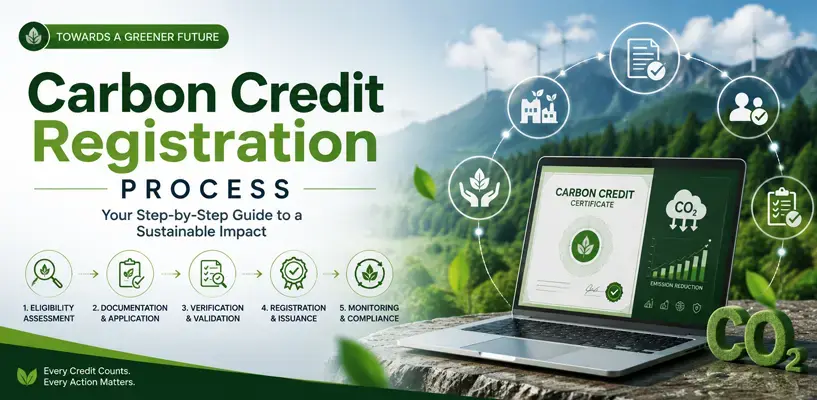
Registering carbon credits is how a project that cuts emissions turns that reduction into a credit it can sell. The path runs through six steps: writing a Project Design Document (PDD), having it checked by an independent agency, registering it with a registry, monitoring the project, verifying the actual reductions, and finally having the credits issued.
In India, projects may be registered under the emerging Indian Carbon Market (ICM) framework; which is a compliance carbon market, or the international voluntary ones, like Verra, Gold Standard, Cercarbono and Global Carbon Council (GCC) etc., depending upon the project type and target market. From first idea to first credit, expect 12 to 20 months for typical projects, depending on project complexity, methodology requirements, documentation, and validation and verification timelines. Large-scale or complex projects may extend up to 30 months.
Stages of the Carbon Credit Registration Process
Before walking through the steps, it helps to know how carbon credits work: one credit equals one ton of CO2e kept out of the atmosphere, proven and signed off by a third party. Each stage below has to finish, and produce its document, before the next can begin.
Stage 1: Design the Project Design Document (PDD)
The developer writes the Project Design Document, the master file for the whole project. It sets out four things in plain terms.
- What the project does, and what would have happened without it, i.e. the baseline scenario before the project implementation
- Which approved methodology it follows, including the rules and procedures for quantifying emission reductions
- How reductions will be measured and tracked over time, or the monitoring plan of the project activity
- The demonstration of additionality, showing that the project is not a “business-as-usual”activity and that the resulting environmental benefits would not have occurred without the project intervention.
This stage takes two to four months.
Stage 2: Validation
Once the Project Design Document (PDD) has been prepared, it undergoes validation by an independent third-party auditor. The purpose of validation is to assess whether the project complies with the requirements of the selected carbon crediting programme, the baseline scenario is appropriately established, the additionality is adequately demonstrated, and the proposed emission reductions have been quantified using an approved methodology.
In Indian Carbon Market (CCTS), these independent auditors are known as an Accredited Carbon Verification Agencies (ACVAs); for international voluntary markets like Verra, Cercarbono and Gold Standard, they are known as Validation and Verification Bodies (VVBs).
This stage takes 3 to 9 months, depending on the complexity of the project, the quality of the submitted documentation, and the time required to resolve audit findings.
Stage 3: Registration
The validated project is submitted to the selected carbon registry to be formally registered.
The registry conducts its own review of the project documentation and validation report to ensure compliance with the applicable programme requirements . This takes upto three months.
Stage 4: Monitoring
The project, after being registered, is now monitored by the project developer as per the monitoring plan of the project activity. In this stage, the project developer collects and maintains monitoring data in accordance with the approved methodology and monitoring plan mentioned in the PDD. Monitoring is conducted continuously throughout the crediting period of the project activity, with a monitoring report prepared at the end of each declared monitoring period.
Data is collected using calibrated measurement instruments specified by the approved methodology, with periodic records maintained as part of the monitoring documentation. Accurate data collection is essential, as data gaps and deviations from the approved monitoring plan may affect the verification, and further, the issuance of credits.
Stage 5: Verification
Following the completion of monitoring, the project proponent submits the Monitoring Report and supporting documents to an independent third-party auditor for verification. The auditor checks whether the reported emission reductions have actually occurred, confirms compliance with the approved monitoring plan and Project Design Document (PDD), and reviews the supporting records and calculations. Upon successful verification, a Verification Report is issued confirming the quantity of verified emission reductions achieved during the monitoring period. This stage typically takes two to three months.
Stage 6: Issuance
Upon successful verification, the registry issues the credits, one for each verified ton of CO2e. Different registries issue credits under different nomenclature. For instance, the Indian Carbon Market issues Carbon Credit Certificates (CCCs); Verra issues Verified Carbon Units (VCUs); Gold Standard issues Verified Emission Reductions (VERs); and Cercarbono issues Carboncers. Each issued credit is assigned a unique serial number and deposited into the project developer’s registry account, where it remains available for sale, transfer, or retirement. Once issued, these credits can be sold, held, or retired against a company’s own targets. This stage takes one to two months.
| Stage | Who does it | What it produces |
|---|---|---|
| Project Design | Project Developer | Project Design Document |
| Validation | Independent Auditor | Validation Statement/Report |
| Registration | Carbon Registry | Registration certificate |
| Monitoring | Developer | Monitoring report |
| Verification | Independent Auditor | Verification Statement/Report |
| Issuance | Carbon Registry | Issued credits |
Carbon Credit Registration Costs and Timelines in India
One of the most important considerations for a project developer, is the cost and time involved in taking a project from conception to carbon credit issuance.. The figures below are indicative for a mid-sized project producing 5,000 to 20,000 credits a year. Actual costs may vary depending on the project type, scale, methodology complexity, registry selected, and the consultants and verification bodies engaged.
|
Stage |
Indicative cost (INR) |
| Feasibility and scoping |
0.5 to 5 lakh |
| PDD preparation |
3 lakh to 15 lakh |
| Validation |
5 lakh to 15 lakh |
| Registry fees (Account Opening, Listing, Registration, Maintenance, etc.) |
0.5 to 5 lakh |
| Monitoring, per year |
1 lakh to 5 lakh |
| Verification, per cycle |
5 lakh to 15 lakh |
| Issuance |
INR 3 to 50 per credit |
Overall, project developers can expect to incur approximately ₹15-70 lakh before the first batch of carbon credits is issued, excluding issuance fees, which vary by registry and the volume of credits generated.
On timing, the limiting factor is simple: you cannot verify reductions until the project has run for at least a full year. So even a well-managed project takes 18 to 30 months from idea to first credit.
After that, each verification cycle is faster, usually two to four months from closing the monitoring period to receiving the credits.
Conclusion
Registering carbon credits is a structured, document-heavy process that costs real money long before any credit is sold. One of the most important decisions for a project developer is the choice of carbon registry and methodology, as these influence project eligibility, market acceptance, compliance requirements, and potential revenue opportunities. While the Indian Carbon Market may be suitable for projects targeting domestic demand, international registries such as Verra, Gold Standard, GCC, and Cercarbono can provide access to broader voluntary carbon markets. Matching the right registry to the types of carbon credits a project produces is what turns an 18 to 30 month investment into a steady stream of revenue.
FAQs
What is the carbon credit registration process?
It is the six-step path that turns a verified emission reduction into a tradable credit: design, validation, registration, monitoring, verification, and issuance.
What is a Project Design Document?
The master file describes the project, including the baseline scenario, the methodology it follows, additionality demonstration, monitoring approach and how to estimate emission reductions. The independent auditors review it during validation and subsequently, the registry does the same before listing.
How long does end-to-end carbon credit project registration take in India?
Usually 18 to 30 months, because a project must run for at least a full year before its reductions can be verified.
What is the difference between the Indian Carbon Market and other markets like Verra, Gold Standard or Cercarbono?
The Indian market is government-run and compliance-linked. Verra/Gold Standard/Cercarbono are international voluntary registries, whose credits trade globally.
What does carbon credit registration cost?
Roughly INR 15 lakh to INR 70 lakh before the first credit is issued, plus yearly monitoring and per-cycle verification costs after that.
Can vehicle scrapping generate carbon credits?
Yes. Vehicle scrapping can generate carbon credits by reducing emissions associated with older vehicles and recovering recyclable materials. MMCM has developed a vehicle scrapping carbon credit methodology under Cercarbono, creating a pathway for eligible RVSFs to monetize these emission reductions .
What is additionality?
Additionality is the principle that a project’s emission reductions must be additional to what would have occurred in the absence of carbon credit revenue or other carbon market incentives. If a project would have been implemented anyway under normal business conditions or regulatory requirements, it generally does not qualify for carbon credits.