
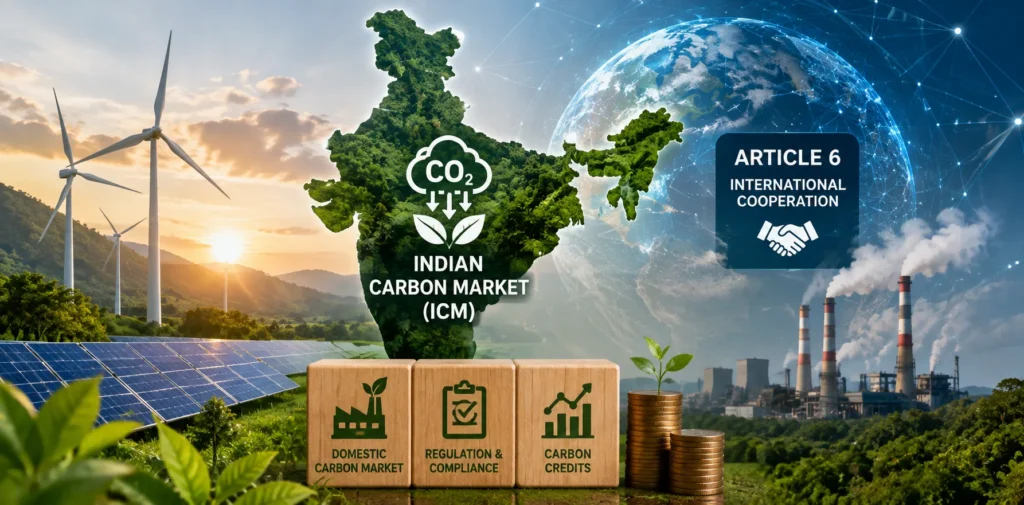
As countries around the world accelerate their climate action, carbon markets are becoming an important tool to reduce greenhouse gas (GHG) emissions while supporting sustainable economic growth. Through the Indian Carbon Market (ICM), the country aims to encourage industries and project developers to reduce emissions and contribute towards India’s climate commitments.
At the same time, India also participates in the global carbon market under Article 6 of the Paris Agreement. Although these two frameworks share the common goal of climate mitigation, they operate independently and serve different purposes.
What is the Indian Carbon Market?
The Indian Carbon Market (ICM) is India’s domestic carbon trading framework established under the Carbon Credit Trading Scheme (CCTS). It creates a financial incentive for reducing emissions by allowing carbon credits to be issued and traded.
The scheme is implemented under the Ministry of Power (MoP). The Bureau of Energy Efficiency (BEE) administers the market, while the National Steering Committee for the Indian Carbon Market (NSCICM) provides policy recommendations. GRID-INDIA operates the national carbon registry, accredited verification agencies validate and verify emission reductions, and carbon credits are traded through approved power exchanges.
The CCTS consists of two mechanisms:
1. Compliance Mechanism
This is a mandatory market for energy-intensive industries. Under this mechanism, industries are assigned Greenhouse Gas Emission Intensity (GEI) targets. Companies that perform better than their assigned targets earn Carbon Credit Certificates (CCCs), while those that fall short must purchase certificates to meet their obligations.
The Compliance Mechanism is being rolled out across nine identified sectors- aluminium, cement, fertilisers, iron and steel, petroleum refineries, petrochemicals, pulp and paper, chlor-alkali, and textiles, with more sectors expected to be added over time.
2. Offset Mechanism
Unlike the compliance market, the Offset Mechanism is voluntary. It allows project developers, industries, urban local bodies, and other non-obligated entities to register projects that reduce, remove, or avoid greenhouse gas emissions and earn Carbon Credit Certificates.
The Offset Mechanism currently covers projects across the following sectors, generating the various types of carbon credits recognised under CCTS methodologies:
- Energy
- Industries
- Agriculture
- Waste Handling and Disposal
- Forestry
- Transport
- Fugitive Emissions
- Construction
- Solvent Use
- Carbon Capture, Utilisation and Storage (CCUS)
These sectors are supported through approved methodologies that define how emission reductions are quantified, monitored, reported, and verified before Carbon Credit Certificates (CCCs) are issued.
What is Article 6?
While the ICM focuses on reducing emissions within India, the Article 6 framework of the Paris Agreement enables countries to cooperate internationally in achieving their climate targets.
In India, participation under Article 6 is led by the Ministry of Environment, Forest and Climate Change (MoEFCC) through the National Designated Authority for the Implementation of the Paris Agreement (NDAIAPA), which evaluates eligible activities and authorizes international transfers where applicable.
Article 6 has two market-based approaches relevant to India.
- Article 6.2: enables participating countries to voluntarily cooperate through the international transfer of authorised mitigation outcomes (ITMOs), subject to corresponding adjustments and bilateral or multilateral agreements between participating Parties.
- Article 6.4: establishes a centralized UN crediting mechanism supervised by the Article 6.4 Supervisory Body. Projects are registered under UNFCCC rules, while host country authorization (where required) remains the responsibility of the national government.
Both mechanisms are designed to mobilise climate finance, encourage technology transfer, and support cost-effective emission reductions across countries.
India’s Eligible Activities under Article 6
To facilitate international carbon market participation, thirteen activities have been identified as eligible for consideration under Article 6.2 and Article 6.4. These include:
- Renewable energy with storage
- Solar thermal power
- Offshore wind
- Green hydrogen
- Compressed biogas
- Fuel-cell based mobility solutions
- Advanced energy-efficient technologies
- Sustainable aviation fuel
- Best available technologies for hard-to-abate industries
- Ocean-based renewable energy technologies
- High Voltage Direct Current (HVDC) transmission integrated with renewable energy
- Green ammonia
- Carbon Capture, Utilisation and Storage (CCUS)
These activities were selected because they have the potential to accelerate technology adoption and attract international climate finance into India.
Timeline: Evolution of India’s Carbon Market and Article 6 Journey
| Timeline | Key Milestone |
| December 2015 | Paris Agreement adopted at COP21; Article 6 established as the framework for international carbon market cooperation. |
| October 2016 | India ratifies the Paris Agreement, becoming a Party eligible to participate in Article 6 mechanisms. |
| November 2021 | At COP26 (Glasgow), Parties adopt the Article 6 Rulebook, operationalising Articles 6.2 and 6.4. |
| May 2022 | India notifies the National Designated Authority for the Implementation of Article 6 (NDAIAPA) under the MoEFCC. |
| December 2022 | The Energy Conservation (Amendment) Act, 2022 is enacted, providing the legal foundation for the Indian Carbon Market (ICM) and the Carbon Credit Trading Scheme (CCTS). |
| June 2023 | The Carbon Credit Trading Scheme (CCTS), 2023 is notified, establishing the Indian Carbon Market and laying the foundation for the Compliance Mechanism. |
| December 2023 | The CCTS is amended to introduce the Offset Mechanism for voluntary participation by non-obligated entities. |
| July 2024 | BEE publishes the Accreditation Procedure and Eligibility Criteria for Accredited Carbon Verification Agencies (Version 1.0) and the Detailed Procedure for Compliance Mechanism (Version 1.0). |
| September 2024 | BEE notifies the eligible sectors and activities under the Offset Mechanism. |
| March 2025 | BEE publishes the Detailed Procedure for the Offset Mechanism under CCTS (Version 1.0). |
| June 2025 | Draft GEI Target Rules issued for Secondary Aluminium, Iron & Steel, Petroleum Refinery, Petrochemicals, and Textiles for public consultation. |
| October 2025 | Final GEI targets were notified for the first four compliance sectors: Aluminium, Cement, Chlor-Alkali, and Pulp & Paper. |
| January 2026 | Final GEI targets notified for Secondary Aluminium, Petrochemicals, Petroleum Refining, and Textiles, expanding the Compliance Mechanism to 490 obligated entities. |
| March 2026 | India’s Carbon Market Portal is launched during Prakriti 2026, marking the operational launch of India’s domestic carbon market, with compliance carbon credit trading expected to commence later in 2026. |
| June 2026 | Revised draft GEI targets issued for the Iron & Steel sector. |
Note: The Fertiliser sector is identified under the Carbon Credit Trading Scheme (CCTS) framework but, as of June 2026, draft or final Greenhouse Gas Emission Intensity (GEI) targets have not yet been notified.
How Do They Relate?
The Indian Carbon Market and Article 6 are often discussed together, but they are not the same system. They operate under different legal and institutional frameworks, although projects may eventually interact with both subject to Government approvals and accounting requirements.
The ICM is India’s domestic carbon market, whereas Article 6 provides the framework for international cooperation under the Paris Agreement.
They share a common objective of reducing greenhouse gas emissions and maintaining robust monitoring, reporting, and verification (MRV) systems. However, they follow separate legal frameworks, approval processes, and governance structures. A carbon credit generated under the Indian Carbon Market carries its own carbon credit retirement and accounting rules, and is not automatically eligible for transfer under Article 6. Such transfers require separate authorization by India in accordance with Article 6 rules.
Looking Ahead
India’s carbon market is entering a transformative phase. As the Compliance and Offset Mechanisms mature and Article 6 cooperation expands, both frameworks are expected to play complementary roles in supporting India’s net zero roadmap and low-carbon transition.
While one focuses on strengthening domestic climate action and the other enables international cooperation, together they demonstrate India’s commitment to balancing economic growth with global climate responsibility.