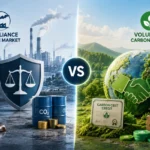


A growing number of organizations worldwide are choosing to go beyond legal requirements and take direct responsibility for their carbon footprint. The voluntary carbon market (VCM) is the mechanism that makes this possible.
Contrary to how compliance carbon markets operate under government regulations, the voluntary carbon market allows participants to take proactive climate action beyond mandatory requirements. By investing in carbon reduction projects, companies can support climate mitigation efforts while working toward their sustainability and net zero commitments.
How the Voluntary Carbon Market Works
Understanding how the voluntary carbon market works requires following the lifecycle of a carbon credit from project development to retirement.
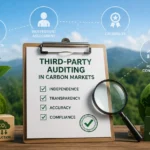
Climate mitigation projects are developed with the purpose of reducing or removing greenhouse gas emissions. Depending on the applicable carbon standard or programme like VCS, Gold Standard, Puro Earth, Cercarbono etc., these projects go through validation, in which an independent third party assesses the project design against the applicable requirements and once implemented, the projects undergo verification, where the reported emission reductions or removals are then independently verified. Once verified, credits are issued and recorded in carbon registries that maintain transparent, publicly accessible records of every credit issued, transferred, and retired.
Organizations and other participants as buyers can then purchase these voluntary carbon credits for permitted purposes. After purchase and being used for a permitted claim or other purpose, credits are permanently retired in the registry, ensuring they cannot be resold or reused.
| Step | Description |
| Project Development | Climate mitigation projects are developed by environmental organizations or private developers |
| Listing | The project is submitted to the applicable carbon programme and made available for review and stakeholder consultation, where required. |
| Validation | An independent third-party auditor (VVB) assesses whether the project design meets the requirements of the applicable carbon standard or programme. |
| Project Registration | Once the applicable requirements are met, the project is formally registered under the carbon programme. |
| Monitoring | The project collects and records data on its activities and emission reductions or removals in accordance with the approved monitoring plan and methodology. |
| Verification | Independent auditors verify the project’s implementation, monitoring data, calculations, and emission reductions or removals |
| Credit Issuance | Once the applicable requirements are met, carbon credits are issued and recorded in carbon registries |
| Trading | Credits are bought and sold through brokers, exchanges, or direct agreements |
| Retirement | Credits are permanently retired in the registry once used for a permitted claim or other purpose |
Who Participates in the Voluntary Carbon Market?
The voluntary carbon market functions as an ecosystem, with different participants playing distinct roles.
Project Developers
They design and implement climate mitigation initiatives, ranging from reforestation and soil carbon projects to renewable energy, industrial methane capture and carbon removal activities etc. Depending on the project structure, the developers may generate revenue through the sales of carbon credits .
Corporate Buyers
Companies may purchase carbon credits to support climate mitigation projects and broader sustainability or climate strategies . Organizations pursuing net zero commitments may also consider eligible carbon credits as part of their wider approach to addressing emissions that remain after direct reduction efforts, subject to applicable standards and guidance .
Brokers and Traders
Brokers and trading platforms can facilitate carbon credit transactions by providing access to carbon credits with different project types, vintage years, and geographies. Their role has grown significantly as the market has scaled and diversified.
Independent Auditors
Third party auditors, known as Validation and Verification Bodies (VVBs), independently assess whether a carbon project meets the applicable requirements and whether reported emission reductions or removals have been achieved in accordance with the relevant methodology and monitoring requirements.
Registries
Registries provide systems for recording and tracking carbon credits throughout their lifecycle, including issuance, transfer, and retirement. Standards and programmes such as VCS, Gold Standard, and Cercarbono operate associated registry systems like Verra, Impact Registry and Eco Registry respectively. .
Why the Voluntary Carbon Market Matters
The voluntary carbon market can play an important role in directing private finance toward climate mitigation activities and supporting organizations in their broader climate strategies .
Accelerating Net Zero Commitments: For organizations working towards their net zero roadmap, the VCM can provide a mechanism for supporting emission reduction and removal activities while direct emissions reduction efforts continue . Carbon credits should complement, rather than replace, efforts to reduce an organization’s own emissions..
Channeling Private Investment into Climate Projects: The VCM can channel private finance toward projects involving areas such as reforestation, clean energy, and carbon removal projects etc. Some projects may also generate both environmental and social co-benefits alongside their climate outcomes. .
Driving Innovation in Carbon Market: Market demand for high quality carbon credits can encourage improvements in project methodologies, monitoring systems, measurement approaches, and other aspects of carbon project development. . This competition raises the overall quality bar across the market.
Creating Environmental and Social Co-Benefits: Some carbon projects can deliver outcomes beyond greenhouse gas reductions or removals, including biodiversity protection, water security, and improved livelihood in vulnerable communities. These co-benefits are increasingly factored into credit pricing and buyer preferences.
Enabling Sector-Specific Climate Action Industries with complex emission structures, including the automotive sector, can use voluntary carbon markets as one component of broader climate strategies . Understanding the connection between carbon credits for global automobile industry activity and voluntary markets is becoming essential for OEMs, suppliers, and fleet operators managing scope 1 2 3 emissions across their value chains.
Conclusion
The voluntary carbon market plays an important role in supporting global climate action by enabling organizations and individuals to voluntarily support emission reduction and removal efforts through the purchase of carbon credits . By purchasing voluntary carbon credits from verified climate projects, participants contribute to emission reduction and removal activities that extend well beyond what regulatory frameworks require.
With the demand for credible climate solutions continuing to grow, the VCM can help mobilize private investment toward sustainable development and climate mitigation initiatives worldwide. For sectors like automotive, where automotive lifecycle emissions remain significant, the voluntary carbon market represents both a responsibility and an opportunity to support the transition toward a circular, low-carbon future.