
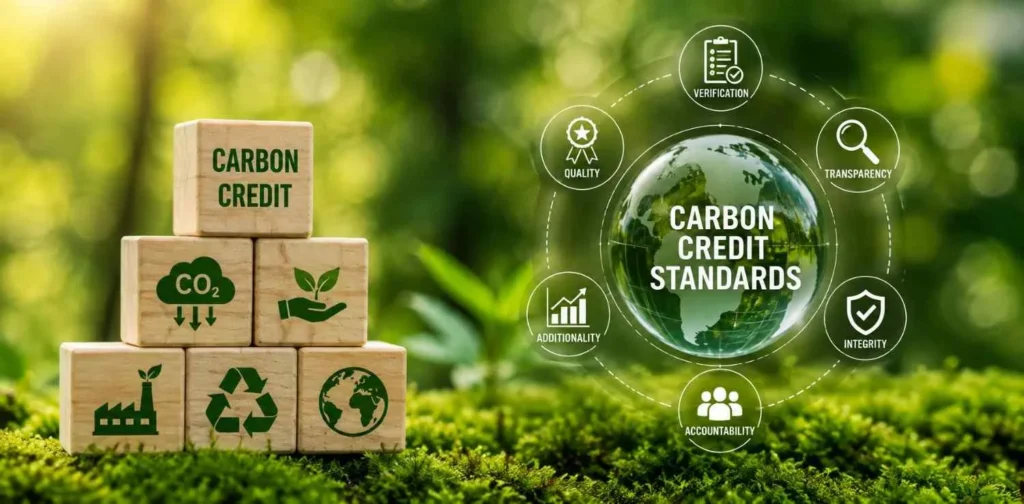
Carbon credit standards are frameworks that ensure carbon reduction,avoidance or removal projects generate credible and measurable climate benefits. These standards define the rules, methodologies, and verification processes used to quantify the greenhouse gas emission reductions or removals. By establishing consistent guidelines, carbon credit standards help ensure that carbon credits represent real, additional, and permanent climate impacts.
In voluntary carbon markets, standards play a critical role in maintaining transparency and trust. They establish requirements for project development, validation, third-party verification, monitoring and the issuance of carbon credits through carbon registries. As global demand for carbon credits grows, these standards help ensure that climate mitigation and carbon removal projects meet stringent environmental and, where applicable, social integrity requirements.
What Are Carbon Credit Standards?
Carbon credit standards are structured governance frameworks that regulate how emission reduction,avoidance or removal projects are designed, measured, verified, and credited. They go well beyond setting rules on paper. They define the entire operational lifecycle of a carbon credit, from the moment a project is conceived to the point where a credit is retired in a registry after use.
These frameworks establish approved methodologies for calculating baseline emissions and measuring project-level reductions or removals. They require projects to meet defined eligibility criteria before any carbon credits can be issued and generally require independent third party validation and verification at specified intervals of the project lifecycle. These carbon credits are recorded in registries with unique serial numbers allowing their issuance, transfer, ownership, and retirement to be tracked. Carbon credit certification standards primarily operate in voluntary carbon markets, although some carbon credits may also be eligible for use in specific compliance mechanisms, depending on the applicable regulations. .
Why Carbon Credit Standards Are Important
Without standards, carbon markets would have no consistent basis for determining what constitutes a credible emission reduction or removal. Standards provide the rules and processes that distinguish quantified and independently assessed climate outcomes from unverifiable claims.
Here is why carbon credit standards are operationally and commercially essential:
- They support credible quantification: They ensure that every carbon credit represents a real and measurable emission reduction, avoidance, or removal, through established methodologies.
- They reduce the risk of fraud and double counting: Standardised project documentation, verification, registry systems, and credit serialisation help prevent the same credit from being issued or used more than once..
- They establish consistent methodologies: Approved methodologies provide a constant approach to quantifying emission reductions and removals to different project types, sectors, and geographies. .
- They strengthen market confidence: Independent validation and verification provide buyers and other stakeholders with greater confidence in the environmental integrity of credits.
- They address environmental and social co-benefits: Many standards include safeguards, stakeholder consultation, or requirements related to environmental and social impacts, depending on the programme and project type..
- They support credible emissions disclosure: Certified and traceable credits can provide documented evidence for organisations making carbon-related claims, subject to the applicable claim guidance and reporting requirements..
Major Carbon Credit Standards
Several major carbon credit standards and programmes operate in the voluntary carbon market. Each has its own focus areas, approved methodologies, eligibility requirements, validation/verification processes, and registry infrastructure. Some are broad-based, while others focus on specific project types (nature-based) or carbon removal activities. The most widely recognized are listed below.
Verified Carbon Standard (VCS)
Administered by Verra, the Verified Carbon Standard (VCS) is one of the most widely used voluntary carbon credit standards globally. It supports a broad range of project types including renewable energy, forestry, methane capture, and energy efficiency improvements. Projects verified under VCS receive Verified Carbon Units (VCUs), each representing one metric tonne of CO₂e reduced, avoided or removed. VCS is recognized for its extensive methodology library and the scale of its registry operations.
Gold Standard
Gold Standard was developed with the involvement of World Wildlife Fund (WWF) and other international NGOs. The Gold Standard for the Global Goals (GS4GG). Projects in line for certification are required to demonstrate measurable contributions to the UN Sustainable Development Goals (UN-SDGs) alongside their emission reporting. This makes Gold Standard particularly relevant for organizations seeking projects that deliver both climate and broader sustainable development benefits. Its projects span sectors such as clean energy, community services, waste management, agriculture and land-use.
American Carbon Registry (ACR)
Founded in 1996, American Carbon Registry (ACR) was the first private voluntary greenhouse gas registry in the world and remains a major standard for the North American carbon markets. It provides approved methodologies across multiple sectors and issues carbon credits that are accepted in several compliance programs, including California’s Cap-and-Trade Program, Washington State’s Cap-and-Invest Program, International Civil Aviation Organization’s CORSIA etc.
Puro.earth
Puro.earth is a carbon removal standard and certification platform focused specifically on engineered carbon removal. Its standard provides methodologies and requirements for quantifying, verifying, and certifying durable carbon removals. Verified removals are issued as CO₂ Removal Certificates (CORCs), with each CORC representing one metric tonne of CO₂ removed and durably stored under an approved methodology. Its methodologies cover carbon removal approaches designed for long-term storage, including biochar, carbonated materials, enhanced rock weathering, and geological carbon storage. .
Plan Vivo
PV Climate is Plan Vivo’s carbon standard, with a strong focus on community and smallholder-led nature-based projects. It places particular emphasis on local participation, sustainable land management, and equitable distribution of project benefits.. Projects achieving PV Climate certification can issue Plan Vivo Certificates (PVCs), with revenues supporting project activities and local communities. .
Cercarbono
Cercarbono is a global environmental certification standard that certifies carbon projects across sectors including energy, waste management, transport, land use, and circular economy. It provides methodologies, certification requirements, and third-party validation and verification processes for quantifying and certifying emission reductions and removals
Cercarbono also offers sector-specific methodologies, including for the recovery and recycling of end-of-life vehicles (ELVs). ELV carbon credits generated through the scrapping of end of life vehicles at government registered facilities follow traceability, monitoring and verification protocols while addressing the specific emissions profile of the automotive sector.
Key Principles of High-Quality Carbon Credit Standards
Major carbon standards are generally built around a set of principles intended to support environmental integrity. The precise requirements and terminology vary between standards and project types:
| Principle | Description |
| Additionality | Emission reductions/removals would not have occurred without the project activity |
| Permanence | Carbon reductions must be long lasting and protected against reversal |
| Verification | Independent third party auditing confirms all claimed emission reductions/removals |
| Transparency | Public registries track the issuance, transfer, and retirement of every credit |
| Double Counting Prevention | Each credit represents a unique reduction and can be retired only once |
These principles apply across all types of carbon credits, whether generated from nature based solutions, industrial emission reductions, or technology-based carbon removal projects. However, the specific requirements vary according to the standard, methodology, project type, and applicable regulatory framework.
How Carbon Credit Standards Work
Carbon credit standards translate these principles into operational requirements through a defined project cycle-
Methodology Selection and Project Documentation
Before any project activity begins, the developer selects an approved methodology that matches the project type. The methodology specifies the eligibility criteria, data requirements, calculation formulas, monitoring frequency, and documentation to be maintained. A project design document (PDD), incorporating all these details, is then submitted to the relevant registry for review.
Project Registration
The submitted PDD and supporting documents undergo an initial review by the relevant carbon crediting programme to determine whether the project meets its applicable registration requirements. Once the documentation has been reviewed and the applicable requirements are met, the project is registered under the programme and assigned the relevant registration status.
Validation
An approved or accredited Validation and Verification Body (VVB) reviews the project design document and other submitted documents to confirm the project’s compliance with the selected standard. This assessment may include reviewing the project’s eligibility, baseline approach, additionality, monitoring plan, emission reduction or removal calculations, and other applicable requirements. Upon successful completion of the required review by the VVB and final approval by the carbon standard; , the project receives the applicable “validated” status in the standard’s registry.
Monitoring, Verification, and Issuance
Once operational, the project developer monitors the relevant parameters according to the approved monitoring plan and prepares the required monitoring documentation. These reports are audited by an independent third party verifier (VVB). Upon successful carbon credit verification, the registry issues credits with unique serial numbers. Depending on their eligibility, credits can then be transferred or used for voluntary climatic commitments or in specific compliance mechanisms. Once a credit is retired, it is removed from circulation and cannot be transferred or used again.
Conclusion
Carbon credit standards play a crucial role in maintaining the credibility and effectiveness of carbon markets. By defining rigorous methodologies, eligibility requirements, monitoring procedures, verification processes, and registry requirements, these standards provide a structured framework for demonstrating that carbon credits represent quantified and independently assessed emission reductions or removals.
For organizations considering carbon credits, understanding the standard behind a credit is an important part of evaluating its quality, intended use, traceability, and suitability for a particular climate claim or compliance requirement..
FAQs
Why are carbon credit standards important?
Carbon credit standards ensure that every credit issued in the market represents a real, measurable, and independently verified emission reduction or removal. Without standards, there would be no consistent basis for comparing or trusting carbon credits across different projects, sectors, or geographies.
What are the major global carbon credit standards?
The major voluntary carbon credit standards include the Verified Carbon Standard (VCS) by Verra, Gold Standard, American Carbon Registry (ACR), Puro.earth, Cercarbono, and Plan Vivo etc. Each defines its own approved methodologies, project eligibility requirements, verification procedures, and registry infrastructure.
How do carbon credit standards ensure credibility?
Standards require projects to follow defined methodologies, and eligibility requirements, maintain monitoring and supporting documentation, undergo independent validation and/or verification at specified intervals, and record the issued credits through public registries with unique serial numbers. This chain of documentation and verification ensures that every credit can be traced from issuance to its retirement.
What principles define high-quality carbon credits?
High quality carbon credits must demonstrate the principles of credible quantification, additionality, permanence, independent verification, public transparency, and effective measures to prevent double counting. These principles are embedded in all major carbon credit certification standards and govern how projects are designed, monitored, and audited.
How do carbon credit standards prevent double counting?
Each credit is assigned a unique serial number in the public registries of the carbon certification programmes. Once a credit is retired against reported emissions, it is permanently removed from circulation and cannot be transferred or retired again.
What role do standards play in voluntary carbon markets?
In voluntary carbon markets, standards provide the frameworks used to develop, quantify, verify, certify, and issue carbon credits . They define what constitutes an eligible project, establish methodologies for measuring climate outcomes, mandate independent verification, and provide systems for tracking credits through their lifecycle.