
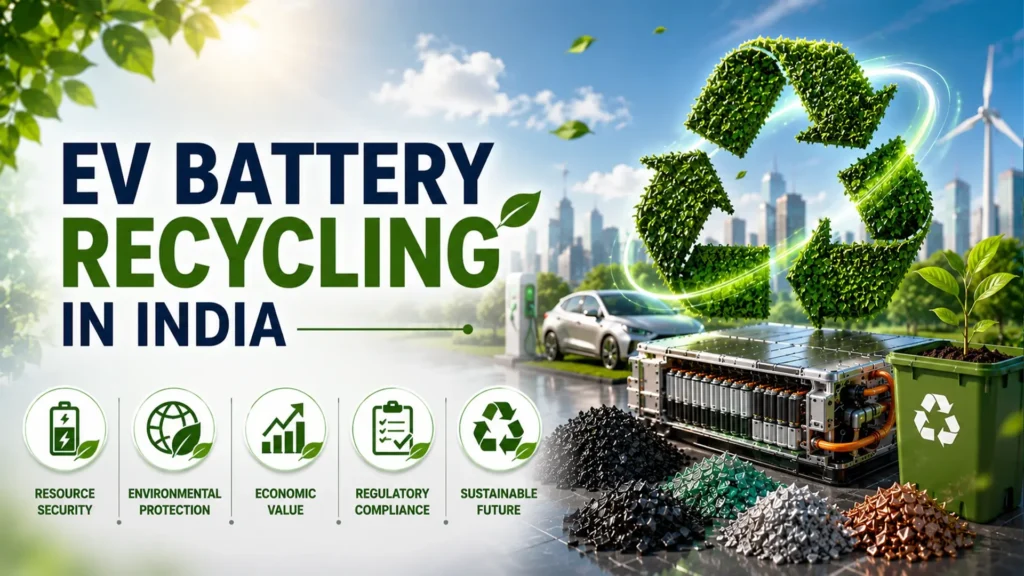
EV battery recycling in India involves recovering critical materials such as lithium, cobalt, and nickel from used battery packs to reduce both environmental impact and import dependency. India’s EV adoption is accelerating across vehicle segments, generating a growing volume of end-of-life lithium-ion batteries that pose serious risks if disposed of through informal channels. With mandatory regulations under the Battery Waste Management Rules 2022 and expanding processing capacity, the country is building a formal ecosystem to recover these materials and support a circular EV supply chain.
Why EV Battery Recycling Is Important in India
India imported over 70% of its lithium requirements in recent years, creating supply concentration risk for domestic battery manufacturers as EV penetration scales across two-wheelers, three-wheelers, and passenger vehicles.
Formal recycling creates a secondary domestic supply of recovered lithium, cobalt, nickel, and manganese that re-enters the manufacturing chain without additional mining or import, reducing both the foreign exchange burden and the geopolitical exposure embedded in virgin mineral procurement.
Lithium-ion batteries contain electrolytes, heavy metals, and reactive compounds that cause measurable soil and groundwater contamination when routed through informal disposal channels. Industry estimates suggest India will need to scale recycling capacity by 50 to 60 times relative to current levels to manage the battery packs sold today once they reach end-of-life in the early 2030s. The economic and environmental case for investing in battery waste management india infrastructure now is therefore structural, not optional.
EV Battery Recycling Process
The ev battery recycling process moves through three sequential stages: safe collection and disassembly, mechanical processing into recoverable fractions, and chemical extraction of battery-grade metals. The quality of output at each stage determines the efficiency of the one that follows.
1. Collection and Dismantling
End-of-life battery packs arrive at authorized facilities through EPR-mandated take-back channels, OEM return programs, or third-party aggregators. Upon receipt, residual charge is fully discharged in controlled conditions to eliminate thermal runaway risk before disassembly begins. Pack-level dismantling separates the battery management system, casing, busbars, and individual modules, with each component category routed to the appropriate downstream process.
2. Mechanical Processing
Dismantled cells are shredded in inert or controlled-atmosphere chambers to prevent combustion of reactive lithium compounds. Shredding produces a heterogeneous output called black mass, containing cathode active materials, anode graphite, electrolyte residues, and metallic current collector foils. Separation equipment using density differentials, magnetic fields, and air classification then isolates the black mass fraction, and the purity of this black mass directly determines hydrometallurgical recovery efficiency downstream.
3. Chemical Recovery
Hydrometallurgical processing dissolves black mass in acid solutions, bringing target metals into a liquid phase for selective separation. Solvent extraction and controlled precipitation isolate lithium, cobalt, nickel, and manganese at battery-grade purity. Recovery efficiency for cobalt and nickel exceeds 95% in modern facilities, while lithium recovery ranges between 70% and 90% depending on process design.
Battery Waste Management Rules and EPR in India
The Battery Waste Management Rules 2022 established Extended Producer Responsibility as the primary regulatory mechanism for battery lifecycle management. Producers, importers, and brand owners carry legally defined annual collection and channelling obligations. To understand the broader framework, what is EPR and how it structures producer accountability across product categories is useful context. The key operational requirements under epr battery recycling india include:
- Mandatory registration on the CPCB Centralized EPR Portal with annual collection volume reporting against targets that increase progressively each compliance year.
- EPR certificate purchase from registered recyclers to offset collection obligations, creating a verifiable audit trail and a market pricing signal for formal recycling capacity.
- Recycler registration conditioned on demonstrated compliance with technical and environmental standards, restricting EPR participation to authorized facilities.
- Prescribed handling standards for hazardous battery components covering transportation, storage, and pre-treatment across all formal chain participants.
- Financial penalties for producers who fail annual EPR targets, providing a consistent regulatory demand signal for recycling infrastructure investment.
Benefits of EV Battery Recycling
A mature EV battery recycling sector produces measurable outcomes across supply chain resilience, environmental performance, and economic value creation, all of which are directly relevant to manufacturers, regulators, and investors in the EV space.
Supply Chain and Economic Benefits
Formal recycling creates a domestic source of critical minerals that reduces import dependency and commodity price exposure. The specific supply chain benefits include:
- Recovered cobalt and nickel returned to battery-grade precursor manufacturing, reducing the foreign exchange cost of virgin mineral imports on a per-kilogram basis.
- Recovered lithium available as lithium carbonate or lithium hydroxide feedstock, at a cost structure tied to recycling economics rather than primary mining and refining.
- EPR certificate revenue providing a secondary income stream for recyclers that improves unit economics at sub-optimal processing volumes.
Environmental and Compliance Benefits
Formal battery recycling channels produce quantifiable environmental outcomes that informal disposal cannot replicate. These benefits directly support how companies achieve net zero targets by reducing lifecycle emissions tied to battery material production. Key benefits include:
- Containment of electrolyte vapours and hazardous heavy metals within controlled processing environments, preventing contamination that informal disposal generates.
- Lower lifecycle carbon footprint for battery materials, since producing battery-grade metals from recycled feedstock requires significantly less energy than primary extraction.
- Documented material recovery data supporting OEM Scope 3 emissions accounting under GHG Protocol frameworks.
Challenges in EV Battery Recycling in India
Several structural constraints limit the pace at which India’s battery recycling sector can scale to match projected demand.
Collection Infrastructure Deficit
Lithium-ion batteries require specialized handling during collection and transport, including thermal management protocols that prevent short-circuit and combustion risk. Building a collection network proportionate to the EV fleet requires OEM participation, certified logistics operators, and consumer awareness programs directing batteries into authorized channels.
- Dedicated collection points are sparse outside metropolitan areas, limiting access for EV owners in smaller cities.
- Consumer awareness of EPR take-back obligations remains low, resulting in informal disposal at the point of vehicle retirement.
Economics and Technology Constraints
High capital costs for hydrometallurgical processing plants and variability in black mass quality create unit economics challenges for recyclers below optimal scale. Profitability depends on the spread between processing costs and recovered material values, a spread exposed to global commodity price volatility for cobalt, nickel, and lithium.
- Battery chemistry variability across EV manufacturers requires flexible processing configurations, increasing per-unit cost relative to homogeneous feedstock.
- Lithium recovery efficiency remains lower than cobalt and nickel recovery in most current hydrometallurgical designs, constraining economics for high-lithium chemistries.
Conclusion
EV battery recycling in India is becoming a critical pillar of the country’s transition to sustainable mobility. By recovering valuable materials and reducing environmental risks, recycling supports both economic and ecological goals. With strong regulatory backing, growing industry participation, and technological advancements, India is steadily building a scalable battery recycling ecosystem. As EV adoption accelerates, strengthening recycling infrastructure and improving collection efficiency will be essential to ensuring a resilient and circular EV supply chain.
FAQs
What is EV battery recycling?
EV battery recycling is the process of recovering critical materials such as lithium, cobalt, nickel, and manganese from end-of-life lithium-ion battery packs through mechanical processing and chemical extraction. The recovered materials are returned to the battery supply chain as precursor compounds, reducing dependence on virgin mineral imports.
Why is EV battery recycling important in India?
India imports over 70% of its lithium requirements, creating supply concentration risk as EV adoption scales. Formal recycling builds a secondary domestic supply of critical minerals, reduces the foreign exchange burden on battery manufacturers, and prevents soil and groundwater contamination from informal battery disposal.
What materials are recovered from EV batteries?
The primary materials recovered from lithium-ion EV batteries are lithium, cobalt, nickel, and manganese from the cathode active material, along with copper from anode current collector foils and aluminum from cathode foils and casing. These are returned as battery-grade precursor compounds or into established metal recycling markets.
How does the EV battery recycling process work?
The process moves through three stages. First, end-of-life packs are collected, discharged, and dismantled. Second, cells are shredded in controlled-atmosphere chambers to produce black mass, which is then mechanically separated. Third, hydrometallurgical processing dissolves the black mass in acid solutions, and selective precipitation isolates each target metal at battery-grade purity.
What are the Battery Waste Management Rules 2022?
The Battery Waste Management Rules 2022 are regulations notified by India’s Ministry of Environment, Forest and Climate Change that establish Extended Producer Responsibility for battery lifecycle management. They require producers to collect and channel a defined proportion of end-of-life batteries to authorized recyclers each year, with compliance tracked through the CPCB EPR portal.
What is EPR in battery recycling?
Extended Producer Responsibility, or EPR, is a regulatory mechanism that makes battery producers, importers, and brand owners legally responsible for ensuring that end-of-life batteries are collected and sent to authorized recyclers. Producers meet their obligations by purchasing EPR certificates from registered recyclers, which creates a market-based demand signal for formal recycling infrastructure.
What are the recovery targets for battery recycling in India?
The Battery Waste Management Rules 2022 set collection and recycling targets that increase progressively each compliance year. These targets are expressed as a proportion of batteries placed on the market by each producer, and they apply across battery categories including portable, automotive, and industrial batteries.