
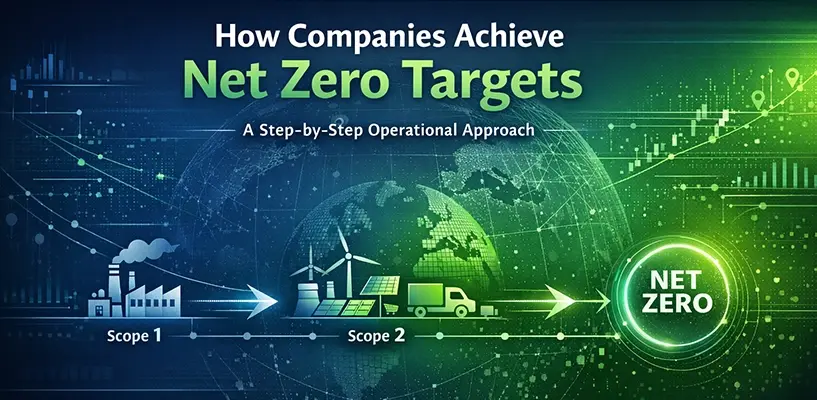
Companies achieve net zero targets by working through their emissions in a practical order rather than treating it as a single goal. They start by cutting fuel use in operations, improving electricity sources through renewables, and fixing inefficiencies inside plants and fleets.
Attention then shifts to the supply chain where most emissions sit across materials, suppliers, logistics, product use, and end of life handling. Only after these reductions are in place do companies use verified carbon removal to address the small portion that cannot be eliminated. Progress is tracked through consistent data, reporting, and internal accountability.
What Does Net Zero Mean for Companies?
Net zero refers to a state where a company reduces its greenhouse gas emissions across operations and value chains as far as possible and balances the remaining residual emissions through verified carbon removal. This concept differs from zero emissions, which implies no emissions at all, and from carbon neutral, which often relies more heavily on offsets.
A corporate net zero strategy follows a reduction first principle. Companies are expected to decarbonize energy use, operations, logistics, and supply chains before considering credits. Global frameworks and reporting standards now align around this principle, making reduction the foundation of any credible net zero roadmap for companies.
Why Companies Are Committing to Net Zero Targets?
Organizations are adopting structured net zero roadmap for companies because emissions performance now affects compliance exposure, investor trust, and operational resilience.
Regulation
Governments increasingly mandate climate disclosures and emissions accounting across Scope 1, Scope 2, and Scope 3. Regulations require traceable data and verifiable progress.
Investor pressure
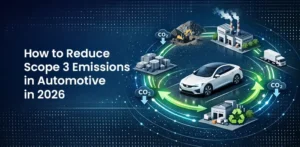
Investors evaluate long term risk based on emissions exposure, especially scope 3 emissions reduction across supply chains.
Customer expectations
Enterprise buyers prefer suppliers that align with their own corporate net zero strategy and reporting obligations.
Risk management
Reducing dependency on fossil energy and inefficient logistics reduces operational and financial risks.
Cost efficiency
Energy efficiency, renewable power, and optimized logistics reduce long term operating costs.
How to achieve Net Zero Targets?
How companies achieve net zero targets is not a pledge. It is a sequence of operational decisions that change where emissions originate, how they are measured, and how they are governed across Scope 1, Scope 2, and Scope 3.
Step 1 — Measure and Map Emissions Across Scope 1, 2, and 3
Net zero begins when a company stops estimating emissions and starts locating them.
What this step involves
- Identify where fuel is burned inside operations and fleets
- Identify how much electricity is purchased and from which source
- Map suppliers, logistics partners, and product use that create Scope 3 emissions
- Replace industry averages with primary data wherever possible
- Create a baseline that future reduction can be measured against
| Scope | Emission Source Examples | Typical Ownership |
| Scope 1 | Fuel combustion, fleets | Direct |
| Scope 2 | Purchased electricity | Indirect |
| Scope 3 | Suppliers, logistics, product use | Value chain |
If emissions are not mapped to real activities, reduction efforts remain theoretical and reporting becomes weak during audits.
Step 2 — Set Science Based and Time Bound Targets
Once emissions are visible, targets define how fast they must fall.
What this step involves
- Align reduction pace with science based targets SBTi
- Break long term goals into interim yearly milestones
- Assign responsibility across procurement, operations, and logistics teams
- Link performance reviews and governance to emissions progress
Without time bound targets, emissions reduction becomes a sustainability narrative instead of an operational mandate.
Step 3 — Reduce Emissions Across Operations and Supply Chains
This is where the corporate net zero strategy becomes practical.
| Area | Example Actions | Emissions Impact |
| Energy | Renewable sourcing | Scope 2 |
| Fleet | Electrification | Scope 1 |
| Suppliers | Engagement programs | Scope 3 |
| Logistics | Route optimization | Scope 3 |
What this step involves
- Shift electricity to renewable sources
- Electrify fleets and equipment that burn fuel
- Work with suppliers to lower material and component emissions
- Optimize transport routes and modes to reduce fuel use
Most companies discover that Scope 3 emissions reduction depends more on procurement and logistics decisions than on factory upgrades.
Step 4 — Neutralize Residual Emissions Through Carbon Removal
Even after reduction, some emissions remain tied to complex supply chains and legacy systems.
What this step involves
- Identify emissions that cannot be removed immediately
- Use high quality carbon removal credits only for this portion
- Select credits with strong registry backing and verification standards
- Avoid using credits as a substitute for reduction
Using credits before reducing emissions leads to greenwashing risk and weak net zero credibility.
Step 5 — Track, Report, and Govern Progress
Net zero fails when data cannot be defended during reporting or audits. What this step involves
- Maintain digital records of energy use, supplier data, and logistics emissions
- Ensure documentation is audit ready and time stamped for carbon credits
- Integrate emissions tracking into ESG reporting systems
- Maintain traceability across Scope 1, 2, and 3 records
If data continuity is missing, reported emissions reductions cannot be verified, which undermines the entire net zero roadmap for companies.
Step summary
- Locate emissions across Scope 1, 2, and 3
- Set science based targets with accountability
- Reduce carbon emissions through energy, fleet, supplier, and logistics actions
- Use carbon removal only for residual emissions
- Maintain traceable records to support reporting and governance
How Digital Traceability Supports Net Zero Execution and How MMCM Supports This?
Net zero plans often fail at the reporting stage, not at the intention stage. Companies reduce energy use and engage suppliers, but when asked to prove Scope 3 reductions, they rely on estimates, averages, and declarations. This creates audit risk.
Digital traceability solves this by connecting operational actions with emissions evidence.
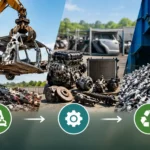
At the vehicle end of life stage, a registered vehicle scrapping facility does more than dismantle vehicles. It generates records for intake verification, depollution, dismantling sequence, material segregation, and certificate issuance. When these steps are captured in a digital system, they become traceable lifecycle evidence.
MMCM supports this through an end-to-end solution for rvsf where AutoLoop records each operational step inside the facility. DigiELV links the scrapped vehicle to a valid Certificate of Deposit, ensuring legal and operational continuity.
This creates a material map. Recovered steel, aluminum, and plastics can be linked back to a specific vehicle and forward into manufacturing supply chains. More than forty dMRV data points and blockchain backed records make this data audit ready.
For every one ton of ELV recycled through this system, about 0.6 tons of CO2e savings can be quantified. These records also support issuance of circularity linked elv carbon credits that are based on actual recovery evidence.
This approach replaces estimated Scope 3 reporting with primary data tied to real operations, reducing greenwashing risk and strengthening net zero governance.
Conclusion
Understanding how companies achieve net zero targets requires recognizing that net zero is a process rather than a declaration. Measurement across Scope 1, Scope 2, and Scope 3, alignment with science based targets SBTi, operational reduction, and disciplined use of carbon removal form the core of a credible corporate net zero strategy.
Transparent reporting supported by traceable data ensures that emissions claims are defensible and audit ready. Organizations that combine reduction, governance, and lifecycle visibility build a practical net zero roadmap for companies that aligns operations, supply chains, and long term climate commitments.
FAQs
1. What does net zero mean for a company?
Ans: Net zero means a company reduces greenhouse gas emissions across Scope 1, Scope 2, and Scope 3 as much as possible, then balances only the remaining unavoidable emissions using verified carbon removal, supported by transparent measurement, reporting, and governance systems.
2. How much emissions must companies reduce before offsetting?
Ans: Companies are expected to reduce around ninety percent of total emissions across operations and value chains before using carbon removal for the remaining residual portion that cannot be technically or economically eliminated in the near term.
3. What are Scope 1, 2, and 3 emissions?
Ans: Scope 1 covers direct emissions from owned sources. Scope 2 includes purchased electricity. Scope 3 includes emissions from suppliers, logistics, product use, and end of life activities across the value chain.
4. How long does it take to achieve net zero?
Ans: Achieving net zero is a long term process that can take decades, depending on infrastructure changes, supplier alignment, technology adoption, regulatory shifts, and the maturity of emissions measurement and reporting systems.
5. Are carbon credits required for net zero?
Ans: Carbon credits are not the starting point but become necessary for neutralizing residual emissions after substantial internal reductions, provided they meet strict quality, verification, and registry standards for credibility.
6. What is the difference between carbon neutral and net zero?
Ans: Carbon neutral often relies on balancing emissions with offsets, while net zero requires deep emissions reductions across all scopes first and uses carbon removal only for the final unavoidable emissions.
7. How can companies reduce Scope 3 emissions?
Ans: Companies reduce Scope 3 emissions through supplier engagement, sustainable material sourcing, logistics optimization, product efficiency improvements, and proper end of life recycling supported by reliable data tracking.
8. What is a science-based target?
Ans: A science based target is an emissions reduction goal aligned with climate science, typically validated by SBTi, ensuring reductions are consistent with limiting global temperature rise within accepted thresholds.
9. How can progress toward net zero be measured?
Ans: Progress is measured through consistent emissions accounting, supplier data integration, digital monitoring systems, audit ready documentation, and periodic disclosure aligned with ESG and regulatory reporting frameworks.
10. What are common challenges in achieving net zero?
Ans: Challenges include limited supplier visibility, data gaps in Scope 3 emissions, high transition costs, technology constraints, regulatory complexity, and difficulty maintaining accurate, traceable reporting across value chains.