
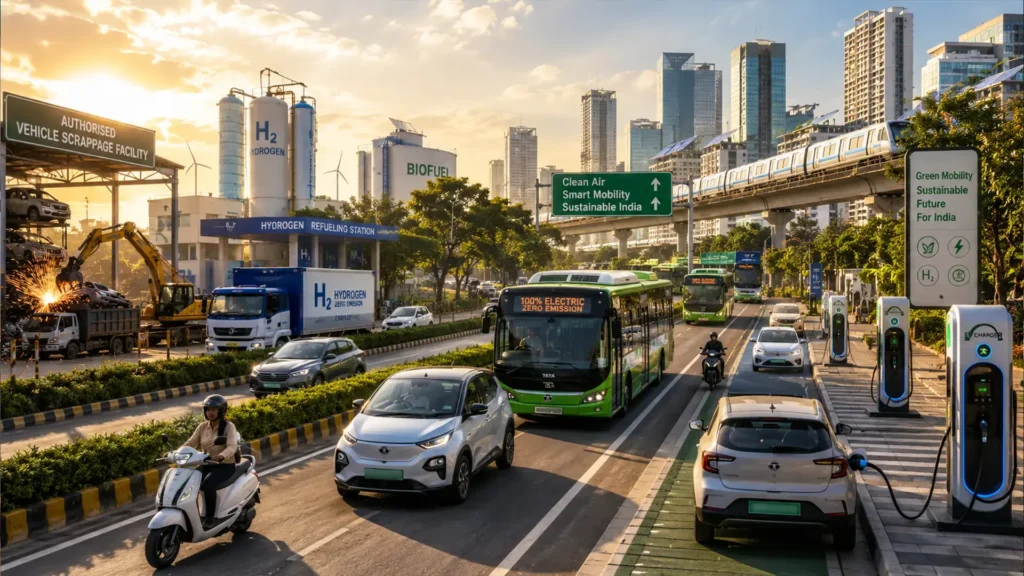
Green mobility in India refers to the shift from fossil fuel-powered transportation to cleaner, lower-emission alternatives, primarily electric vehicles, biofuels, and green hydrogen. The strategy is driven by three converging pressures. Road transport contributes over 13 percent of India’s greenhouse gas emissions, urban air quality is deteriorating in major cities, and import dependence on crude oil creates a structural energy security risk. The government’s stated target is 30 percent EV penetration across vehicle categories by 2030, supported by a charging infrastructure build-out of over 100,000 public stations and capital schemes such as PM E-DRIVE and FAME-II.
The transition is not a single-track EV story. It is a multimodal, multifuel approach that recognises the scale and diversity of the country’s vehicle fleet. EVs are the long-term direction for light-duty vehicles, biofuels remain essential for commercial fleets that cannot electrify quickly, and green hydrogen is emerging as the answer for heavy-duty long-haul transport.
What Green Mobility Means and Why India Needs It
Green mobility describes transportation systems that reduce greenhouse gas emissions, air pollution, and fossil fuel dependency through cleaner vehicles, cleaner fuels, and the infrastructure to support both. The case for India is structural, not aspirational.
The Emissions Picture
Road transport is responsible for over 13 percent of India’s greenhouse gas emissions, and Indian cities consistently rank among the most polluted globally. Private vehicle growth keeps adding to congestion, fuel consumption, and urban air quality stress, which is why the central and state response is now layered across regulation, capital, and infrastructure rather than any single lever.
The Energy Security Case
India runs one of the world’s largest oil import bills. Reducing the transport sector’s dependence on crude reduces both emissions and economic exposure to global price shocks. Green mobility policy India direction therefore sits at the intersection of climate policy, industrial strategy, and trade balance, not just environmental policy.
Key Government Policies Driving Green Mobility
The active national schemes give the green mobility transition its capital base. The table below covers the major frameworks and what each one funds.
| Scheme | Focus Area | Scale |
| PM E-DRIVE | EV adoption and charging | Rs 10,900 crore over 2024 to 2026; 72,300 chargers |
| FAME-II | EV demand subsidy | Rs 11,500 crore total outlay |
| ACC Battery PLI | Domestic battery manufacturing | Rs 18,100 crore for 50 GWh capacity |
| Vehicle Scrappage Policy | Retiring old high-emission vehicles | Notified 2021, RVSF network active |
| National Green Hydrogen Mission | Heavy-duty hydrogen mobility | Rs 19,744 crore outlay; 5 MMT by 2030 |
| Battery Waste Management Rules | EV battery recycling | 70 percent target by 2024-25 rising to 90 percent post 2026-27 |
GST on EVs has been reduced to 5 percent from 12 percent, and several states layer road tax waivers on top. The funding gap that matters most is the post-2030 framework: stable long-term policy beyond the current decade is what manufacturers and investors are still waiting for.
EV Adoption in India: Where Things Stand
The electric vehicles India 2025 numbers are clearer now than at any point in the transition. Adoption is real, infrastructure is lagging, and barriers cluster around cost, charging, and grid quality.
Market Size and Growth
India’s EV sector grew 24.5 percent to 1.9 million units in 2024, reaching about 7.5 percent market penetration per Vahan data, the headline electric vehicles India 2025 milestone. Two and three wheelers lead the volume curve, particularly in tier-2 cities and smaller towns.
- 1.9 million EVs sold in 2024 across all segments
- Two and three wheelers account for the majority of registrations
- World Resources Institute estimates 10 million metric tons of CO2 cut between 2020 and 2024 through EV adoption India figures confirm
Charging and Grid Readiness
Public charging grew from 1,800 stations in 2022 to over 27,737 in March 2026. The ratio still sits at one public charger per 235 EVs against a global benchmark of one per 6 to 20.
- 25,000 to 35,000 new charging stations targeted in 2025
- 100,000 to 150,000 public stations expected by 2030
- Battery swapping is emerging as a complementary route for two and three wheelers
Remaining Barriers
High upfront vehicle cost relative to ICE equivalents, range anxiety in semi-urban areas, grid reliability gaps, and standardisation across charging networks are the four binding constraints. The carbon and cost trade-offs across these variables are detailed in how to reduce automotive carbon emissions.
Which States Are Leading EV Adoption
State policy differentiation has produced a clear leader board. Delhi, Maharashtra, Karnataka, Tamil Nadu, and Uttar Pradesh have used registration fee waivers, road tax exemptions, and EV-friendly building codes to push faster adoption inside their borders.
- Delhi runs the lowest EV electricity tariff and a fast-charger-every-5-km target.
- Maharashtra mandates chargers every 25 km on state highways and EV-ready infrastructure in commercial and housing complexes.
- Karnataka has built the Bengaluru-Mysore and Bengaluru-Chennai charging corridors.
- Tamil Nadu is the only state where roughly 90 percent of public chargers sit within 1 km of a highway.
- Uttar Pradesh has the highest absolute EV registrations driven largely by the e-rickshaw segment.
Beyond EVs: Biofuels, Hydrogen, and the Multifuel Approach
India’s existing fleet of over 300 million ICE vehicles cannot be replaced overnight, which is why clean mobility India strategy runs on three parallel tracks rather than one. The broader sustainability in automotive industry trajectory depends on each track scaling on its own clock, and the green mobility policy India framework now reflects that explicitly.
Biofuels
Diesel will remain dominant for buses and heavy goods vehicles for the rest of this decade, and biofuels provide a transitional emissions cut without fleet replacement.
- India targets 20 percent ethanol blending in petrol by 2025-26 (currently around 12 percent)
- Bio-jet fuel targets sit at 1 percent by 2027 and 2 percent by 2028
- The Global Biofuels Alliance launched in 2023 anchors international cooperation
Green Hydrogen
The National Green Hydrogen Mission targets 5 million metric tonnes annually by 2030 with 60 to 100 GW of electrolyser capacity. Hydrogen’s energy density and refuelling speed make it the leading candidate for medium and heavy commercial vehicles.
- Tata Motors and Ashok Leyland are developing hydrogen vehicles
- Reliance, BPCL, and HPCL are building refuelling infrastructure
- Strategic Interventions for Green Hydrogen Transition adds Rs 17,500 crore for electrolyser manufacturing
Hybrid Vehicles
Hybrids are the fastest-growing transitional segment with a projected CAGR above 18 percent in passenger vehicles. They offer up to 35 percent higher fuel efficiency than ICE without range anxiety. The current 28 percent GST plus cess (43 percent total tax) limits scale, and broader policy support is what would change the curve.
How Vehicle Scrapping Supports Green Mobility in India
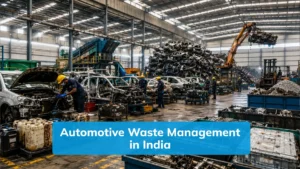
Sustainable transportation India coverage usually focuses on what enters the fleet. Equally important is what exits it. Aged vehicles emit significantly more particulate matter and NOx per kilometre than current BS6 vehicles, and they account for a disproportionate share of urban air pollution. Retiring those vehicles through authorised channels is a supply-side intervention that complements every demand-side scheme listed above. The mechanism and incentives are documented in the vehicle scrappage policy in India.
The Certificate of Deposit issued by a Registered Vehicle Scrapping Facility entitles the owner to a purchase rebate on a new vehicle, which directly reduces the upfront cost barrier to EV adoption. Authorised RVSFs also handle batteries from EVs reaching end-of-life under the Battery Waste Management Rules, closing the recovery loop on critical minerals and feeding the circular economy in automotive industry. ELV carbon credits generated through dMRV-verified scrappage allow OEMs to offset Scope 3 emissions from legacy fleets, which makes retirement of a polluting vehicle visible inside corporate sustainability reporting and detailed under end of life vehicles in India workflows.
Conclusion
India’s green mobility transition is one of the largest industrial and infrastructure shifts the country has attempted. The scale is real: 1.9 million EVs sold in 2024, more than 27,000 public chargers as of early 2026, and policy commitments spanning EVs, biofuels, hydrogen, and battery recycling. The transition is not only about what enters the fleet, though; it is equally about what exits.
Retiring high-emission vehicles through authorised scrapping removes the most polluting assets, creates incentives for new clean vehicle purchases, recovers critical battery materials, and generates carbon credits for OEMs. A credible green mobility plan needs both ends working, and organised scrapping is the end that does not get enough attention in mainstream coverage.
FAQs
What is green mobility in India?
Green mobility in India, also known as clean mobility India, is the shift from fossil fuel transportation to cleaner alternatives including electric vehicles, biofuels, and green hydrogen. The strategy targets 30 percent EV penetration by 2030 alongside ethanol blending, hydrogen mobility for heavy vehicles, and authorised scrapping of older vehicles.
What is India’s EV penetration target by 2030?
India targets 30 percent EV penetration across all vehicle categories by 2030 under the EV30@30 initiative. It covers passenger cars, two-wheelers, three-wheelers, and commercial vehicles, supported by PM E-DRIVE, FAME-II, the ACC Battery PLI scheme, and over 100,000 public charging stations.
What is the PM E-DRIVE scheme?
PM E-DRIVE is India’s EV demand and infrastructure scheme launched in 2024 with an outlay of around Rs 10,900 crore. It funds EV subsidies for two-wheelers, three-wheelers, e-buses, and trucks, and allocates Rs 2,000 crore for 72,300 charging stations across 50 highway corridors.
Which states have the highest EV adoption in India?
Delhi, Maharashtra, Karnataka, Tamil Nadu, and Uttar Pradesh lead EV adoption India by registrations and policy support. Uttar Pradesh has the highest absolute count driven by e-rickshaws. Delhi runs the lowest EV electricity tariff and the densest fast-charger target.
What is the National Green Hydrogen Mission?
The National Green Hydrogen Mission, notified in 2023, targets 5 million metric tonnes of green hydrogen annually by 2030 with 60 to 100 GW of electrolyser capacity. Outlay sits at Rs 19,744 crore. The mission focuses on heavy-duty mobility, refining, fertiliser, and industrial use.
How does vehicle scrapping support green mobility?
Authorised vehicle scrapping retires high-emission older vehicles, recovers materials including battery minerals, and issues a Certificate of Deposit that gives owners a purchase rebate on a new vehicle. The policy reduces fleet emissions and lowers the cost barrier to EV adoption simultaneously.
What is India’s ethanol blending target?
India targets 20 percent ethanol blending in petrol by 2025-26, currently around 12 percent. The biodiesel target is 5 percent by 2030, and bio-jet fuel targets 1 percent by 2027 rising to 2 percent by 2028. India is the world’s third-largest ethanol producer.