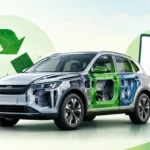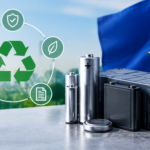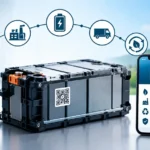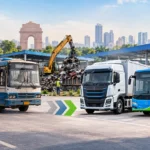

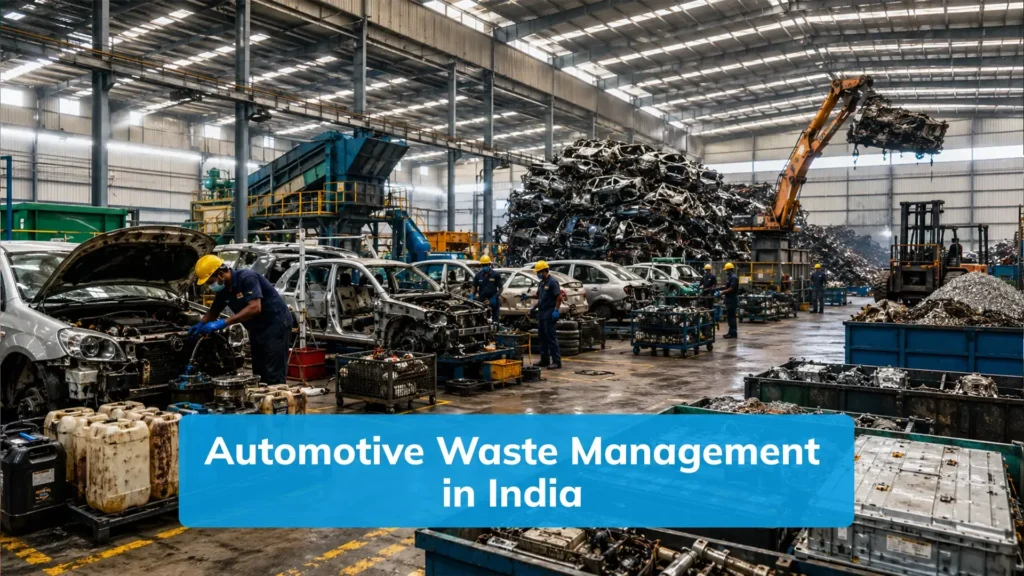
Automotive waste management in India is the system that governs what happens to a vehicle and its hazardous contents once it stops being roadworthy. It covers fluid drainage, dismantling, material recovery, and the documentation that tracks every step. The waste itself ranges from used motor oil and refrigerants to lead-acid batteries, lithium-ion cells, catalytic converter metals, and the bulk steel that forms the body shell.
The reason this sector matters in 2026 is scale. India holds more than 200 lakh vehicles already past their operational end-of-life, plus a fast-growing EV fleet whose batteries will reach retirement within a decade. Until recently most of that volume flowed through informal scrap markets that operated outside environmental control. The ELV rules India 2025 closed that gap by making formal scrapping the only legally compliant pathway for OEM EPR targets.
What Counts as Automotive Waste
Automotive waste splits into two operational buckets. In-service waste comes from workshops and fleet operators while a vehicle is still on the road: used engine oil, spent coolant, brake fluid, refrigerants, replaced filters, and worn tyres. End-of-life waste is the larger and more hazardous category, and it is what comes out when a vehicle is dismantled at retirement.
End-of-life waste is mixed by design. A single retired vehicle holds metals, plastics, glass, rubber, electronic modules, hazardous fluids, an energy storage system, and pyrotechnic airbag inflators. Each stream sits under a different rule and a different licensed processor. Steel goes to mills, refrigerants to certified destruction, catalytic converters to platinum-group-metal recovery, lithium-ion cells to battery recyclers, and shredder residue to co-processing or controlled disposal.
There is no single end pathway, which is why categorising the waste at the source matters more than any downstream optimisation. The full taxonomy is laid out in end of life vehicles in India.
Regulatory Framework Governing Automotive Waste
Four regulations now define the legal envelope around vehicle scrapping waste India operations. Each closes a gap the others do not, and reading them together is the only way to understand the compliance architecture.
ELV Rules 2025
Notified on 6 January 2025, the rules introduce binding EPR for vehicle OEMs. Producers carry annual ELV collection and recycling targets that count only when met through Registered Vehicle Scrapping Facilities. Informal scrapping no longer qualifies for EPR.
- Annual OEM targets monitored against DigiELV records
- ELV processing must occur only at registered RVSFs
- Backlog of 200 lakh+ vehicles formally addressed
Vehicle Scrappage Policy 2021
The Scrappage Policy created the RVSF licensing framework under MoRTH and set fitness thresholds: commercial vehicles over 15 years and personal vehicles over 20 years must pass automated tests. It also introduced the Certificate of Deposit and DigiELV registry. The mechanics are in vehicle scrappage policy in India.
- Fitness thresholds for commercial and personal vehicles
- CoD as proof-of-scrappage instrument
- DigiELV linked to VAHAN for national tracking
Battery Waste Management Rules 2022
Battery waste sits under a separate EPR regime with rising recycling targets (70 percent by 2024-25, 90 percent after 2026-27) and recycled-content mandates (5 percent by 2027-28, 20 percent by 2030-31) for new battery manufacturing. The technical pathway is in EV battery recycling in India.
- Recycling targets rising to 90 percent
- Recycled-content phase-in from 2027-28
- Direct EPR on battery producers
Hazardous Wastes Rules 2016
The Hazardous and Other Wastes Rules govern every fluid stream generated during de-pollution. Each fluid moves through licensed handlers under documented manifests, and refrigerant venting is prohibited.
- Manifest tracking from drain to final processor
- Licensed handlers for every fluid stream
- Refrigerant recovery mandatory
How an RVSF Processes a Vehicle
A compliant Registered Vehicle Scrapping Facility runs a five-stage workflow that moves a vehicle from intake to material output without losing track of any waste stream. Documentation runs in parallel at every stage. The full operational specification is in what is registered vehicle scrapping facility.
Intake and Verification
Intake validates the vehicle against VAHAN before any work begins. Staff confirm ownership, run blacklist and hypothecation checks, register the vehicle on DigiELV, and assign a unique ELV identifier that follows the vehicle through every later stage. Physical condition is logged with photos and weighbridge entries.
Depollution
Depollution is the most safety-critical stage. Fluids are drained in sequence into labelled hazardous-class HDPE containers, refrigerant is recovered using certified equipment, and the lead-acid or lithium-ion battery is removed and segregated for downstream handling. Pyrotechnic airbag inflators are deployed or removed under controlled procedure.
Component Removal
Reusable parts are stripped from the depolluted shell: tyres, alternators, starters, electronic control units, lights, and seats. Remanufacturable cores such as engines, gearboxes, and turbochargers are graded and routed to remanufacturing channels. Catalytic converters are pulled separately for PGM recovery, which is one of the highest-value flows in the entire process.
Hulk Shredding and Material Separation
The depolluted shell is shredded and output is sorted by material class. Approximately 754 kg of steel comes out of a typical passenger vehicle. Non-ferrous metals route to secondary smelters, plastics and glass to their own processors, and shredder residue to co-processing or controlled disposal.
Documentation and Certificate Issuance
Once outputs are logged, the Certificate of Deposit is issued to the vehicle owner as proof of compliant scrapping. The DigiELV record is updated, the vehicle is deregistered from VAHAN, and waste manifests are filed for audit. AutoLoop captures the dMRV data points across all five stages, which becomes the basis for any downstream carbon accounting under the Cercarbono methodology.
Where RVSF India Waste Management Still Struggles
Regulation has moved faster than infrastructure, and four structural gaps still slow the transition from informal to formal handling.
Informal Sector Dominance
The majority of ELVs in India still flow through informal dismantlers who skip depollution and strip batteries without protocol. Their pricing edge comes from avoiding compliance cost, not from operational skill.
- Higher upfront cash to vehicle owners
- Fluid leaks to soil and groundwater
- Uncontrolled battery and refrigerant handling
Low RVSF Density
Operational RVSFs concentrate in metro corridors. A vehicle owner in a tier-3 city often has no compliant facility within reasonable logistics distance, which pushes volume back to informal channels and undermines automotive EPR India targets at the OEM level.
EV Battery Capacity Lag
Lithium-ion recycling capacity in India is scaling but trails the EV fleet’s projected retirement curve. Targets are aggressive, but certified processing capacity has not caught up.
EPR Implementation Detail
OEMs need clearer audit guidance on how ELV targets are calculated, reconciled, and verified across facilities. Ambiguity slows compliance planning even where intent is fully in place.
Material Recovery from India’s ELV Waste Stream
Automotive waste is feedstock that has not yet been organised. A formalised ELV pipeline supplies meaningful volumes of secondary steel, aluminium, copper, and battery-grade minerals back into Indian manufacturing, which reduces import dependence on critical minerals and supports the National Critical Minerals Mission 2025. The same volumes also cut upstream emissions tied to virgin material production, which is why end of life vehicle management India connects directly to circular economy in automotive industry.
Conclusion
End of life vehicle management India has shifted from a peripheral compliance topic to a strategic sector with direct implications for critical mineral security, transport emissions, public health, and EV transition credibility. The ELV rules India 2025 and the 2021 Scrappage Policy provide the regulatory architecture, RVSFs provide the operational unit, and dMRV-backed records provide the auditability that downstream stakeholders now demand. The remaining work is physical: more compliant facilities, more lithium-ion recycling capacity, clearer audit guidance for automotive EPR India, and consumer education to redirect informal flows.
FAQs
What is automotive waste management?
Automotive waste management covers collection, de-pollution, dismantling, material recovery, and disposal of waste from vehicles during operation and at end-of-life. It spans hazardous fluids, lead-acid and lithium-ion batteries, catalytic converters, plastics, glass, and bulk metals. India regulates it through ELV, Battery Waste, and Hazardous Wastes Rules.
What are the ELV Rules 2025 in India?
The Environment Protection ELV Rules 2025 introduce mandatory EPR for vehicle OEMs. They require ELVs to flow only through Registered Vehicle Scrapping Facilities for compliance purposes. The rules also define what compliant de-pollution, dismantling, and material recovery look like at facility level.
What is Extended Producer Responsibility in automotive waste?
EPR places legal duty for collecting and recycling ELVs on the OEM that produced them. OEMs must meet annual collection and recycling targets through RVSF channels. Targets are monitored through DigiELV records and audited against scrappage data captured at the facility.
How are hazardous fluids managed at scrapping facilities?
Fluids are drained in sequence into labelled hazardous-class containers and shipped to licensed handlers under manifest tracking. Refrigerant recovery is mandatory because venting is prohibited under the Montreal Protocol and the 2016 Hazardous Wastes Rules. RVSFs document every fluid stream from drain point to final processor.
What happens to EV batteries at end-of-life vehicle?
Lithium-ion packs are removed during depollution, tested for capacity, and routed either to second-life applications or to certified recyclers under the Battery Waste Management Rules 2022. Recycling targets rise from 70 percent by 2024-25 to 90 percent after 2026-27, with recycled-content mandates phasing in.
How much steel is recovered from a scrapped vehicle?
A typical passenger vehicle yields approximately 754 kg of steel after depollution and shredding. Non-ferrous metals like aluminium and copper are recovered separately. Recovered steel displaces virgin steel at Indian mills, which avoids the upstream carbon and energy intensity of primary steelmaking.
Why is informal vehicle scrapping a problem in India?
Informal scrapping skips depollution, leaks fluids into soil, vents refrigerants, and strips batteries without protective protocol. Workers face direct exposure, vehicle owners receive no Certificate of Deposit, and OEMs cannot count those vehicles toward EPR targets.