
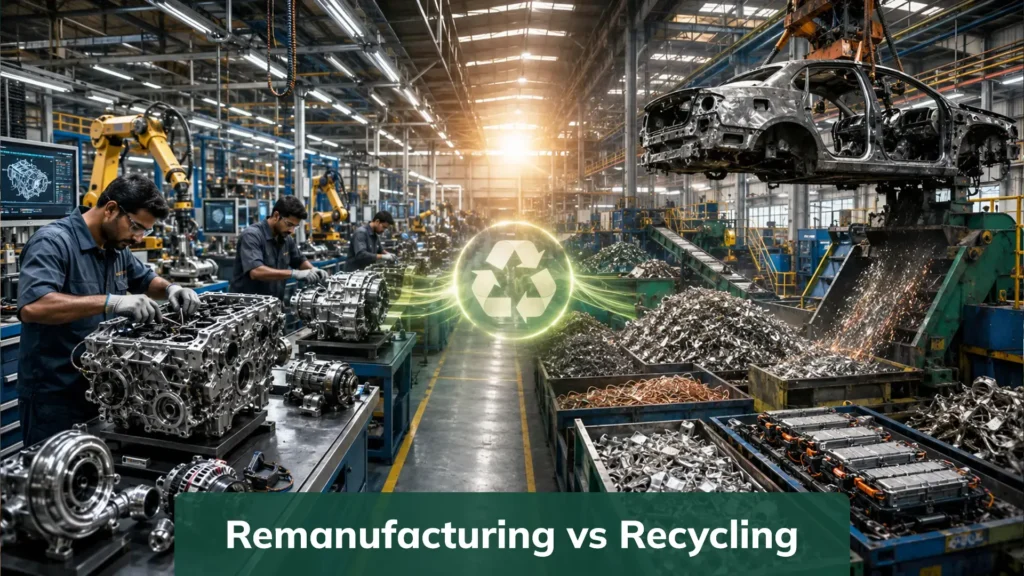
Remanufacturing and recycling are both circular economy processes, but they sit at different rungs of the value hierarchy. Remanufacturing rebuilds a used component back to original equipment specifications and returns it to service as a working part. Recycling breaks the component or vehicle down to base materials that re-enter manufacturing as feedstock. The first preserves embedded engineering and energy; the second recovers what the engineering can no longer provide.
In India both pathways now sit on the same infrastructure. The Vehicle Scrappage Policy of 2021 created the Registered Vehicle Scrapping Facility framework, which gives remanufacturers a formal source of cores and recyclers a formal source of scrap. The distinction matters in practice because the choice between rebuilding a part and shredding it decides how much embedded value is retained. Read this blog to understand why authorised scrapping is the upstream condition that controls what either pathway can deliver.
What Is Remanufacturing in the Automotive Industry
Automotive remanufacturing India operations restore a used component to its original engineering specification, with a warranty equivalent to a new part. It is not a fix-it repair, and it is not refurbishment. Remanufacturing involves complete disassembly, replacement of any sub-component outside tolerance, and final functional testing on the same equipment used for new units.
The standard reman sequence runs core acquisition, complete disassembly, deep cleaning to remove combustion residue, dimensional inspection against original tolerances, machining or replacement of any out-of-spec sub-component, reassembly to OEM build sheets, and end-of-line testing. Engines, gearboxes, turbochargers, alternators, starters, electronic control units, steering racks, and brake callipers are the parts that move through this pipeline at scale. Components that clear all stages leave the facility indistinguishable from new in performance and warranty terms.
The environmental case for remanufacturing comes from preserving embedded energy. Building a new engine block consumes the energy of mining ore, smelting iron, casting, machining, and shipping. Automotive remanufacturing in India keeps most of that work intact, which delivers roughly 80 percent energy savings against producing the same component new.
The global automotive sector avoids over 800 kilotons of CO2 annually through reman, and reman volume sits at about two-thirds of all global remanufacturing activity, a benchmark referenced in automotive lifecycle emissions modelling.
What Is Automotive Recycling and How It Works
Vehicle recycling India operates one rung below the value hierarchy. It dismantles the vehicle to recover materials rather than parts. Recycling reduces the vehicle and its sub-systems to base feedstocks: steel, aluminium, copper, plastics, glass, and the platinum-group metals embedded in catalytic converters.
Process Stages
The recycling process begins with depollution, which removes all hazardous fluids and recovers refrigerants under licensed protocol. Reusable parts in serviceable condition are then dismantled for the aftermarket. The depolluted shell is shredded, and the fragmented output is sorted by material class through magnetic separation for ferrous metals, eddy-current separation for non-ferrous, and density sorting for plastics, rubber, and glass.
Materials Recovered
A typical end-of-life passenger vehicle yields approximately 754 kg of steel, plus aluminium recovered from engine blocks and wheels, copper from wiring harnesses, and platinum-group metals from the catalytic converter that punch above their weight in per-kilogram value. EV battery packs add lithium, cobalt, and nickel to the recovery list, which is why pack handling is now a separate engineering discipline.
Remanufacturing vs Recycling: A Side-by-Side View
The two processes share a starting point and an ending purpose but diverge on every operational dimension in between.
| Dimension | Remanufacturing | Recycling |
| Output | Working component restored to OE spec | Raw materials returned to feedstock |
| Value retained | Form, function, embedded engineering | Material value only |
| Energy savings vs new | Approximately 80 percent | Significant for steel, lower for plastics |
| Warranty | Equivalent to a new part | Not applicable; output is feedstock |
| Typical scope | Engines, gearboxes, turbos, alternators | Whole vehicle shell, residue post-reman |
| Hierarchy position | Higher, value preservation | Lower, material recovery |
| Source dependency | High-quality cores | Any ELV regardless of condition |
The decision rule is direct: a component should be evaluated for reman first, and routed to recycling only when reman is no longer technically possible. Skipping reman for parts that can still be rebuilt is a value loss the downstream recycler cannot recover.
The same logic applies at scale across an OEM portfolio: every gearbox or turbocharger that bypasses reman and goes straight to shredding represents lost value in both the original engineering and the carbon already spent on its first manufacture.
Remanufacturing and Recycling in India’s Automotive Circular Economy
India sits at an early but accelerating point on both pathways. The regulatory frame is in place through the Vehicle Scrappage Policy and the Battery Waste Management Rules; supply-side infrastructure is the binding constraint. Reading each process separately clarifies where the gaps actually sit and where a stakeholder, whether OEM, fleet operator, or aftermarket player, can intervene to accelerate formalisation in their own segment.
Remanufacturing in India
The remanufactured auto parts India market is led by the commercial vehicle aftermarket, where engines, gearboxes, and fuel injection components have visible activity. Most of that activity sits outside formal certification, which means quality varies and warranty cover is uneven.
- Largely informal sector with limited standardised testing
- Core supply inconsistent due to absence of structured ELV dismantling
- OEM-led reman programmes nascent at scale in India
- Formalisation curve will follow RVSF network density
Recycling in India
The end of life vehicle recycling India ecosystem is being formalised through the vehicle scrappage policy in India, which sets the depollution and material recovery standards every RVSF must meet. Steel recovery is the most mature flow; battery recycling is the highest-growth one.
- Steel recycling industry well established at scale
- Battery Waste Management Rules 2022 set rising recycling targets
- Critical mineral recovery emerging from catalytic converters and EV packs
- Informal dismantling still holds significant market share
Where Authorised Vehicle Scrapping Fits in Both Processes
Both pathways depend on the same upstream condition: an end-of-life vehicle that has entered a formal, organised dismantling channel. That channel is the Registered Vehicle Scrapping Facility. The reason the RVSF sits at the intersection of reman and recycling is structural: the same technician who removes a turbocharger from a depolluted engine bay can either route it intact to a remanufacturer or send it to the shredder, and that single routing decision is what determines whether the turbo’s embedded engineering survives or is reduced to alloy feedstock.
Inside the RVSF, the same workflow enables both downstream paths. Depollution removes fluids and refrigerants safely, which is non-negotiable for either remanufacturing or recycling. Dismantling and grading separate components by condition: parts with intact structural integrity become cores for remanufacturers, while parts beyond functional restoration go to material recyclers.
Batteries are tested separately for second-life, remanufacturing, or full recycling depending on capacity and chemistry. The Certificate of Deposit issued at the end of the workflow becomes the traceability anchor that lets downstream players document material provenance.
Conclusion
Remanufacturing vs recycling is a complementary comparison and not of the competitive nature. Remanufactured auto parts in India preserves the maximum value embedded in a component and should always be evaluated first; recycling closes the loop when reman is no longer technically possible. Both pathways in India are constrained by the same upstream problem: until recently, the absence of a structured ELV dismantling pipeline, which the Vehicle Scrappage Policy and the RVSF network are now building.
As organised scrapping scales, core supply improves for remanufacturers and clean scrap improves for recyclers. The arc of India’s circular economy in the automotive industry ultimately depends on what happens at the dismantling stage.
FAQs
What is the difference between remanufacturing and recycling?
Remanufacturing restores a used component to original equipment specifications with a warranty equivalent to a new part. Recycling reduces the component or vehicle to base materials that re-enter manufacturing as feedstock. Reman preserves form and function; recycling preserves only material value.
What is automotive remanufacturing?
Automotive remanufacturing returns a used component to at least its original performance specification. It involves complete disassembly, deep cleaning, dimensional inspection, replacement of out-of-spec sub-components, reassembly to OEM build sheets, and end-of-line testing equivalent to a new unit.
Which is better, remanufacturing or recycling?
Reman sits higher in the circular economy hierarchy because it preserves embedded engineering and energy. A component should be evaluated for reman first and routed to recycling only when reman is technically not viable. Both are needed, but skipping remanufacturing for parts that can be rebuilt is a value loss.
What components are commonly remanufactured in India?
Engines, gearboxes, turbochargers, alternators, starters, electronic control units, steering racks, and brake callipers are the components with the most remanufacturing activity in India. The commercial vehicle aftermarket leads volume, especially in engines and fuel injection sub-assemblies.
How much energy does remanufacturing save versus new production?
Remanufacturing typically saves approximately 80 percent of the energy needed to produce the same component. The saving comes from preserving the embedded energy of original mining, smelting, casting, and machining work. The global automotive reman sector avoids over 800 kilotons of CO2 annually through this preservation.
What materials are recovered from end-of-life vehicles in India?
A typical passenger ELV yields approximately 754 kg of steel, plus aluminium, copper, platinum-group metals from the catalytic converter, and lithium, cobalt, and nickel from any EV battery pack. Steel is the largest stream by mass; PGMs and battery minerals are the highest-value per kilogram.
What is the role of RVSFs in automotive recycling?
Registered Vehicle Scrapping Facilities run the depollution, dismantling, and grading work that decides what flows into remanufacturing and recycling downstream. They also issue the Certificate of Deposit, which gives traceability for both pathways. RVSF quality directly decides the value the rest of the chain can recover.