
Carbon markets have become an important mechanism for reducing greenhouse gas emissions and supporting global climate action. These markets create systems through which emissions, emission reductions, and removals resulting from various greenhouse gas (GHG) mitigation activities can be assigned an economic value and, depending on the market, traded through defined mechanisms. Verified emission reductions or removals are termed as carbon credits, with each credit generally corresponding to one metric tonne of CO₂e. .
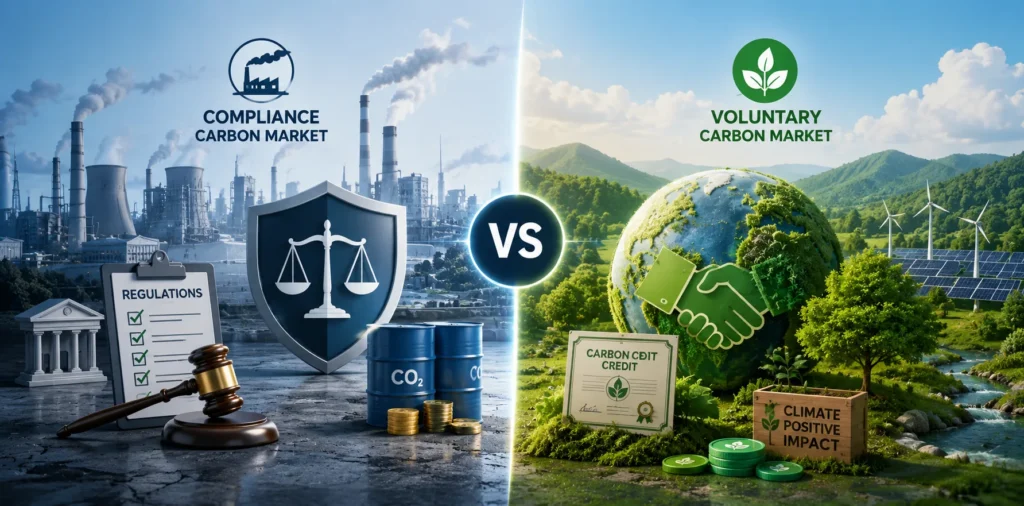
Two major types of carbon markets exist today: compliance carbon markets and voluntary carbon markets.
Compliance markets operate under government regulations that require certain entities to meet defined emission or emission-intensity obligations, while voluntary carbon markets allow organizations and individuals to develop emission reduction, avoidance or removal projects on a voluntary basis, and voluntarily purchase carbon credits to support climate action and, where appropriate, make claims in accordance with applicable rules and frameworks. A clear sense of how these two markets differ is key to building climate and sustainability strategies that actually work.
How Compliance Carbon Markets Work
A carbon compliance market is a regulated system where governments establish mandatory requirements for specified entities to manage their greenhouse gas emissions. Power producers, industrial plants, and manufacturing facilities must operate within these limits or face financial penalties.
Compliance carbon markets can operate through different mechanisms, depending on how the regulatory system is designed. Two common approaches are the “cap-and-trade” mechanism and “emission-intensity targets.”
Under a cap-and-trade system, the government sets a limit, or “cap,” on the total amount of emissions permitted from regulated entities. Companies receive or purchase emission allowances, with each allowance typically representing the right to emit one metric tonne of CO₂e. Companies that reduce their emissions and have surplus allowances can sell them, while companies that exceed their available allowances must purchase additional allowances. This creates a financial incentive to reduce emissions.
Under an emission-intensity-based system, companies are given a target for the amount of GHG emissions they can generate per unit of output, rather than a fixed limit on their total emissions. Companies that perform better than their assigned target may earn compliance units, while those that perform worse may need to purchase units to meet their obligation.
Different compliance carbon markets use different approaches. For example, the European Union Emissions Trading System (EU ETS) operates through cap-and-trade, while India’s Carbon Credit Trading Scheme (CCTS) compliance mechanism sets emission-intensity targets for specified obligated entities from a set of industries. Entities that outperform their targets may receive Carbon Credit Certificates, while entities that fall short may need to purchase or surrender certificates to meet their obligations..
Understanding how carbon credits work within this framework is critical for regulated industries managing compliance obligations.
| Component | Description |
| Regulatory Requirement | Government establishes mandatory requirements for covered entities |
| Target / Cap | May be an absolute emissions cap or an emission-intensity target, depending on the system |
| Units | Allowances or compliance certificates, depending on the market design |
| Trading | Participants can buy or sell eligible units according to market rules |
| Compliance | Covered entities must meet their applicable obligations or face consequences under the relevant regulations |
How Voluntary Carbon Markets Work
The voluntary carbon market is different from compliance markets, because participation is generally driven by organizational choice rather than mandatory legal obligation. Organizations may purchase carbon credits to meet their sustainability goals, fulfill ESG commitments, or address certain emissions .
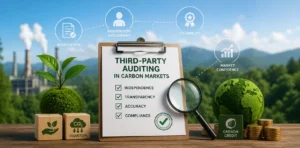
Carbon projects can generate credits representing quantified greenhouse gas (GHG) emission reductions or removals. These projects undergo validation and verification by independent third party auditors (VVBs), as per the applicable carbon standard and guidelines.
Standards and programmes such as Verra, Gold Standard, and Cercarbono, have systems for registering projects and tracking issued units.. These systems provide information such as project details, credit issuance, transfers, and retirement, helping maintain traceability throughout the lifecycle of a credit. The voluntary carbon market has a wide range of carbon credits in activities including nature based solutions, renewable energy, methane capture, and carbon removal technologies such as Direct Air Capture and Storage (DACCS). Once retired, these credits are permanently removed from the circulation to prevent double counting.
Sector specific innovations in carbon credits, such as ELV carbon credits generated from sustainably scrapping end of life vehicles at registered vehicle scrapping facilities (RVSFs) demonstrate how voluntary carbon markets can support emission reductions across different industries. .
| Step | Description |
| Project Development | Environmental projects reduce or remove greenhouse gas emissions using approved methodologies |
| Listing | The project is submitted to the applicable carbon programme and made available for review and stakeholder consultation, where required. |
| Validation | An independent third-party auditor (VVB) assesses whether the project design meets the requirements of the applicable carbon standard or programme. |
| Project Registration | Once the applicable requirements are met, the project is formally registered under the carbon programme. |
| Monitoring | The project collects and records data on its activities and emission reductions or removals in accordance with the approved monitoring plan and methodology. |
| Verification | Independent third party auditors verify the project’s implementation, monitoring data, calculations and reported emission reductions/removals |
| Credit Issuance | Once applicable requirements are met, credits are issued through carbon registries with unique serial numbers/identifiers |
| Purchase | Organizations and other participants buy credits voluntarily for permitted purposes |
| Retirement | Credits are permanently retired in the registry when they are used for a permitted claim or other purpose to prevent double counting of transfer or use |
Key Differences Between Compliance and Voluntary Carbon Markets
The difference between carbon markets goes beyond participation rules. They can differ in regulatory structure, pricing, participant profiles, and strategic purpose.
- Regulation versus voluntary participation: A compliance carbon market is built on legally binding obligations. Regulated industries cannot exit the system without incurring penalties. Voluntary markets are generally outside compliance regulations and entered into by choice and are often linked to corporate climate strategies or other voluntary climate action and regulated by associations like ICVCM (Integrity Council for the Voluntary Carbon Market)...
- Pricing and supply: Compliance market allowance prices are influenced significantly by regulation, market design, supply and demand, and the stringency of the applicable targets or cap. Voluntary carbon credit prices are also determined by demand and supply, but can vary substantially depending on project quality, credit quality, methodology, standard, and buyer preferences.
- Participant profiles: Regulated vs voluntary carbon markets attract different participants. Compliance markets primarily involve entities covered by the relevant regulation. Voluntary markets can involve corporations, financial institutions, logistics companies, NGOs, and individuals that voluntarily purchase or transact in carbon credits.
- Market objectives: Compliance markets are designed to achieve regulated emission reductions or meet mandatory climate or energy-policy objectives. Voluntary markets can provide finance for climate mitigation projects and support organizations in pursuing voluntary climate commitments.
| Feature | Compliance Carbon Market | Voluntary Carbon Market |
| Regulation | Government mandated | Voluntary participation |
| Purpose | Meet legal emission targets or caps | Support voluntary climate action and permitted climate claims |
| Participants | Regulated industries and other market participants | Companies, NGOs, institutions, individuals and other participants |
| Pricing | Influenced strongly by regulation, market design, supply and demand | Influenced by project characteristics, credit quality, supply and demand |
| Market Mechanism | Varies by jurisdiction, including cap and trade system or intensity-based systems | Primarily project-based crediting and trading |
Why Both Carbon Markets Are Important
The distinction between compliance and voluntary carbon markets matters, but both can contribute to broader climate action in different ways..
Compliance markets place legally binding requirements on specified sectors and entities , creating financial incentives for regulated companies to reduce their greenhouse gas emissions and improve their emissions performance.. India’s Carbon Credit Trading Scheme (CCTS) and the EU Emissions Trading System (EU ETS) are examples of compliance carbon markets, although they use different market mechanisms. These systems can drive emission reductions across covered industries by making emissions management part of regulatory compliance.
Voluntary carbon markets allow organizations to voluntarily support climate mitigation projects and purchase carbon credits for permitted purposes, including supporting climate commitments and, where appropriate, addressing certain value-chain emissions. For organizations pursuing net zero targets compliance markets and voluntary carbon markets can play complementary roles, with compliance markets addressing regulated emissions and voluntary markets supporting mitigation activities beyond their regulatory scope. .
Together, compliance and voluntary carbon markets can create complementary incentive structures for climate action. Compliance systems focus on emissions from the regulated entities at scale, while voluntary markets can support mitigation across areas beyond regulatory boundaries, including certain supply chain emissions, financed emissions, and sector specific opportunities such as automotive (end-of-life vehicle circularity) sector.
Conclusion
Compliance and voluntary carbon markets play distinct but complementary roles in global climate action. Compliance markets are regulated systems in which specified entities must meet mandatory emission or emission-intensity requirements, while voluntary carbon markets allow organizations and individuals to voluntarily register ghg mitigating projects and purchase carbon credits representing quantified emission reductions or removals.. Together, these markets create financial incentives for reducing greenhouse gas emissions, supporting climate mitigation projects, and accelerating the transition to a low carbon economy.
Understanding the distinction between compliance and voluntary systems is essential for organizations navigating emissions management and climate action . Whether meeting a regulatory obligation or participating in the voluntary carbon market, organizations should consider factors such as independent verification, registry traceability, and proper credit retirement to support the credibility and integrity of their climate actions .
FAQs
What is a compliance carbon market?
A compliance carbon market is a regulated system where specified entities must meet legally binding emission or emission-intensity requirements . Companies must stay within their allocated allowances or purchase additional ones. Examples include the EU ETS, California’s Cap and Trade Program, and India’s CCTS.
What is a voluntary carbon market?
A voluntary carbon market is a system where organizations and individuals voluntarily develop and register carbon projects, purchase and trade carbon credits representing quantified emission reductions or removals, and use or retire eligible credits for permitted climate-related purposes..
What is the difference between compliance and voluntary carbon markets?
The difference between carbon markets lies in participation, pricing, and purpose. Compliance markets are legally mandated with policy driven allowance pricing. Voluntary markets are entered by choice, with project based credits and market driven pricing. The compliance vs voluntary carbon market distinction also covers participant profiles and strategic climate objectives.
Who participates in compliance carbon markets?
Entities covered by the relevant regulation participate in compliance markets. Depending on the market, these may include power producers, industrial plants, oil and gas companies, and heavy manufacturing facilities etc..
Why do companies buy voluntary carbon credits?
Companies buy voluntary carbon credits to support climate mitigation projects and, where appropriate, support voluntary climate commitments or make claims consistent with applicable standards and guidance. The appropriate use of credits depends on the company’s climate strategy and the rules governing the relevant claim .
Are compliance carbon credits more expensive than voluntary credits?
Not necessarily. Prices vary significantly between markets and over time. Compliance-market prices are strongly influenced by regulation, market design, supply, demand, and the stringency of the applicable obligations. Voluntary carbon credit prices vary according to factors such as project type, quality, methodology, standard, supply, and buyer demand..
How do carbon markets help reduce emissions?
Carbon markets can create financial incentives for emission reductions and removals. Compliance markets do this through mandatory regulatory obligations and market mechanisms, while voluntary carbon markets can channel finance toward climate mitigation projects. The effectiveness of either system depends on its rules, market design, environmental integrity, and implementation..