
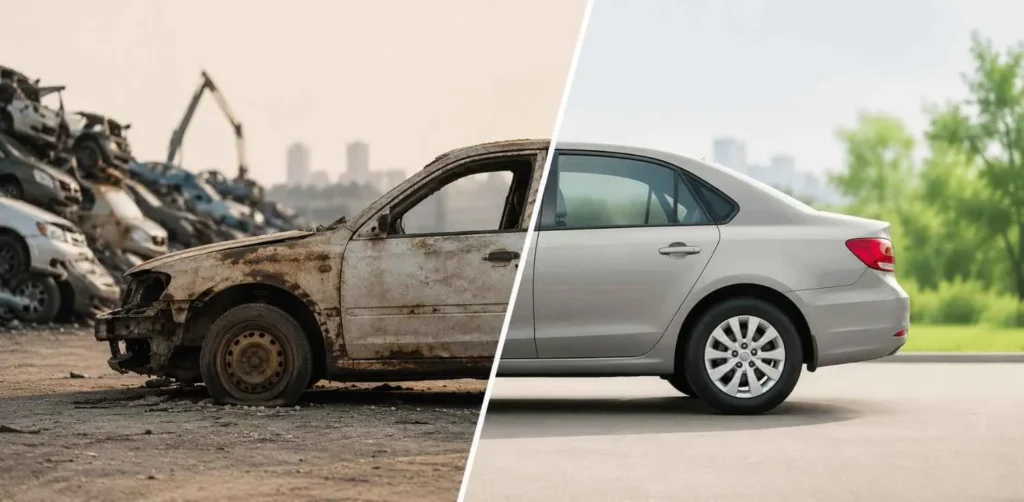
The choice between scrapping and selling comes down to one question: can the car still be driven legally and safely. If it can, selling almost always returns more money. If it cannot, because of its age, a failed fitness test, or repair bills that no longer make sense, scrapping is the better route.
Scrapping at an authorised Registered Vehicle Scrapping Facility (RVSF) also issues a Certificate of Deposit (CoD), which gives you a discount on your next vehicle plus waivers on registration and road tax in most states.
When You Should Sell Your Old Car
Selling works best when the car is still a usable asset to someone else. A buyer pays for a vehicle they can drive away and register without trouble, so the value sits in its condition, its age, and how much demand the model still has. Run through these points before you decide.
- It passes its pollution check and fitness test without needing major repairs first; the engine, body, and frame are sound, with no chassis damage pending.
- It is below the retirement age: 15 years for petrol, 10 for diesel in the National Capital Region (NCR) and similar restricted cities.
- The model still sells well. Mid-segment Maruti, Hyundai, and Honda cars hold value better than premium or commercial models of the same age.
- You can spare four to eight weeks for listings, test drives, haggling, and the Regional Transport Office (RTO) transfer paperwork.
If most of these hold true, selling is worth the effort. If most fail, the sale window has effectively closed, whatever price a listing might suggest.
When You Should Scrap Your Old Car
There are two separate reasons to scrap a car. The first is that the law leaves you no choice. The second is that the numbers no longer favour keeping or selling it. Either one on its own is enough.
When the Law Forces the Decision
Some vehicles simply cannot be sold for road use any longer, so scrapping becomes the only legal exit.
- It has crossed the retirement age under India’s vehicle scrappage policy: 15 years for petrol, 10 for diesel in NCR.
- It has failed its Automated Testing Station (ATS) fitness test, so the registration cannot be renewed for road use.
- It has chassis damage, heavy rust, or frame damage that a buyer’s inspection will catch.
- It keeps failing its pollution check because the engine and emission systems are worn past economical repair.
When the Money Favours Scrapping
Even a car that could technically find a buyer is sometimes worth more scrapped than sold.
- Repairs in the past year have already cost more than 40 percent of the car’s current value.
- The scrap total, metal value plus the Certificate of Deposit benefit, lands within 30 percent of the best sale price. At that point, speed and clean closure win.
- The car will not start or drive, so any asking price is theoretical; no serious buyer pays full value for a car they cannot test.
Scrap vs Sell: Side-by-Side Comparison
The two routes differ in more than price: in how long they take, how much paperwork falls on you, and when your legal responsibility ends. The table sets these differences side by side, with the rupee figures covered in the next section.
|
What matters |
Scrapping |
Selling |
| Time to close | 5 to 10 working days | 4 to 8 weeks |
| Paperwork on you | RC, identity proof, CoD from the facility | RC, Form 29, Form 30, NOC, insurance transfer |
| Vehicle condition needed | Any condition is accepted | Must pass a buyer’s inspection |
| When your liability ends | At deregistration from VAHAN | Only when the buyer files the transfer at the RTO |
| Insurance | Partial premium refund | You must transfer or cancel it yourself |
| What happens to the car | Depolluted and recycled under regulation | Keeps running with the same emissions |
| Government incentives | OEM discount plus tax waivers | None |
| Risk | Low; a supervised, regulated process | Disputes and unpaid fines until VAHAN updates |
How to Calculate the Real Financial Return on Each Option
A sale price and a scrap quote are not the same kind of number. A sale price shrinks once you subtract its costs; a scrap return grows once you add up its parts. The example below uses a 14-year-old mid-segment hatchback. Figures are indicative and vary by car model, condition, state of registration, and the OEM offering the scrappage discount.
What Selling Actually Leaves You
A car like this typically attracts offers of INR 50,000 to INR 80,000, depending on its condition and demand.
From that, subtract the broker’s 5 to 10 percent commission, around INR 10,000 to INR 25,000 in repairs to make it sale-ready, and any unpaid green tax you clear or discount. You are left with roughly INR 30,000 to INR 60,000, after four to eight weeks of effort.
What Scrapping Actually Returns
The scrap route pays out in three parts that you add together.
- Metal value: a 1,000 kg car at INR 25 to 40 per kg gives INR 25,000 to INR 40,000. Per-kg rates vary by region and scrap-metal market conditions.
- CoD discount: a 4 to 6 percent rebate on a new INR 8 lakh vehicle, so INR 32,000 to INR 48,000. The percentage varies by Original Equipment Manufacturer (OEM) policy.
- Tax waivers: registration fee and road tax concessions in most states, another INR 15,000 to INR 30,000. State-specific waiver schedules apply.
Together that is roughly INR 72,000 to INR 1,18,000, and it closes in five to ten working days. Figures exclude any costs you have already incurred on the vehicle in its final year of use.
The Simple Rule to Decide
Compare the two totals. If what selling leaves you is within 30 percent of the scrap total, scrap the car, because the clean process, the speed, and the end of any liability outweigh a small cash difference.
Only when a sale clearly clears that 30 percent gap is the extra time and risk worth taking on.
Legal and Environmental Implications of Selling vs Scrapping an Old Car
The two routes part ways on a point that outlasts the money: when your responsibility ends, and what becomes of the vehicle afterward. Dealer exchanges and cross-state sales carry their own legal exposure and deserve the same scrutiny.
The Liability Trap in Selling
Handing over the keys does not hand over the legal record. That only happens when the RTO updates VAHAN, and that step depends entirely on the buyer.
- Form 29 and Form 30 must be filed at the RTO within 14 days of the sale.
- Until VAHAN shows the transfer, you remain the owner on record, answerable for any fine, accident claim, or misuse of that number.
- Buyers often delay or skip the filing, and you get no alert when it happens.
- Pending RC transfers are common across major RTOs; industry reports indicate cases routinely remain open for months to years after handover.
- Traffic e-challans auto-route to the registered owner’s mobile number through the National Informatics Centre’s e-Challan system, with no automated alert when the transfer reflects on VAHAN.
- Accident FIRs and court summons continue to flow to the registered name; in fatality cases, the registered owner is named in police records by default.
Trading Your Old Car In at a Dealership
Dealership exchange feels like the easiest route, but the legal exposure can be worse than a private sale. The dealer holds your vehicle as inventory and onward-routes it to a buyer or scrap vendor, and the ownership transfer on VAHAN rarely closes cleanly through that chain.
- Most exchange transactions move the physical car but not the registration record on VAHAN, so you continue to appear as the registered owner long after the showroom transaction.
- Your registration number can collect traffic challans, accident FIRs, and parking violations for as long as the transfer stays open against your name.
- If the dealer routes the car to an informal scrap channel, no Certificate of Deposit is issued, so the OEM rebate, tax waivers, and traceable material recovery available through an RVSF are all foregone.
- The dealer’s onward buyer or scrap vendor has no incentive to file Form 29 and Form 30 on your behalf, and the resale may pass through several hands before any transfer is attempted.
If you do take this route, insist on a written transfer commitment, retain copies of Form 29 and Form 30, and verify VAHAN until the new owner’s name is reflected.
Selling Across State Lines for Fitness Extensions
Some owners re-register their vehicle in a state with more permissive fitness rules and sell it there, keeping the car on the road past NCR’s retirement age. Re-registration is a legal procedure under the Central Motor Vehicles Rules, but the practical exposure runs deeper than the route appears.
- The fitness extension is state-specific; bringing the vehicle back to a restricted city for use violates the original ban that triggered the move in the first place.
- The onward buyer in the new state may not complete their transfer, returning you to the same RC liability trap that haunts ordinary private sales.
- Enforcement cameras and pollution control checks at NCR entry points have tightened in recent years, and a single challan on a flagged vehicle can run into multiples of the resale price advantage.
- Re-registration fees, road tax recalculation in the new state, and the recovery foregone from the Certificate of Deposit typically narrow the financial gain to a margin that does not justify the compliance risk.
Why Scrapping Settles the Legal Record and Material Recovery in One Process
Scrapping at an authorised facility settles both the legal record and the car’s disposal in one regulated chain.
- The facility drains all fluids, removes the battery under the Battery Waste Management Rules 2022, and handles hazardous parts under Central Pollution Control Board (CPCB) rules.
- Deregistering the vehicle afterward wipes it from VAHAN for good, so your liability ends there, not at handover.
- Industry estimates indicate that roughly 75 to 80 percent of a car’s material is recovered and returned to the supply chain through regulated scrapping, against negligible recovery from informal disposal channels.
- Independent vehicular emissions studies indicate that a 15-year-old petrol car typically emits two to three times the particulate matter of a Bharat Stage 6 (BS6) car, so retiring it is a measured cut in tailpipe pollution.
Conclusion
If your car is roadworthy, in demand, and within its legal age, selling usually puts more money in your hand. Once it has crossed the retirement age, failed a fitness test, or its sale value sits within 30 percent of the scrap return, scrapping is the clearer choice. Dealer exchanges and cross-state re-registration both leave the registered-owner liability open, so the route that closes everything cleanly is scrapping through a Registered Vehicle Scrapping Facility. It pays a fair return, ends your liability at deregistration, and disposes of the vehicle properly in one supervised process.
FAQs
Should I scrap or sell my old car in India?
Sell if the car is roadworthy and within its legal age. Scrap if it failed fitness, crossed the age limit, or repairs cost too much.
When does a car have to be scrapped in India?
Petrol cars at 15 years and diesel cars at 10 years in NCR. A failed fitness test at any age also forces retirement.
How much money does scrapping a car return?
Roughly INR 72,000 to INR 1,18,000 in total, combining scrap metal value, the Certificate of Deposit discount, and registration and road tax waivers.
What documents are needed to scrap a car?
Your RC, identity proof, address proof, and a no-objection certificate from your financier if a loan is still recorded on the vehicle.
How long does scrapping take compared to selling?
Scrapping closes in 5 to 10 working days. A private sale usually takes 4 to 8 weeks, including negotiation and the RTO ownership transfer.
Am I still liable after selling my old car?
Yes, until the buyer files the transfer and VAHAN updates. Any fine or accident in that gap remains your legal responsibility.
Is scrapping better than selling a diesel car in NCR?
For diesel over 10 years in NCR, driving it is banned, so there is no legal buyer. Scrapping is both required and the better return.