
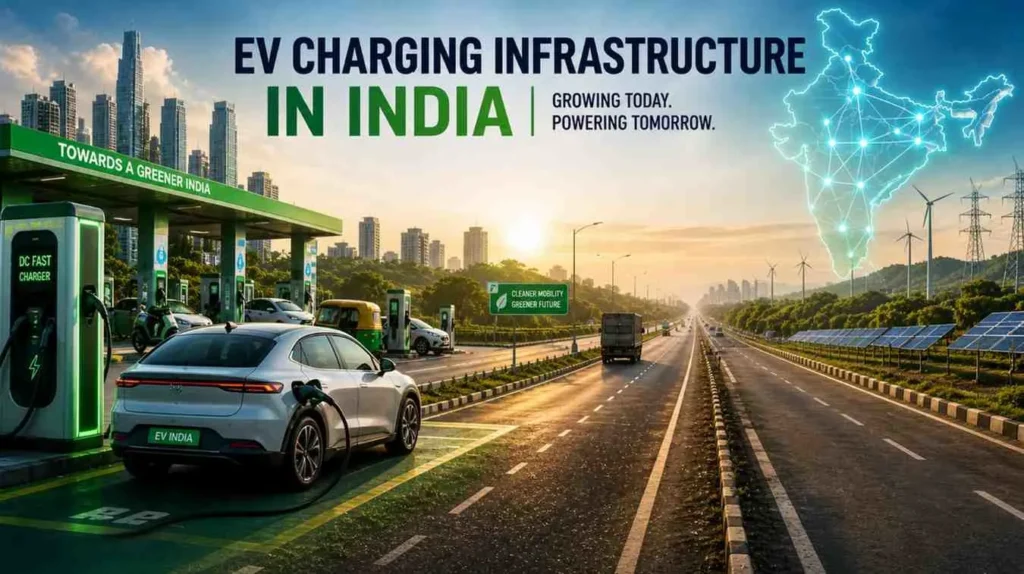
India had over 29,000 public EV charging stations as of early 2026, up from about 5,000 in 2022, a near six-fold expansion of EV charging infrastructure in India in three years. Yet rollout still trails adoption. With 2.3 million EVs registered in 2025 and the ratio at roughly one charger per 235 EVs, India is well short of the global benchmark of one per 6 to 20.
Policy ambition is strong and private investment is accelerating, but distribution is uneven, a meaningful share of installed chargers are non-functional, and the fast charging infrastructure India operators have built remains thin outside major urban corridors. To reach the 30 percent EV penetration target by 2030, India will need an estimated 1.32 million public charging stations, more than 40 times the current installed base, per ORF projections.
Current State of Public EV Charging India
Public EV charging India numbers have shifted significantly in 2025 and early 2026. The most recent Ministry data tabled in Parliament puts installed and operational numbers in different brackets, which is the most important distinction. Hard numbers below come from Parliament data, the Bolt. Earth 2026 report, and the Anari EV landscape report.
- 27,737 public stations installed and 22,753 operational as of March 2026, per Ministry data reported to Parliament.
- 39,500 chargers including semi-public locations by late 2025, of which 8,414 were fast chargers, per the Bolt.Earth 2026 report.
- Public chargers grew from 6,586 in March 2023 to 12,146 in February 2025 and 29,277 by May 2025, per the Anari EV landscape report.
- Uttar Pradesh, Karnataka, Maharashtra, and Tamil Nadu lead on total installations.
- Charger-to-EV ratio of approximately 1 per 235 EVs against the global benchmark of 1 per 6 to 20.
- Approximately 55 percent of Indian EV owners have reliable home charging despite home charging being the most efficient option.
- BPCL’s network has reportedly run at 60 percent non-operational, illustrating how the installed and operational gap manifests at the network level. The carbon trade-off behind these gaps is detailed in how to reduce automotive carbon emissions.
Types of EV Chargers in India
Electric vehicle charging stations India operators run are categorised by power level and current type. The right charger depends on vehicle segment, use case, and location, and the table below captures the practical split.
| Charger Type | Power | Current | Use Case |
| AC Slow (Bharat AC-001) | 3.3 kW | AC | Two-wheelers, three-wheelers, overnight home and workplace |
| AC Fast (Type 2) | 7 to 22 kW | AC | Four-wheelers at home, malls, offices |
| DC Fast (CCS2) | 25 to 60 kW | DC | Highway, fleet, urban hubs for four-wheelers |
| DC Ultra-Fast | 100 to 350 kW | DC | Long-distance corridors, commercial fleets |
| Bharat DC-001 | 15 kW | DC | Legacy four-wheelers, public stations |
AC chargers dominate India’s installed base because the two and three wheeler fleet is large. DC fast chargers are the binding gap inside the broader fast charging infrastructure India is building: they cost Rs 3 to 7 lakh per 60 kW unit, with total project cost much higher when land, grid connection, and permissions are included. PM E-DRIVE targets 22,100 DC fast chargers for four-wheelers by March 2026, plus 1,800 e-bus chargers and 48,400 two and three wheeler chargers, signalling where central capital is flowing.
EV Charging Policy India: Government Schemes Supporting Rollout
EV charging policy India direction runs on two tracks: a national capital programme through PM E-DRIVE and FAME-II, and state-level rules that set deployment speed on the ground. Both shape the green mobility in India trajectory.
National Schemes
PM E-DRIVE allocates Rs 2,000 crore for 72,300 charging stations across 50 national highway corridors, with subsidies of up to 80 percent on upstream power infrastructure. FAME-II, the predecessor scheme, sanctioned an earlier wave of public chargers and seeded the operator ecosystem.
- PM E-DRIVE: 22,100 DC fast chargers for cars, 1,800 for e-buses, 48,400 for two and three wheelers
- 80 percent subsidy on upstream power infrastructure for site developers
- Highway corridor focus: toll plazas, fuel outlets, railway stations, airports
- FAME-II legacy sanctions seeded earlier rollout in metros and tier-1 cities
State-Level Differentiation
States are setting their own targets and incentives on top of central allocations, and the pace varies sharply.
- Delhi: lowest EV tariff in India, fast charger every 5 km target, concessional land rates for charge point operators (CPOs).
- Karnataka: chargers along the Bengaluru Mysore and Bengaluru Chennai corridors for intercity connectivity.
- Maharashtra: chargers mandated every 25 km on state highways, EV infrastructure required in commercial and housing complexes.
- Tamil Nadu: only state where roughly 90 percent of chargers sit within 1 km of a highway.
- Uttar Pradesh: 300 new stations planned, with tax and subsidy relief plus dense e-rickshaw demand driving urban load.
EV Charging Stations India 2025 Gaps and Challenges
EV charging stations India 2025 deployment data tells a more complicated story than headline numbers suggest. Five gaps explain why ratio metrics keep slipping behind EV registrations; the grid carbon side is framed in automotive lifecycle emissions modelling.
Installed vs Operational Gap
Of the 27,737 stations installed and reported to Parliament, only 22,753 were operational, an 18 percent national non-functional rate. Some networks have run far worse on reliability metrics.
- BPCL network reported 60 percent non-operational chargers
- Site utilisation as low as 5 percent at many locations
- Commercial viability suffers when chargers idle without revenue
Urban Concentration
Urban concentration leaves rural and tier-2 corridors thin. About 85 percent of Karnataka’s chargers sit in Bengaluru, and similar patterns hold across states.
- Highway coverage outside Tamil Nadu is inadequate
- Rural and semi-urban gaps persist despite headline growth
- Long-distance EV travel depends on uneven corridor density
Grid and Cost Constraints
DC fast chargers are power-hungry, and many urban distribution networks were not designed for them. Voltage fluctuations and rural grid quality cause downtime even where chargers are installed.
- Total project cost runs well above the Rs 3 to 7 lakh equipment number
- High electricity tariffs and connection charges hurt CPO economics
- Land acquisition and RWA permissions remain slow in metros
Home Charging and Interoperability
Only 55 percent of Indian EV owners have reliable home charging, and residential complexes struggle to retrofit without clear RWA guidelines. Multiple charging standards still create friction across networks.
- Building codes for EV-ready wiring (Delhi 20 percent, Maharashtra 1 per 5 spots) see uneven enforcement
- Open-access protocols across CPO networks remain unresolved at scale
What India Needs to Reach the 2030 EV Charging Target
The scale is concrete. India needs an estimated 1.32 million public charging stations to support 30 percent EV penetration by 2030, more than 40 times the current installed base, per ORF. CII projects over 400,000 new chargers needed annually at the 1:40 EV-to-charger planning ratio. DC fast chargers’ share in city-highway corridors needs to rise to 35 to 60 percent by 2030 per the Anari EV landscape report. The Golden Quadrilateral carries 40 percent of India’s road freight on 0.5 percent of the road network, which is why DC fast charger deployment on those corridors is essential for fleet electrification.
The private sector response is visible. Tata Power runs 5,300 plus chargers across 530 cities and is targeting 25,000 by 2028 through OEM-led Open Collaboration 2.0, with 500 Mega Charger hubs planned. Ather Grid, Bolt.Earth, and ChargeZone are scaling two and four wheeler networks across tier-1 and tier-2 cities. Oil marketing companies hold 18,000 plus fuel outlets that could convert to charging at scale, and solar-microgrid pilots from BluSmart and Fortum hint at how renewable integration could anchor the next wave, with second-life EV batteries increasingly considered for stationary storage at large hubs.
Conclusion
India’s EV charging network is growing at a rapid pace, yet the headline numbers do not reflect how well the system actually works on the ground. The focus cannot remain on installation counts alone. What matters is how many chargers are operational, easy to access, compatible with modern EVs, and placed in locations where demand truly exists.
At present, many charging points face issues such as downtime, slow charging speeds, or inconvenient placement. This creates a clear gap between availability in theory and usability in practice. Moving from nearly 29,000 stations today to the 1.32 million required by 2030 will depend on more than just expansion. It will require stronger power infrastructure, common standards across networks, consistent reliability, better coverage on highways, and wider access to home charging for EV owners.
The decisions of the next two to three years will decide whether India’s 30 percent EV target becomes reality, and the broader sustainability in automotive industry trajectory hinges on the same execution.
FAQs
How many EV charging stations are there in India in 2026?
India had 27,737 public EV charging stations installed and 22,753 operational as of March 2026, per Ministry data tabled in Parliament. Including semi-public locations, the count crosses 29,000. The number has grown nearly six times since 2022 but still trails EV registrations.
What is the EV charger-to-vehicle ratio in India?
The ratio sits at roughly one public charger per 235 EVs as of early 2026. The global benchmark is one charger per 6 to 20 EVs. Closing that gap is the central planning challenge for state and central agencies through 2030.
What are the types of EV chargers available in India?
EV chargers in India fall into AC slow (Bharat AC-001 at 3.3 kW), AC fast (Type 2 at 7 to 22 kW), DC fast (CCS2 at 25 to 60 kW), DC ultra-fast (100 to 350 kW), and legacy Bharat DC-001 (15 kW). AC chargers dominate; DC fast chargers are the binding gap.
What is the PM E-DRIVE scheme for EV charging?
PM E-DRIVE allocates Rs 2,000 crore for 72,300 charging stations across 50 national highway corridors with up to 80 percent subsidy on upstream power infrastructure. The plan covers 22,100 DC fast chargers for cars, 1,800 for e-buses, and 48,400 for two and three wheelers.
Which states have the most EV charging stations in India?
Uttar Pradesh, Karnataka, Maharashtra, and Tamil Nadu lead on total installations as of early 2026. Tamil Nadu is the only state where roughly 90 percent of chargers sit within 1 km of a highway. Delhi runs the lowest EV tariff and a fast-charger-every-5-km target.
How many EV charging stations does India need by 2030?
India needs an estimated 1.32 million public charging stations to support 30 percent EV penetration by 2030, more than 40 times the current base, per ORF. CII projects over 400,000 new chargers required annually at the 1:40 planning ratio.
Why are so many EV charging stations non-functional in India?
About 18 percent of nationally installed stations were non-operational in March 2026 data, and networks like BPCL have reported 60 percent non-functional rates. Causes include grid voltage issues, low utilisation undermining maintenance economics, payment failures, and weak operator service models.