
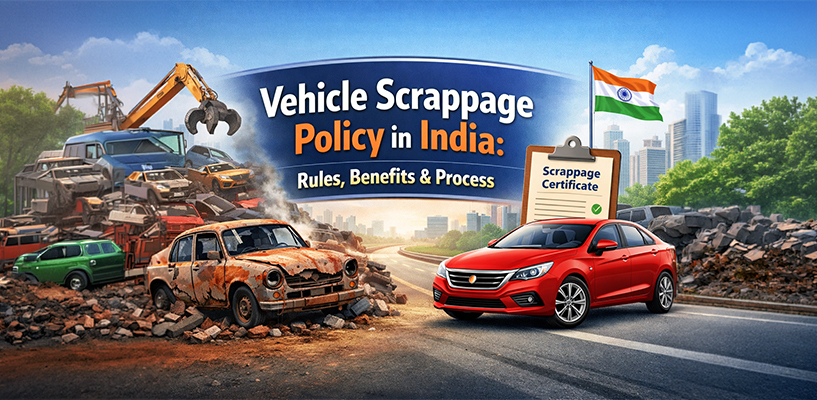
India’s vehicle scrappage policy in India phases out old and polluting vehicles through mandatory fitness testing after 15 years for commercial vehicles and 20 years for personal vehicles. Testing occurs at Automated Testing Stations and failed vehicles must be scrapped at Registered Vehicle Scrapping Facilities. Owners receive incentives such as scrap value, tax rebates, and registration fee waivers while supporting formal recycling and pollution reduction.
What Is the Vehicle Scrappage Policy in India?
The vehicle scrappage policy in India is introduced as a voluntary vehicle fleet modernization program aimed at reducing pollution and improving road safety by removing unfit vehicles from circulation. The policy formalizes the scrappage ecosystem by shifting disposal away from informal dismantling practices into a regulated system that works through fitness testing at Automated Testing Stations, ELV marking in VAHAN records, and final dismantling at Registered Vehicle Scrapping Facilities. This structured chain connects vehicle fitness, legal deregistration, recycling, and incentives into one governed process.
Which Vehicles Are Covered Under the Policy?
Vehicles become eligible for evaluation under the vehicle scrappage policy in India based on age and fitness condition. After a failed fitness test or non testing, VAHAN records mark the vehicle as an end of life vehicle, which directs it toward the regulated scrappage pathway.
1. Commercial vehicles 15 plus years
Commercial vehicles that complete 15 years from the date of registration must undergo mandatory fitness testing at an Automated Testing Station. Continued operation depends on passing this test. Failure results in classification as an end of life vehicle and movement toward authorized scrapping.
2. Personal vehicles 20 plus years
Personal vehicles are subject to mandatory fitness evaluation after completing 20 years from registration. These vehicles can continue to operate only if they pass the fitness test. Failure triggers the scrappage process.
3. Fitness based eligibility
Eligibility for scrapping is not determined by age alone. Vehicles that fail fitness testing at any stage, even before reaching the age threshold, may be classified as unfit and directed toward scrapping through the VAHAN system.
4. Exemptions
Certain categories such as vintage vehicles, specialized purpose vehicles, and government notified exemptions may fall outside standard scrappage requirements. These cases are governed by specific regulatory provisions.
| Vehicle Type | Age Threshold | Fitness Test Required | Outcome |
| Commercial | 15 plus years | Mandatory | Pass or Scrap |
| Personal | 20 plus years | Mandatory | Pass or Scrap |
Step-by-Step Process of Vehicle Scrapping in India
The vehicle scrappage policy in India follows a defined sequence that connects fitness testing, ELV classification, authorized dismantling, certification, and incentive eligibility. Each stage is recorded through official systems to ensure traceability and compliance.
1. Fitness test at Automated Testing Station
The process begins when the vehicle is presented at an Automated Testing Station for mandatory fitness evaluation after crossing the age threshold. The test measures braking, emissions, suspension, lighting, and structural safety through automated equipment linked to VAHAN. The result is recorded digitally and cannot be altered manually.
2. Pass or fail decision and ELV marking
If the vehicle passes the test, it may continue operating for a defined period. If the vehicle fails, VAHAN records immediately classify it as an end of life vehicle or ELV. This classification prevents further legal use of the vehicle and initiates the scrappage pathway.
3. Hand over to Registered Vehicle Scrapping Facility (RVSF)
The owner then hands over the vehicle to a Registered Vehicle Scrapping Facility. At intake, ownership and vehicle records are verified against VAHAN data. The facility issues a Certificate of Deposit confirming lawful receipt of the vehicle for scrapping.
4. Dismantling and material recovery
The vehicle undergoes depollution where fluids, batteries, and hazardous components are removed. Systematic dismantling separates reusable parts and recyclable materials such as steel, aluminum, and plastics for recovery and recycling.
5. Certificate issuance and incentive eligibility
After the ELV is handed over to the RVSF, the facility issues a Certificate of Deposit. This certificate enables deregistration of the vehicle and allows the owner to claim applicable incentives such as road tax rebates, registration fee waivers, and manufacturer discounts.
| Step | Activity | Outcome |
| 1 | Fitness test | Vehicle evaluated |
| 2 | Pass or Fail | Eligibility decided |
| 3 | Scrapping | Vehicle dismantled |
| 4 | Certificate | Incentives enabled |
What Is an Automated Testing Station (ATS)?
An Automated Testing Station is a facility where vehicles undergo mandatory fitness checks after crossing the age limit under the vehicle scrappage policy in India. It replaces earlier manual inspections at transport offices with equipment based testing that records results digitally in official vehicle systems.
During the test, the vehicle is evaluated for braking performance, suspension condition, emissions levels, lighting, wheel alignment, and overall mechanical fitness. These checks are performed using calibrated machines that measure performance against defined standards rather than visual assessment.
Because the process is equipment led and digitally recorded, the fitness outcome is consistent and difficult to manipulate. Vehicles that meet the required standards are allowed to continue operating for a defined period. Vehicles that do not meet these standards move toward the regulated scrappage process.
What Is a Registered Vehicle Scrapping Facility (RVSF)?
A Registered Vehicle Scrapping Facility is an authorized center approved by state transport authorities to dismantle end of life vehicles under defined rules. Only these facilities are legally permitted to accept vehicles for scrapping and issue the documentation required to close the vehicle’s ownership record.
A detailed explanation of how these facilities operate is provided in our registered vehicle scrapping facility blog.
Environmental controls are a core part of RVSF operations. Before dismantling begins, the vehicle goes through a depollution process where oils, coolants, fuel residues, batteries, airbags, and refrigerants are removed and handled according to pollution control guidelines. This prevents soil, air, and water contamination during dismantling.
When a vehicle is accepted, the facility issues a Certificate of Deposit or CD. This document confirms that the vehicle has entered the authorized scrapping system and allows the owner to claim incentives linked to the vehicle scrappage policy in India. After dismantling is completed, the vehicle is officially removed from active registration records using the certificates issued by the facility.
Material recovery is the final stage. Metals such as steel and aluminum, along with plastics, glass, and usable components, are separated and sent for recycling. These recovered materials re-enter manufacturing supply chains, supporting circular use of resources while ensuring the vehicle is permanently taken out of circulation.
Incentives Available Under the Vehicle Scrappage Policy
Incentives under the vehicle scrappage policy in India are structured to encourage owners to choose authorized scrapping over informal dismantling. These benefits are linked to the Certificate of Deposit issued by a Registered Vehicle Scrapping Facility and become applicable when the owner purchases a new vehicle after scrapping the old one.
1. Scrap value from the scrapping facility
When a vehicle is handed over for dismantling, the owner receives scrap value based on the recoverable material weight. This value typically ranges between four to six percent of the original ex-showroom price of the vehicle and is paid directly by the facility.
2. Road tax rebate from state governments
State governments provide road tax concessions on the purchase of a new vehicle when the owner presents the Certificate of Deposit. The rebate can go up to twenty five percent depending on state policies and vehicle category.
3. Registration fee waiver on new vehicle
Owners are eligible for a waiver of registration fees when registering a new vehicle against a scrapped one. This benefit reduces the upfront cost of replacement and is processed through transport department systems.
4. Manufacturer discount on new purchase
OEMs may offer additional discounts when customers present proof of scrappage. These discounts are not mandatory but are commonly offered to support fleet modernization.
| Incentive Type | Benefit Range |
| Scrap Value | 4 to 6 percent |
| Road Tax Rebate | Up to 25 percent |
| Registration Fee | Waiver |
| OEM Discount | Up to 1.5 percent |
Also read: carbon credits for global automobile industry
Environmental and Economic Benefits of the Policy
The vehicle scrappage policy in India creates measurable outcomes in emissions control, road safety, and material recovery by ensuring that old and unfit vehicles are removed through authorized channels. These benefits arise from how vehicles are tested, dismantled, and recycled within a regulated system rather than from disposal alone.
1. Emissions reduction from older vehicles
Vehicles built under older emission standards release far higher pollutants than vehicles built under current standards.
- Older engines produce higher particulate matter and nitrogen oxides
- Removing these vehicles reduces pollution from daily road use
- Replacement vehicles operate under stricter emission norms
2. Improvement in road safety
Vehicles that fail fitness tests often have worn components that affect safe driving.
- Brake performance, suspension, and structural stability decline with age
- Removing unfit vehicles reduces mechanical failure on roads
- Fewer unsafe vehicles remain in active circulation
3. Structured recycling and material recovery
Authorized dismantling allows recovery of materials in a controlled manner.
- Steel, aluminum, copper, plastics, and glass are separated for reuse
- Recycling reduces the need for primary metal production
- Energy use is lower compared to producing materials from raw sources
These outcomes are linked to mechanisms such as end-of-vehicle or ELV carbon credits where recycling data connects to emissions accounting.
4. Support for formal recycling operations
The policy shifts dismantling activity from informal setups to authorized facilities.
- Growth of regulated dismantling and recycling operations
- Creation of formal jobs in scrapping and material handling
- Improved compliance with environmental norms
5. Reduced pressure on raw material extraction
Material recovery reduces reliance on mining and imports.
- Recycled metals re enter manufacturing supply chains
- Lower dependence on imported scrap and virgin metals
Also read: how to reduce automotive carbon emissions
How Digital Traceability Supports Compliance and Transparency and How MMCM Supports This?
The vehicle scrappage policy creates a chain of actions that must remain consistent from fitness failure to final deregistration.
Each stage produces records that need to match across testing centers, scrapping facilities, and transport databases.
The challenge is not the physical dismantling of vehicles but maintaining continuity of data from the moment a vehicle enters the scrappage pathway until its identity is permanently closed.
1. Linking operational records to vehicle identity
Once a vehicle is handed over for scrapping, multiple operational steps occur inside the facility such as intake verification, job card creation, dismantling stages, and inventory segregation. These steps must be tied to the same vehicle record without breaks.
- Intake details must match original vehicle information
- Dismantling status must remain linked to the vehicle record
- Recovered materials must be recorded against the same vehicle entry
This linkage prevents misuse of vehicle identity after scrapping.
2. Ensuring certificate authenticity through system backed records
Certificates issued during scrapping have legal value only when they are supported by actual operational data.
- Certificate of Deposit must originate from verified intake
- Certificate of Vehicle Scrapping must be backed by dismantling records
- Ownership closure depends on consistency between certificates and operational logs
Digital tracking ensures certificates cannot exist without supporting evidence.
3. Building audit trails across the scrappage lifecycle
Regulators and auditors often examine whether vehicles shown as scrapped have actually gone through the required process. Manual documentation creates gaps that are difficult to justify.
- Time stamped records create a clear sequence of actions
- Digital logs reduce the possibility of record manipulation
- Consistent data across stages supports audit reviews
4. Connecting responsible scrappage data with environmental reporting
Material recovery and responsible dismantling are increasingly used in environmental disclosures and carbon accounting. This requires reliable data that connects recycling outcomes to specific vehicles and scrapping events.
Digital platforms such as MMCM address this requirement by connecting facility operations, inventory tracking, compliance documentation, and certificate generation into a single workflow through an end-to-end solution for RVSF. This strengthens traceability, supports audit readiness, and enables transparent reporting across the scrappage ecosystem without repeating the operational steps already described above.
Conclusion
The vehicle scrappage policy in India creates a formal path for removing old and unfit vehicles from the road through testing, authorized scrapping, and documented closure of records. This replaces informal dismantling with a system where vehicle disposal, recycling, and certification are connected.
As vehicles that no longer meet safety and emission standards exit the system, pollution from daily road use reduces and material recovery becomes part of a regulated recycling chain. For owners, the process provides a lawful way to dispose of vehicles while receiving the incentives defined under the policy.
This structure makes vehicle removal a recorded and accountable activity rather than an untracked transaction.
FAQs:
1. What is the vehicle scrappage policy in India?
A government program that removes old and unfit vehicles through mandatory fitness testing and authorized scrapping while providing incentives for owners to replace polluting vehicles with compliant alternatives.
2. At what age is a vehicle required to be scrapped?
Commercial vehicles after 15 years and personal vehicles after 20 years must undergo fitness testing. Vehicles that fail the test are required to be scrapped through authorized facilities.
3. What happens if a vehicle fails the fitness test?
The vehicle is classified as an end of life vehicle and cannot be legally used. It must be handed over to an authorized scrapping facility for dismantling and certification.
4. What is an ATS in vehicle scrapping?
An Automated Testing Station is a facility that conducts machine based fitness tests to check braking, emissions, suspension, and safety before determining if a vehicle can remain in use.
5. What is an RVSF?
A Registered Vehicle Scrapping Facility (or RVSF) is an authorized center that dismantles end of life vehicles safely and issues certificates required for legal deregistration and incentive claims.
6. How much incentive do vehicle owners receive?
Owners receive scrap value between four to six percent, road tax rebates up to 25 percent, registration fee waiver, and possible manufacturer discounts on new purchases.
7. Can vehicles be scrapped in any state?
Vehicles can be scrapped at any authorized facility, provided ownership records and certificates align with official transport department systems for lawful deregistration.
8. Is vehicle scrapping mandatory?
Scrapping becomes mandatory when a vehicle fails the fitness test after crossing the prescribed age limit defined under the vehicle scrappage policy in India.
9. How long does the scrapping process take?
From fitness failure to certification, the scrapping process typically takes a few days depending on facility workload and completion of verification and dismantling procedures.
10. What documents are required for scrapping?
Vehicle registration certificate, identity proof of owner, and required authorization documents are needed to hand over the vehicle for lawful scrapping and certification.