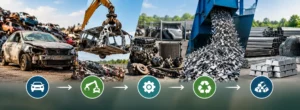


Green steel is steel produced with a carbon dioxide equivalent emission intensity of less than 2.2 tonnes of CO₂e per tonne of finished steel, as specified in India’s Green Steel Taxonomy issued by the Ministry of Steel through Gazette Notification S.O. 763(E) dated 12 December 2024. The taxonomy classifies qualifying steel into three, four and five star categories based on its emission intensity, with certification carried out by the National Institute of Secondary Steel Technology (NISST), the designated nodal agency.
What Does India’s Green Steel Taxonomy Define?
India’s Green Steel Taxonomy establishes a government-backed framework for defining and classifying steel by its verified emission intensity. The taxonomy sets a single qualifying threshold and grades performance beneath it through star ratings.
Steel with an emission intensity below 2.2 tonnes of carbon dioxide equivalent per tonne of finished steel qualifies as green. Steel above that figure is not eligible for a green rating, regardless of the production route used.
Greenness is expressed as a percentage showing how far a plant’s emission intensity falls below the threshold. The star band itself is set by the measured intensity value rather than derived from that percentage, so the rating describes performance rather than technology choice or fuel type.
NISST expresses greenness as G% = [(Et − Ep) ÷ Et] × 100, where Et is the threshold and Ep is the plant’s measured intensity. A plant at 1.8 therefore reports roughly 18 percent greenness while sitting in the four star band.
The framework is route-neutral. NISST’s Guideline for Green Steel Certification, dated 30 December 2025, lists blast furnaces with basic oxygen furnace, electric arc furnace, induction furnace, direct reduced iron, composite routes and standalone rolling mills among the routes covered. A plant must have finished product making facilities to apply
| Rating | Emission intensity |
|---|---|
| Five star | Below 1.6 t-CO2e per tonne of finished steel |
| Four star | Between 1.6 and 2.0 t-CO2e per tonne |
| Three star | Between 2.0 and 2.2 t-CO2e per tonne |
| Not eligible | Above 2.2 t-CO2e per tonne |
What Emissions Does the Taxonomy Count?
India’s Green Steel Taxonomy measures emissions from Scope 1, Scope 2 and limited Scope 3 sources up to finished steel production. The Scope 3 boundary includes emissions from processes such as sintering, pellet making, coke making, beneficiation, and the embodied emissions in purchased raw materials and intermediate products. It excludes upstream mining, downstream emissions and transportation emissions.
This means the taxonomy does not measure the full lifecycle emissions of steel. As a result, a green steel rating under India’s taxonomy may not be directly comparable with a steel emissions figure calculated using a different emissions boundary.
Excluded from the count are upstream mining, downstream emissions, and transportation emissions both within and outside the plant gates. A five star rating therefore describes performance across a specified production boundary rather than a full cradle-to-grave footprint, which is a distinction worth carrying into any Scope 1, 2 and 3 reporting exercise that uses certified steel as an input.
How Does Green Steel Certification Work in India?
The National Institute of Secondary Steel Technology (NISST), under the Ministry of Steel, serves as the nodal agency for India’s green steel certification framework. The certification process uses emissions data assessed through the prescribed measurement, reporting and verification framework, which NISST uses to determine the applicable star rating and issue the Green Steel Certificate.
The certification process began on 1 April 2025 with the launch of the Green Steel Certification Portal. By 29 July 2025, 39 steel producers had applied for certification, marking the initial rollout of the taxonomy across the industry.
The certification steps
- Registration: A steel plant registers with NISST through the Green Steel Certification Portal. Plants must maintain operational and production data covering the entire financial year.
- Data submission and audit: The plant submits emissions and production data, which an approved measurement, reporting and verification agency audits against the taxonomy’s technical parameters.
- Rating and issue: NISST determines the emission intensity value, assigns the corresponding star band and issues the certificate. The guideline puts this at roughly 60 to 63 working days from receipt of a complete application, subject to timely response from all parties
- Annual renewal: Certificates are issued on a financial-year basis. Plants may opt for more frequent assessment where they want an updated rating within the year.
Ratings have started reaching the market. In February 2026 ArcelorMittal Nippon Steel India received a four star rating for hot rolled coils and sheets and a three star rating for cold rolled coils and sheets, audited by NISST. The company described itself as the first integrated steel plant certified under the taxonomy
The threshold bands are reviewed every three years by the Ministry of Steel. A rating earned today therefore describes performance against a benchmark that is expected to tighten as the industry improves, which is worth planning for rather than discovering at renewal.
Why Green Steel Matters for Automotive and Other Buyers
Steel can account for a significant share of the embodied emissions in a vehicle. Mariinox estimates that an end of life passenger car can yield around 440 kg of steel, with about 0.65 tonnes of CO₂ emissions avoided when that recovered steel replaces virgin steel production. This is a company estimate based on its stated methodology, rather than a figure from India’s Green Steel Taxonomy.
For buyers, the value of green steel certification is that it provides verified emissions data for the finished steel product. Under India’s taxonomy, the emission intensity is measured and verified through the prescribed MRV process, and the resulting certificate records the steel’s embodied emissions, greenness percentage and star rating. This gives automotive manufacturers and other steel buyers a more consistent basis for comparing suppliers and tracking the emissions associated with purchased steel.
The buyers with most to gain are those already reporting on purchased materials, including automotive, construction and infrastructure manufacturers. A certified input can provide supplier-specific emissions data that may support the purchased goods and services category of a manufacturer’s Scope 3 inventory, subject to the company’s chosen accounting methodology and reporting standard.
The recycled content angle matters here too. Electric arc furnace and induction furnace routes running on scrap typically carry lower emission intensity than integrated primary routes, so material recovered through established circular economy practices feeds directly into the ratings a plant can achieve. For exporters there is a second reason to hold certification.
For exporters there is a second reason to hold certification, though it needs stating carefully. European buyers face the Carbon Border Adjustment Mechanism (CBAM) and their own reporting duties, and they are asking suppliers for verified emissions data. A NISST star rating is not a CBAM submission and does not substitute for one.
CBAM sets its own calculation method and requires verification by a verifier accredited by an EU national accreditation body18, and it counts stages the Indian taxonomy leaves out. What certification gives an exporter is an audited intensity figure and the measurement discipline behind it, which is groundwork rather than filing.
Companies already building GHG inventories for net zero targets may find useful overlap in the underlying plant-level activity and emissions data, although the methodologies and reporting boundaries can differ.
Conclusion
India’s Green Steel Taxonomy gives the term “green steel” a defined basis in measured and verified emissions. It sets the threshold for certification, specifies how emissions are measured, and establishes the evidence required for a steel product to receive a green steel rating.
But the taxonomy does not represent the full lifecycle footprint of steel. Its rating covers a defined production boundary, so it provides verified product level emissions data without capturing every emission associated with the steel’s extraction, transport, use and end of life. This distinction matters for buyers that follow emissions accounting standards or procurement rules with different boundaries.
FAQs
What is the definition of green steel in India?
Steel with a carbon dioxide equivalent emission intensity below 2.2 tonnes per tonne of finished steel, as defined by the Green Steel Taxonomy notified in December 2024.
Who issues green steel certificates in India?
The National Institute of Secondary Steel Technology, under the Ministry of Steel, serves as nodal agency for measurement, reporting and verification and issues the certificates and star ratings.
What emissions are counted in the green steel rating?
Scope 1, Scope 2 and limited Scope 3 up to finished steel production. Mining, transportation and downstream emissions are excluded from the calculation.
How many stars can green steel receive?
Ratings run from three to five stars. Per NISST, five star is 1.6 t-CO2e per tonne or below, four star is above 1.6 up to 2.0, and three star is above 2.0 up to 2.2
Is the green steel certificate permanent?
No. Certificates are issued on a financial-year basis, and the threshold bands themselves are reviewed by the Ministry of Steel every three years.
Does green steel certification apply to all production routes?
Yes. Blast furnace, electric arc furnace, induction furnace, direct reduced iron, composite routes and standalone rolling mills are all covered by the framework.
How long does green steel certification take?
Published NISST guidance indicates roughly 60 to 63 working days from receipt of a complete application, subject to audit scheduling and data completeness.
Why does green steel matter for car manufacturers?
A certified rating gives documented emissions data for purchased steel, supporting the purchased goods element of a manufacturer’s Scope 3 inventory and customer disclosure requests.
Does using scrap improve a plant’s star rating?
Using scrap steel can help a plant achieve a higher Green Steel star rating if it lowers the plant’s measured emissions intensity. However, India’s Green Steel Taxonomy does not award a rating based on the use of scrap itself. The star rating is determined by the verified emissions intensity of the finished steel.