
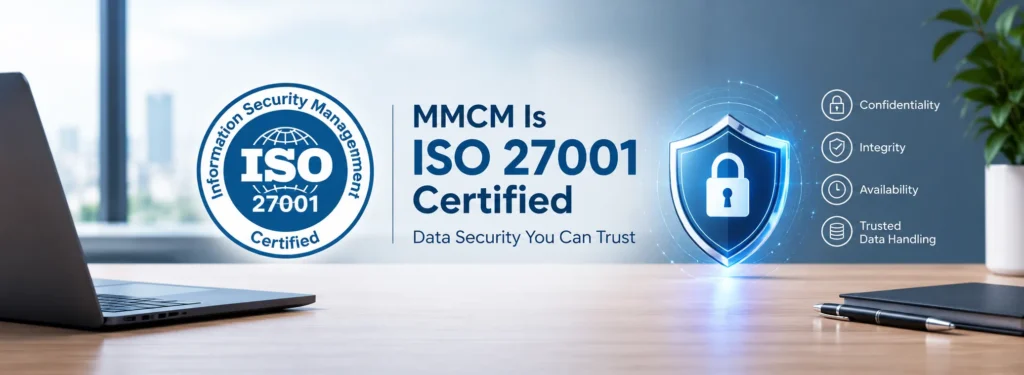
ISO 27001 is the international standard for Information Security Management Systems (ISMS). Any company that holds ISO 27001 certification has built, implemented, and independently verified a structured system to protect confidential information across people, processes, and technology. MMCM is an ISO 27001 certified company India-wide, which means every piece of data flowing through the platform, from vehicle owner records and registration documents to DigiELV entries and OEM partner data, is protected under a globally recognised security framework.
The relevance of that certification to anyone working with MMCM is direct. When a vehicle is scrapped, the owner shares personal information: name, address, vehicle registration, ownership documents. When OEMs and fleet operators work with MMCM, they share corporate fleet records, EPR compliance data, and carbon credit transaction logs. ISO 27001 certification India organisations apply the same rigour to that data that governs banks, IT companies, and government-facing platforms.
What ISO 27001 Certification Means
ISO 27001 is published by the International Organization for Standardization (ISO) jointly with the International Electrotechnical Commission (IEC), which is why the full name is ISO/IEC 27001. The standard defines the requirements for an information security management system India and global organisations use to handle sensitive information securely. Any ISO 27001 certification India organisation earns is awarded only after an independent audit by an accredited body; it is not self-declared, and certified companies undergo annual surveillance audits with full recertification every three years.
The 2022 version of the standard, ISO/IEC 27001:2022, organises 93 controls across four categories: organisational controls (37), people controls (8), physical controls (14), and technological controls (34). The 2022 update introduced new controls covering threat intelligence, information security for cloud services, and ICT readiness for business continuity. These additions matter directly for the DigiELV platform, which rests on cloud architecture and depends on continuous availability for every ELV record it carries.
Three core principles run through the entire framework. Confidentiality ensures data is accessed only by authorised parties. Integrity ensures data is accurate and not altered without authorisation. Availability ensures data is accessible when needed. An ISMS certified company India calls itself secure only if all three principles are demonstrably maintained, audited, and continuously improved, and any ISO 27001 certified company India in the data-handling space is expected to evidence this in audit cycles.
What Data MMCM Handles and Why It Needs Protecting
The data security automotive India context for MMCM is not abstract. The platform operates as a data custodian across three distinct categories that flow through different parts of the operation, each with its own protection profile.
Vehicle Owner Data
Personal information enters the system at the point of vehicle deregistration. Names, addresses, contact details, vehicle registration certificate (RC) data, and identity documents submitted for ownership verification all sit inside MMCM’s records. Owners hand over this information when they bring the vehicle to an authorized RVSF for scrapping, and the platform stores it under the same ISMS controls that protect every other class of data inside the certified perimeter.
Vehicle and Compliance Records
DigiELV platform data ties end-of-life vehicle records to MoRTH’s national VAHAN registry. Each Certificate of Deposit issued at scrapping connects an individual vehicle and owner to the formal compliance record, which is what allows downstream EPR reporting to be auditable back to the source RVSF event. Both the registry tie-in and the CoD record sit inside the certified data perimeter.
OEM and Corporate Partner Data
Fleet scrapping records for large automotive and commercial fleet operators, ELV carbon credit transaction logs, and contractual documentation shared by corporate clients all live inside the same security perimeter. OEM partners increasingly require ISO 27001 certification India vendors hold before commercial engagement begins, especially as data security automotive India norms tighten. The audit detail expected by enterprise compliance teams is supported by the same controls that secure owner data at the front end of the workflow.
What ISO 27001 Certification Covers at MMCM
The certification operates across four functional layers at MMCM, each mapping to a category of the 2022 standard’s 93 controls.
Organisational Controls
Documented information security policies, defined roles and responsibilities, and a formal risk assessment process anchor the operational layer. Internal audit cycles, management review, and supplier security evaluation all run on a fixed cadence under the ISMS rather than ad-hoc.
- Information security policy reviewed and approved at executive level
- Risk assessment and treatment plan refreshed annually
- Vendor and supplier security evaluation before commercial engagement
- Internal audit programme covering all controls each cycle
People Controls
Employees and contractors operate under documented roles, signed confidentiality agreements, and regular security awareness training. Access provisioning and de-provisioning follow a formal joiners-movers-leavers process, and no individual holds unmonitored access to production data systems.
- Background verification at hiring for sensitive roles
- Confidentiality agreements covering all data classes
- Security awareness training delivered on a fixed cadence
- Access reviews on joiner, mover, and leaver events
Physical and Technological Controls
Physical security covers offices, server locations, and any facility holding sensitive records, with access logged and monitored. Technological controls span cryptography for data at rest and in transit, secure development practices for the DigiELV codebase and the AutoLoop RVSF management platform, network segmentation, vulnerability management, and incident response procedures with documented playbooks.
- Encryption for data at rest and in transit across the platform
- Secure software development lifecycle for DigiELV and AutoLoop
- Logging, monitoring, and threat intelligence integration
- Incident response with defined escalation timelines
Why This Matters for Vehicle Owners and OEM Partners
ISO 27001 vehicle scrapping certification translates into different specific assurances depending on which side of the platform a stakeholder sits on, but the underlying guarantee is the same: data is handled inside an audited, internationally certified security framework, not under ad-hoc internal practice.
For vehicle owners, personal information and ownership documents are processed under defined access controls and retention rules. Data is not shared beyond what is required for compliance, and access is restricted to authorised personnel only. In the event of a security incident, MMCM has a documented response process with breach notification timelines defined in advance. India’s Digital Personal Data Protection Act 2023 is tightening obligations for every organisation handling personal data, and ISO 27001 certification positions the platform well ahead of that regulatory curve.
For OEM and fleet partners, fleet scrapping data, EPR compliance records, and carbon credit transactions all sit inside the certified perimeter. ISO 27001 is increasingly required in enterprise vendor assessments and government tenders, which removes a procurement barrier that uncertified vendors still face. Data security automotive India norms are tightening through TISAX, ISO 21434, and India’s AIS-189; working with an ISMS certified company India in the scrapping ecosystem aligns directly with each of those obligations.
Audit trails and documentation typically demanded by OEM compliance teams are supported by the information security management system India auditors examine during certification cycles.
Conclusion
ISO 27001 certification is not a checkbox. It is a commitment to every vehicle owner, OEM partner, and fleet operator who shares data with MMCM. As India’s vehicle scrapping ecosystem scales and digital platforms such as DigiELV become central to ELV compliance, the security of that data becomes inseparable from the credibility of the scrapping process itself.
Holding ISO 27001 certification means the same standards applied to banks and IT service providers now apply to the records of every vehicle scrapped through the platform, every CoD issued, and every EPR transaction logged. That is what responsible, organised vehicle scrapping infrastructure looks like in practice.
FAQs
What is ISO 27001 certification?
ISO 27001 is the international standard for Information Security Management Systems by ISO and IEC. It defines requirements for protecting confidential information across people, processes, and technology, and certification is awarded after an independent audit by an accredited body, with annual surveillance and three-year recertification.
Is MMCM ISO 27001 certified?
Yes. MMCM holds ISO/IEC 27001:2022 certification, which means every category of data flowing through the platform, from vehicle owner records to DigiELV entries to OEM partner data, is protected under a globally recognised security framework. The certification is independently audited.
What data does ISO 27001 protect at an RVSF?
ISO 27001 protects vehicle owner information, registration data, identity documents, DigiELV records, Certificate of Deposit data, OEM fleet records, EPR compliance documentation, and carbon credit transaction logs across the scrapping workflow.
Why does a vehicle scrapping company need ISO 27001?
Vehicle scrapping handles personal owner data, ownership documents, OEM fleet records, and compliance data tied to national registries. ISO 27001 vehicle scrapping certification ensures that data is handled with the rigour required by the DPDP Act, OEM vendor assessments, and international automotive data standards.
What is the difference between ISO 27001:2013 and ISO 27001:2022?
ISO 27001:2022 restructured the original 14 control domains into 4 categories and reduced controls from 114 to 93. New controls cover threat intelligence, information security for cloud services, ICT readiness for business continuity, and other areas reflecting modern threat landscapes. The 2022 version is the current certifiable standard.
How does ISO 27001 protect vehicle owner data in India?
Vehicle owner data is held under defined access controls, encryption for storage and transmission, retention rules, and incident response procedures with notification timelines. Access is restricted to authorised personnel and reviewed on a fixed cadence. The framework directly supports DPDP Act 2023 compliance.
Is ISO 27001 required under India’s DPDP Act?
The Digital Personal Data Protection Act 2023 does not name ISO 27001 specifically, but the standard’s controls map closely to DPDP requirements on consent, security safeguards, and breach notification. Holding the certification gives an organisation a head start on DPDP compliance and on demonstrating reasonable security practice.