
A Pollution Under Control (PUC) certificate is a mandatory government document confirming that a vehicle’s tailpipe emissions sit within the permissible limits set by the Central Pollution Control Board. It is required for every internal combustion engine vehicle under the Motor Vehicles Act, 1988 and the Central Motor Vehicles Rules, 1989. The certificate records measured carbon monoxide, hydrocarbon, and opacity levels at testing, and it is the legal proof that a vehicle is not polluting beyond what the standard allows.
Driving without a valid PUC is an offence under Section 190(2) of the Motor Vehicles (Amendment) Act, 2019, with a fine up to Rs 10,000 and possible imprisonment. From April 2026, Delhi has reactivated its “No PUC, No Fuel” rule, barring petrol pumps in the capital from dispensing fuel to any vehicle without a valid PUC on VAHAN. This guide covers what the certificate contains, how the test works, validity by vehicle type, how to get or renew it, the penalty for non-compliance, and what repeated PUC failures actually signal about a vehicle’s condition.
What Does a PUC Certificate Contain
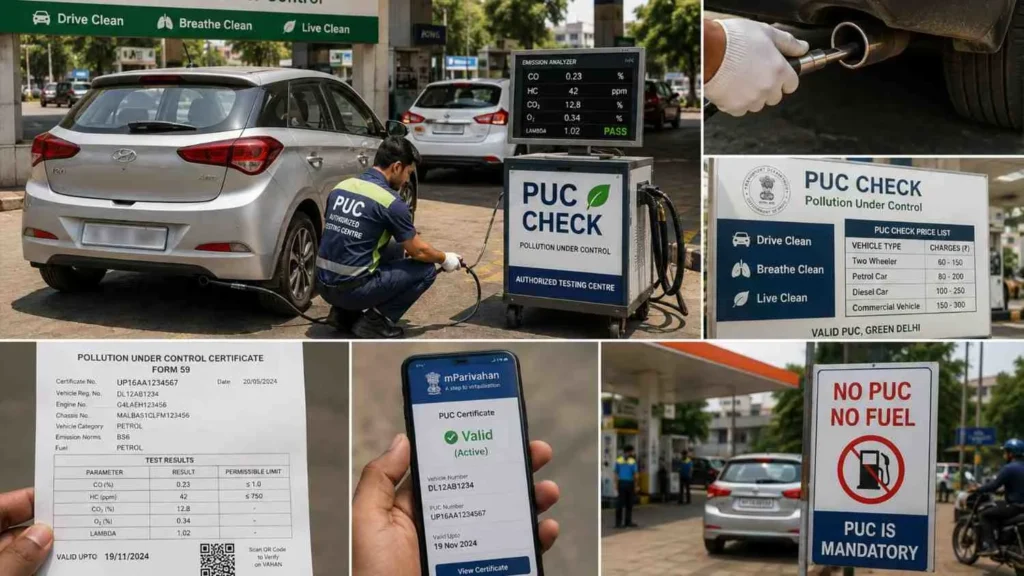
A PUC certificate issued in India is in standard Form 59 format and carries the same fields regardless of which authorised centre tests the vehicle. The data is also pushed to the VAHAN database in real time, which is what allows traffic police to verify status without seeing the physical slip.
- A unique PUC serial number tied to the testing centre
- The vehicle registration number being certified
- The date of the emission test and the certificate expiry date
- The actual emission readings recorded for CO, HC, and opacity at the time of testing
- The name and registration number of the authorised testing centre
- A QR code linked to the VAHAN database for live verification
A digital copy through the mParivahan app is now accepted as valid proof in most states. Carrying a printed slip is no longer a compliance requirement so long as the PUC status on VAHAN is current.
What Is Checked in a PUC Emission Test
The emission test measures exhaust gas concentrations using a calibrated probe inserted into the vehicle’s exhaust pipe. The vehicle is either idled or gently revved depending on type and the analyser reads the values that matter for the relevant emission norm. The full set of pollutant limits sits inside BS6 norms in India, but the PUC test specifically flags three measurements.
Carbon monoxide is reported as a percentage of total exhaust volume and reflects how completely the engine is burning fuel. Hydrocarbons are reported in parts per million and signal unburned fuel slipping past combustion. Smoke opacity is measured for diesel vehicles and reflects particulate density in the exhaust. The full test takes under ten minutes. If any reading exceeds the permissible limit for the vehicle’s emission category, a rejection slip is issued and the vehicle cannot be legally driven until repairs and a retest bring readings back inside the band.
PUC Certificate Validity by Vehicle Type
PUC certificate validity India rules tie directly to vehicle age and emission standard. The validity periods below match the Central Motor Vehicles Rules and are the primary featured snippet target on this query.
| Vehicle Category | Validity Period |
| New BS6 vehicle (first year from purchase) | 1 year |
| BS6 vehicle after first year | 6 months |
| BS4 and earlier petrol vehicle | 6 months |
| BS4 and earlier diesel vehicle | 6 months |
| Two-wheeler (post first year) | 6 months |
| Three-wheeler (post first year) | 6 months |
| Commercial vehicle (post first year) | 6 months |
The actual expiry printed on the certificate is the binding date, since centres can issue a shorter validity if a reading sits close to the permissible limit. Vehicle owners doing fitness planning should also review the vehicle fitness certificate in India timeline because PUC validity and fitness validity often run on different cycles.
How to Get or Renew a PUC Certificate
A PUC can only be issued after a physical emission test; the online portal only allows status checks, downloads, and reprints of an already-issued certificate. The renewal process is identical to the first-time process, which is why pollution under control certificate vendors treat both the same way.
The standard sequence runs as follows.
- Drive the vehicle to an authorised emission testing centre, most commonly located at petrol pumps, RTOs, or standalone government-approved booths. The Parivahan portal lists every authorised centre by pincode.
- Hand over the vehicle registration certificate. No other document is typically required for a standard PUC test.
- Allow the technician to insert the exhaust probe and run the emission test, which takes under ten minutes including data entry.
- If the readings clear the threshold, the certificate prints immediately and the digital record updates on VAHAN within minutes.
- Pay the test fee, which sits between Rs 60 and Rs 150 for two-wheelers, Rs 80 and Rs 200 for petrol cars, and Rs 100 and Rs 250 for diesel cars depending on the state.
To check or download an existing PUC certificate, visit puc.parivahan.gov.in and enter the vehicle registration number along with the last five digits of the chassis number. The mParivahan app gives the same access on mobile and is the format most state police now accept as valid digital proof.
Penalty for Driving Without a Valid PUC Certificate
PUC certificate fine India enforcement runs under Section 190(2) of the Motor Vehicles Act, 1988 as amended in 2019. The fine for a first offence is up to Rs 10,000, with possible imprisonment of up to six months, a fine, or both. A repeat offence carries the same maximum and is enforced more strictly. Traffic police use VAHAN lookup against the registration number, so the absence of a physical slip is no defence in states that accept digital proof.
Two 2025 and 2026 shifts matter for vehicle owners. Anti-pollution drives in Delhi NCR, Bihar, and Maharashtra have pushed PUC checks into routine traffic stops at metro junctions. More consequential is Delhi’s reactivated “No PUC, No Fuel” rule from April 2026, which prohibits petrol pumps from supplying fuel to any vehicle whose PUC is not valid on VAHAN. The rule uses the same camera and database integration referenced in automated testing station India workflows.
When PUC Failures Signal It Is Time to Scrap Your Vehicle
A PUC failure is a compliance event on the surface and a diagnostic signal underneath. When a vehicle consistently fails or just barely passes emission tests, the cause is usually engine deterioration: worn piston rings, injector fouling, a failing catalytic converter, or oxygen sensor drift. These faults compound and the cost of keeping an older vehicle inside emission limits often exceeds what the vehicle is worth.
When the Pattern Becomes a Decision
A single failed test usually means a tune-up or a sensor replacement. A pattern of failures, narrow passes, and rising repair bills says the emission control hardware has aged past economic repair. The signals below tend to appear together rather than in isolation.
- Consistent PUC failures despite repairs and tune-ups
- Emission readings passing but sitting close to the permissible limit at every test
- Rising repair cost to maintain emission compliance year on year
- Vehicle age beyond 15 years for commercial or 20 years for personal vehicles in major cities
- A failed Automated Testing Station fitness check on top of the PUC issue
The Authorised Scrapping Pathway
Vehicles that cannot sustain emission compliance qualify as end-of-life under the vehicle scrappage policy in India, which routes them through Registered Vehicle Scrapping Facilities. Owners who scrap through an RVSF receive a Certificate of Deposit that provides a purchase rebate on a new vehicle and registration fee waivers in several states. That offset, combined with avoided repair cost, often makes scrapping the rational choice once the PUC pattern has tipped.
Conclusion
A PUC certificate is one of the simplest compliance requirements for any vehicle owner in India: a test that takes under ten minutes and costs under Rs 250. The consequences of skipping it now extend beyond fines into fuel-pump access in Delhi and similar enforcement layers expected in other metros. Beyond the legal frame, regular PUC testing is the most direct way to monitor a vehicle’s emission health, and a steady deterioration in test results is the clearest early signal that the vehicle is approaching end-of-life. The structured exit covered in end of life vehicles in India turns that signal into a financially supported transition rather than a forced retirement.
FAQs
What is PUC certificate full form?
PUC stands for Pollution Under Control. The full name on Form 59 is Pollution Under Control Certificate, issued under the Motor Vehicles Act, 1988 and CMV Rules, 1989 to confirm tailpipe emissions sit within Central Pollution Control Board limits.
Is PUC certificate mandatory in India?
Yes. Every internal combustion engine vehicle must carry a valid PUC at all times. Driving without one is an offence under Section 190(2) of the Motor Vehicles Act. From April 2026 in Delhi, vehicles without a valid PUC on VAHAN cannot be refuelled at petrol pumps.
What is the validity of PUC certificate for new vehicles?
For a newly registered BS6 vehicle, the first PUC is valid for one year from registration. After that first year, validity drops to six months at every renewal. BS4 and earlier vehicles, two-wheelers, three-wheelers, and commercial vehicles are typically issued for six months at a time.
What is the fine for driving without PUC in India?
The penalty is governed by Section 190(2) of the Motor Vehicles Act, 1988 as amended in 2019. The fine for a first offence is up to Rs 10,000, with possible imprisonment of up to six months, a fine, or both. The vehicle can also be detained on a repeated violation.
How do I get a PUC certificate?
Drive to an authorised emission testing centre at a petrol pump, RTO, or standalone booth. Present the vehicle registration certificate, allow the technician to run a 10-minute exhaust probe test, pay the fee (typically Rs 60 to Rs 250 by vehicle type and state), and collect the printed slip.
Can I check my PUC certificate status online?
Yes. Visit puc.parivahan.gov.in and enter the vehicle registration plus the last five chassis digits to see current PUC status and validity. The mParivahan app gives the same lookup and stores a digital copy state police accept.
Do electric vehicles need a PUC certificate?
No. PUC certification applies only to internal combustion engine vehicles because the test measures tailpipe exhaust. Battery electric vehicles are exempt. Hybrid vehicles with an internal combustion engine onboard remain subject to PUC testing.