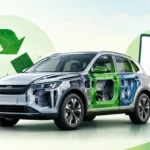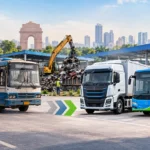

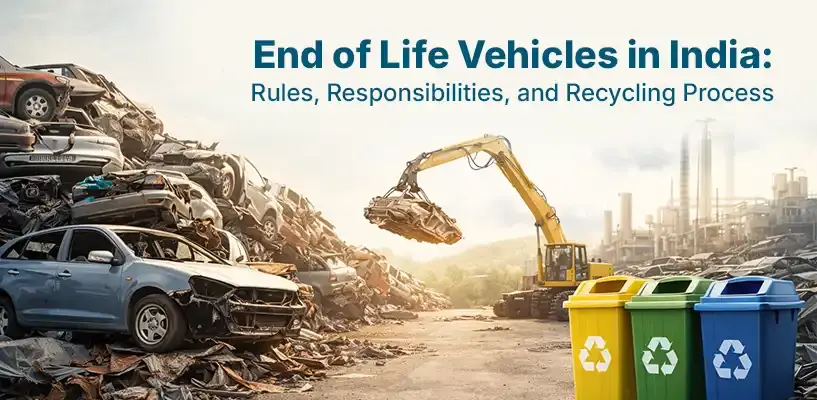
End of life vehicles in India are regulated under the Environment Protection (End-of-Life Vehicles) Rules, 2025, which establish a government-mandated framework for environmentally sound vehicle scrapping through Extended Producer Responsibility.
Vehicles that are deregistered, declared unfit, or exceed prescribed age limits must be processed at an authorised Registered Vehicle Scrapping Facilities to enable verified material recovery, emissions avoidance, and audit-ready emissions accounting aligned with national circular economy and sustainability goals.
What Are End-of-Life Vehicles (ELVs)?
End-of-life vehicles are vehicles that are no longer legally permitted or technically fit to operate on public roads under applicable regulations. Once a vehicle meets defined eligibility conditions, it enters the formal ELV management system for deregistration, scrapping, and material recovery.
A vehicle becomes an ELV due to age-related limits, failure in automated fitness testing, cancellation of registration, severe damage from accidents or natural events, or voluntary declaration by the registered owner. These triggers are designed to balance road safety, emissions control, and regulatory enforcement.
Within the framework governing end of life vehicles in India, ELV classification activates mandatory routing to authorized scrapping channels, ensuring traceability, pollution control, and compliance with the vehicle scrappage policy in India.
Why India Introduced Formal ELV Regulations
India introduced formal regulations for end of life vehicles in India to address structural gaps in vehicle retirement, environmental control, and material recovery. The objective was not limited to scrapping older vehicles, but to establish a regulated system that links deregistration, recycling, and producer accountability within a traceable and auditable framework.
- Rapid growth in vehicle ownership increased the number of ageing and unfit vehicles, raising emissions, fuel inefficiency, and road safety risks.
- Older vehicles generate higher pollutant emissions, while uncontrolled disposal of oils, batteries, and refrigerants creates soil, air, and water contamination.
- Informal scrapping dominated ELV processing, leading to unsafe practices, material leakage, undocumented dismantling, and weak compliance oversight.
- Regulated recycling enables recovery of steel and non-ferrous metals, reduces reliance on primary mining, and strengthens circular economy outcomes.
- Alignment with global ELV and Extended Producer Responsibility frameworks improves regulatory consistency, supply-chain credibility, and sustainability reporting.
Extended Producer Responsibility (EPR) for Vehicles
Extended Producer Responsibility in the ELV framework assigns lifecycle accountability to producers for the environmentally sound disposal and material recovery of vehicles placed on the Indian market.
Producers include original equipment manufacturers, importers, and vehicle assemblers who are required to meet annual scrapping and recycling targets linked to historical sales volumes and vehicle material composition.
Compliance is demonstrated through verified scrapping certificates, authorised facility records, and audit aligned documentation, enabling traceable reporting and providing measurable inputs for sustainability disclosures and emissions accounting.
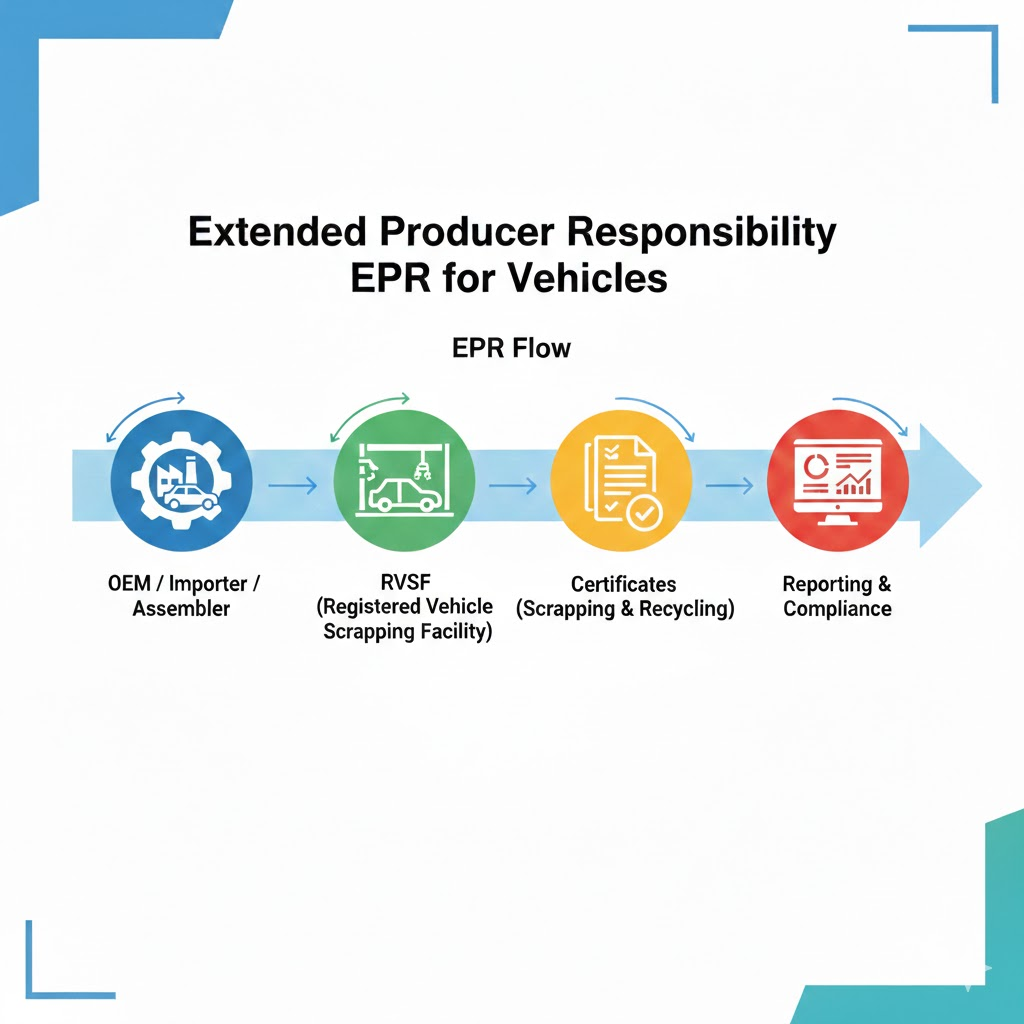
Role of Registered Vehicle Scrapping Facilities (RVSFs)
Registered vehicle scrapping facilities operate as the authorized infrastructure backbone for ELV recycling.
- Operate under regulatory authorization and environmental consent
- Implement depollution, dismantling, and material segregation protocols
- Issue certificates required for deregistration and incentive eligibility
- Maintain traceable documentation and mass balance records
These facilities also form the data foundation for emissions and material recovery assessments used to reduce automotive carbon emissions at a system level.
Incentives for Vehicle Owners Under the ELV Framework
The ELV framework applies market-aligned incentives to move vehicle owners from informal dismantling into regulated scrapping channels, strengthening compliance, traceability, and emissions accounting across the automotive value chain.
- Vehicle owners realise scrap value based on verified material recovery, primarily steel and recyclable fractions, supporting emissions avoidance and reducing leakage from informal processing.
- A valid Certificate of Deposit enables access to tax concessions and fee waivers linked directly to documented compliance and audit readiness.
- OEM-linked purchase incentives align consumer participation with Extended Producer Responsibility obligations and supply chain decarbonization goals.
- Together, these incentives reduce the cost gap between informal and authorised scrapping, increase verified ELV inflows, and support Scope 3 emissions disclosure and sustainability reporting.
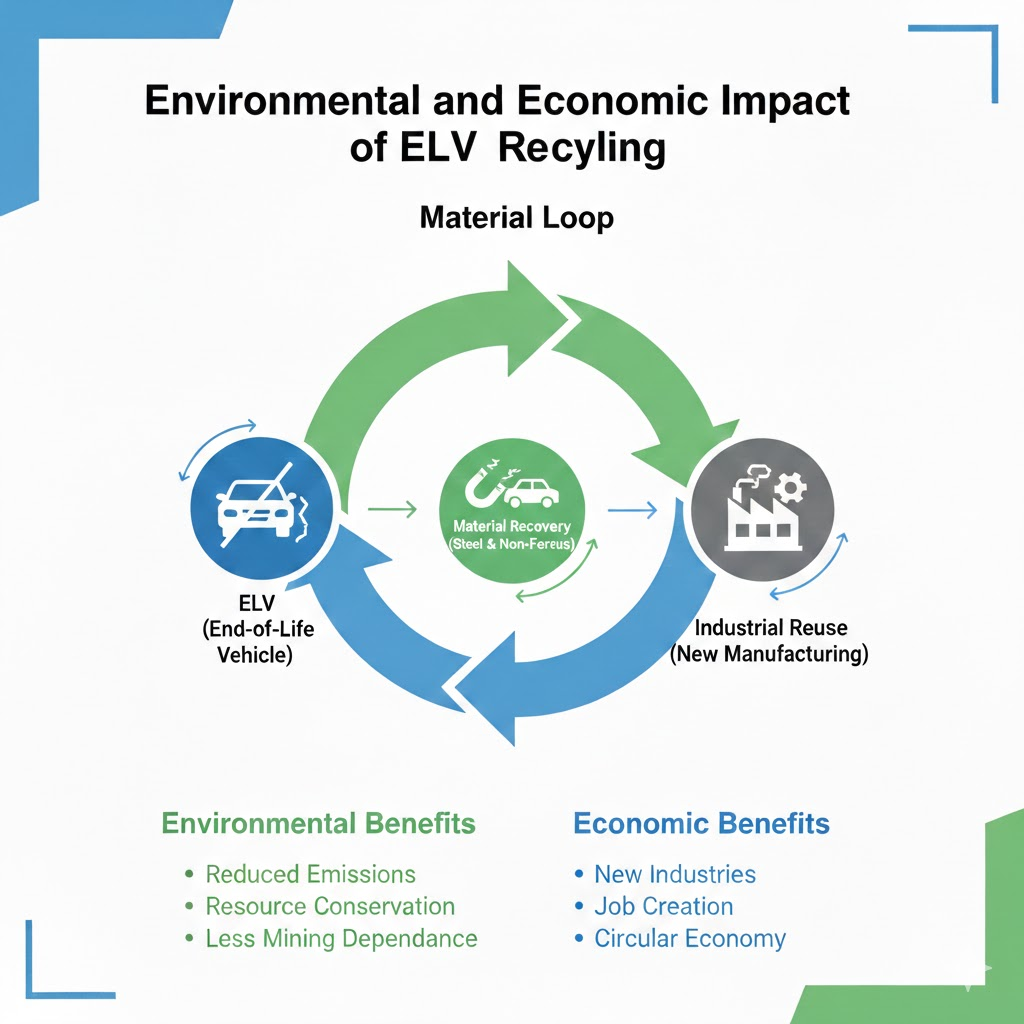
Environmental and Economic Impact of ELV Recycling
Formal ELV recycling integrates vehicle retirement into a controlled, resource-efficient industrial system, delivering measurable environmental benefits alongside economic value creation.
- Systematic removal of older vehicles reduces disproportionate tailpipe emissions, while verified material recycling lowers process emissions associated with primary metal production.
- Scientific dismantling enables high recovery of steel and non-ferrous metals, converting ELVs into secondary raw materials for industrial reuse and improving material efficiency.
- Substituting recycled metals for virgin inputs reduces dependence on primary mining, lowers energy consumption, and supports emissions avoidance relevant to carbon markets and emissions accounting.
- Expansion of authorised scrapping infrastructure generates formal employment across dismantling, logistics, material processing, and compliance, strengthening industrial standards and long-term sector viability.
How Digital Traceability Strengthens ELV Compliance and How MMCM Supports This?
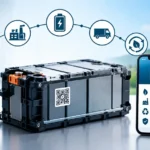
Digital traceability plays a central role in ELV compliance by linking vehicle identification, deregistration, dismantling, and material recovery into a single, auditable record. The ELV framework defined by NITI Aayog and MoRTH relies on accurate documentation, mass-balance checks, and verifiable Certificates of Deposit to prevent informal scrapping, data gaps, and double counting.
Within this system, MMCM functions as a digital infrastructure layer rather than an operational operator. Through platforms such as DigiELV and AutoLoop, MMCM enables structured data capture at Registered Vehicle Scrapping Facilities, supports Extended Producer Responsibility compliance, and improves audit readiness through digital MRV workflows. This traceability connects on-ground scrappage and recycling activities to reliable data for emissions accounting, sustainability reporting, and circularity-linked carbon assessments, while remaining aligned with existing regulatory processes.
Conclusion
End of life vehicles in India create measurable environmental and material risks when they fall outside formal systems. Unregulated dismantling leads to unmanaged emissions, loss of recoverable metals, and gaps in emissions accounting across the automotive value chain.
The ELV framework responds by linking transport regulation with environmental compliance and Extended Producer Responsibility. Vehicles processed through authorised scrapping infrastructure generate traceable records of dismantling and material recovery. This improves verification, supports audit readiness, and strengthens sustainability reporting for producers.
FAQs
An end-of-life vehicle in India is a vehicle that is no longer roadworthy or legally permitted for use due to age, failed fitness testing, registration cancellation, severe damage, or voluntary declaration, and must be processed through authorised scrapping channels.
A vehicle typically becomes an ELV after 15 years for transport vehicles and 20 years for non-transport vehicles, subject to mandatory automated fitness testing. Failure to meet prescribed fitness or emissions standards results in ELV classification.
The ELV Rules 2025 are environmental regulations issued under the Environment Protection Act that introduce Extended Producer Responsibility for vehicles, define recycling targets, mandate authorised scrapping, and establish compliance, reporting, and traceability requirements across the ELV ecosystem.
Extended Producer Responsibility in vehicle recycling assigns manufacturers, importers, and assemblers responsibility for meeting ELV recycling targets, procuring verified recycling outcomes, and maintaining documentation to demonstrate compliance with material recovery and environmental obligations.
Certain specialised vehicles, defence vehicles, or categories explicitly notified by the central government may be excluded or subject to separate treatment under ELV rules, depending on their operational purpose, ownership, or regulatory classification.
Vehicle owners receive scrap value, complete waiver of registration fees, motor vehicle tax concessions (up to 25%), and manufacturer-linked purchase discounts (up to 1.5% on ex-showroom price), subject to submission of valid scrapping certificates issued by authorised Registered Vehicle Scrapping Facilities.
Last Updated on: March 12, 2026