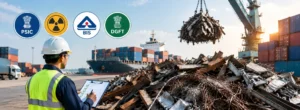

India’s Steel Scrap Recycling Policy, notified by the Ministry of Steel in November 2019, created a framework for organised, scientific collection, dismantling and processing of scrap from end-of-life vehicles, household goods and industry.
It proposed a hub-and-spoke network of scrap processing centres fed by collection and dismantling centres, with the aim of supplying quality ferrous scrap to steelmakers and reducing dependence on imported scrap.
What Is the Steel Scrap Recycling Policy 2019?
A Ministry of Steel framework, notified in the Gazette on 7 November 2019, that promotes metal scrapping centres for the scientific processing and recycling of ferrous scrap. The Ministry describes its own role as facilitative, since the policy provides standard guidelines rather than funding or operating any centre.
That description comes from the Ministry itself. In a reply to Rajya Sabha Unstarred Question 3679 on 4 April 2022, it stated that the policy was notified on 7 November 2019 and provides standard guidelines for collection, dismantling and shredding activities, inside a framework to increase the availability of domestically generated scrap.
That scrap definition follows the waste stream rather than the industry. The policy covers recyclable ferrous, non-ferrous and other non-metallic scrap recovered from end-of-life products, among them vehicles and white goods. Ship recycling is governed separately under its own law.
Why Did India Need a Steel Scrap Recycling Policy?
India needed a more organised scrap supply to support its steelmaking capacity and reduce dependence on imports. In 2019, domestic scrap supply stood at about 25 million tonnes, largely from the unorganised sector, while imports added another 7 million tonnes. The National Steel Policy 2017 target of 300 million tonnes per annum of steel production capacity by 2030 increased the importance of building a reliable domestic supply chain.
Historical import data, which the Ministry of Steel reported in April 2022 from Joint Plant Committee figures, shows the scale of that dependence in the years around the policy’s notification. These are past figures and do not describe current import levels.
|
Financial year |
Steel scrap imports (historical, as reported in April 2022) |
|
2018–19 |
6.56 million tonnes |
|
2019–20 |
6.57 million tonnes |
| 2020–21 |
5.57 million tonnes |
The supply challenge was not limited to imports. In December 2022, the Ministry of Steel told the Rajya Sabha that producing 120 million tonnes of crude steel required about 30 million tonnes of scrap, with 26 million tonnes sourced domestically and 4 million tonnes imported.
A stronger recycling system could address this supply requirement while reducing the resources consumed in steel production. Using scrap instead of virgin raw materials reduces demand for mining and processing, making steel recycling from vehicles an important part of the resource recovery chain.
The Steel Scrap Recycling Policy, 2019, estimated the following resource and environmental savings per tonne of scrap used. Every figure in the table is the policy’s own 2019 estimate rather than a measured outcome:
| Resource or impact | Estimated saving per tonne of scrap (2019 policy estimate) |
| Iron ore | 1.1 tonnes |
| Coking coal |
630 kg |
| Limestone | 55 kg |
| Energy | 14 MJ/kg on the blast furnace route; under 11 MJ/kg on the electric arc furnace and induction furnace route |
| Greenhouse gas emissions | Estimated at about 58% lower |
|
Water use |
Estimated at about 40% lower |
These estimates illustrate why scrap recycling matters beyond material availability. A more organised collection and processing system can help steelmakers access secondary raw materials while reducing resource use and the environmental burden associated with steel production.
What Are the Objectives of the Steel Scrap Recycling Policy?
The policy sets out eight objectives. They run from promoting a circular economy in steel and formalising the collection, dismantling and processing of end-of-life products, to supplying quality scrap that reduces imports, decongesting cities of end-of-life vehicles, lowering greenhouse gas emissions, and managing residues in line with the Hazardous and Other Wastes Rules, 2016 wherever a residue falls within the scope of those Rules.
Those objectives are organised around the 6Rs, which the policy names as Reduce, Reuse, Recycle, Recover, Redesign and Remanufacture. The list also carries Extended Producer Responsibility, with manufacturers expected to design vehicles for recyclability at end of life. Both ideas put design decisions upstream of the scrap yard.
How Does the Policy’s Hub-and-Spoke Model Work?
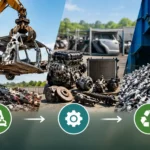
Four collection and dismantling centres feed one scrap processing centre, which is the policy’s 4+1 model. The spokes collect end-of-life products and strip them, the hub shreds, shears and bales the material into furnace-ready grades, and the processed scrap then moves to steel mills.
Those hubs were to be placed where material moves cheaply. The policy pointed to sites near highways, rail sidings and port-linked projects, inside eco parks and recycling zones, with containerised transport to limit pilferage in transit. Location decides whether a spoke can supply a hub economically.
That hub-and-spoke scale was estimated in centres rather than in tonnes. The 2019 policy projected that about 70 processing centres of one lakh tonnes each, served by about 300 collection and dismantling centres, would be needed to replace imports, and it estimated that the requirement would rise to roughly 700 processing centres once steel output reached 250 million tonnes. These are the policy’s own projections from 2019, not counts of centres that were built.
The same projections carried an employment estimate of about 400 people for each 4+1 unit, again as the policy assessed it in 2019. The design also had a second purpose, which was drawing collectors from the unorganised sector into a formal chain with weighbridges, records and graded output.
What Standards Did the Policy Set for Scrapping Centres?
Two sets of guidelines, one for dismantling centres and one for scrap processing centres, with an authorisation regime that can be withdrawn for breach. Dismantling covers depollution and safe storage, processing covers equipment and segregation, and both require trained staff and a route for residues.
Dismantling centres
A dismantling centre was to be a large gated site with impermeable surfaces, where fluids are drained and parts removed, preferably with zero discharge. Batteries, filters, condensers and tyres are stored safely, radiation is measured at intake, and fire protection and trained staff are required as prescribed.
Under the 2019 guidelines, that centre was to issue a Certificate of Destruction to the owner and upload the record to a common digital platform. The Certificate of Destruction is the 2019 policy’s own instrument. It is separate from the documents an owner now receives at a Registered Vehicle Scrapping Facility (RVSF) under the later Motor Vehicles (Registration and Functions of Vehicle Scrapping Facility) Rules, 2021, where a Certificate of Deposit is issued when the vehicle is handed over and a Certificate of Vehicle Scrapping is issued after treatment, so that the registration can be cancelled.
Scrap processing centres
Processing centres were to run shredding, shearing, baling and slitting equipment on best available technology, with radioactive detection at intake and storage for segregated material. Output is separated by chemical composition against the specified BIS scrap grades, which is the logic behind scrap metal grading in the trade.
Authorisation and environmental compliance
Authorisation under the policy depends on complying with the environmental laws and rules that apply to a centre, and which ones apply depends on the activities the centre carries out and the waste streams it handles. The policy pointed to the Environment (Protection) Act, 1986, the Water and Air Acts, and the CPCB guidelines for end-of-life vehicles as the general framework. Rules for specific streams, such as the Hazardous and Other Wastes Rules, 2016, radiation protection rules, and the e-waste, battery and plastic waste rules, apply only where a centre handles the material those rules cover, so not every rule on the list applies to every centre. ISO 9001 and ISO 14001 certification were preferred rather than required.
Those authorisations can also be withdrawn. A centre in breach faces de-authorisation, and hazardous material has to go to authorised recyclers rather than into the open market. Compliance is a condition of operating under the framework, not a reporting exercise beside it.
Who Is Responsible for What Under the Policy?
The policy assigned responsibilities to five groups: aggregators, the centres themselves, central and state governments, manufacturers of vehicles and white goods, and owners handing over an end-of-life product. These were roles the policy envisaged, not legal duties in themselves; where a role is now enforceable, the obligation comes from later rules. The policy describes this as shared responsibility, with the Ministry of Steel as focal ministry and an Inter-Ministerial Coordination Committee above it.
Aggregators
Aggregators were to hold long-term tie-ups with dismantling and processing centres, segregate material to BIS specifications, and run weighbridges and value yards. Their second role is structural, drawing informal collectors into a chain that records what it buys and what it sells on.
Dismantling and processing centres
Under the policy, centres were to verify a vehicle against the Vahan database before accepting it, and to deface or drill engine parts so that they could not return to the market as spares. They were also to segregate scrap by composition and train staff continuously. Verification at intake was the step the policy relied on to separate an authorised centre from an informal yard.
Central and state governments
The Ministry of Steel is the focal ministry, with an Inter-Ministerial Coordination Committee chaired by the Steel Secretary drawing in road transport, heavy industries, environment, revenue and labour. States were to support centres through land, stamp duty, power tariffs and industry status, alongside single-window environmental clearance.
Manufacturers
The 2019 policy envisaged that manufacturers of vehicles and white goods would design for recyclability, avoid hazardous substances, share dismantling information within six months of a launch, and run take-back schemes. Those were expectations set out in a policy, not obligations a manufacturer could be held to under it. The legally enforceable obligations on vehicle producers came later and rest on their own legal basis: the Environment Protection (End-of-Life Vehicles) Rules, 2025 set EPR targets for producers, so the 2019 policy is part of the background to those obligations rather than their source.
Owners
An owner was to hand an end-of-life vehicle to a centre authorised under the applicable rules, with proof of ownership, and Annexure I of the policy lists what should come with it, among them the body, engine, transmission, axles, battery and catalytic converter for a car. White goods go with a self-certified undertaking.
How Does the Policy Connect to India’s Vehicle Scrapping Policy?
The 2019 policy set the framework for scrapping centres, and the Ministry of Road Transport and Highways later added the incentives and disincentives that retire old and unfit vehicles. The Ministry of Steel described that division in April 2022, which places the vehicle scrappage policy on the supply side of the same chain.
Those two tracks use different certificates, which is where readers most often go wrong. The 2019 policy’s Certificate of Destruction is issued by a dismantling centre as proof that a vehicle has been destroyed, while the later RVSF Rules use two certificates of their own: a Certificate of Deposit when a registered facility accepts the vehicle, and a Certificate of Vehicle Scrapping once treatment is complete.
Those facilities exist in practice, and the public sector is one of several operators. A government release in December 2024 reported that the joint venture between MSTC, a central public sector enterprise under the Ministry of Steel, and Mahindra Accelo had six operational RVSFs. These are one operator’s facilities among many, and the national count of registered facilities is far larger.
Those centres run on records as much as on equipment. Digital systems such as MMCM’s AutoLoop can support vehicle-level operational records and material recovery documentation at registered facilities, which is the organised handling the 2019 policy described. Any statutory claim still has to meet the verification requirements applicable to it.
What Has Happened Since the Policy Was Notified?
Building the centres was left to the market. The Ministry of Steel told the Rajya Sabha in December 2022 that the decision to set up scrapping centres by public or private sector units is taken on commercial considerations, and the framework carries no funding and no incentive on scrap sales, leaving pricing to the parties generally.
Those commercial decisions have since added up to a sizeable network of registered facilities. According to a Ministry of Steel response in Parliament, 151 RVSFs were operational across 23 States and Union Territories as of 24 July 2026. That figure counts registered vehicle scrapping facilities only, so it is not a count of every scrap processing centre in the country, and it does not show how far the policy’s 4+1 hub-and-spoke structure has been built.
The same response put the scale of scrap use in context: 36 million tonnes of ferrous scrap were used in steel production in FY 2025-26, of which approximately 28 million tonnes were generated domestically. Set against the 25 million tonnes of domestic supply the policy described in 2019, the figures show domestic generation growing, while imports continue to supply part of the requirement.
A successor policy has also been reported. Trade press reported in January 2026 that a Joint Secretary in the Ministry of Steel described a national steel scrap recycling policy as being in the final stage of formulation. Whether it has since been notified should be confirmed against the Ministry of Steel’s own notifications before it is relied on.
Conclusion
The Steel Scrap Recycling Policy 2019 set out an organised and environmentally bounded route for ferrous scrap: spokes that collect and dismantle, hubs that shred and grade, authorisation that can be withdrawn, and responsibilities spread across aggregators, centres, governments, manufacturers and owners. It treated import dependence as a design problem rather than a trade one.
That design did not build anything by itself. Centres remain commercial decisions taken by public and private operators, so the practical question for a reader is whether a given registered vehicle scrapping facility meets the standards the policy described. A successor policy was reported to be in the final stage of formulation in January 2026, and its current status is best confirmed with the Ministry of Steel.
FAQs
When was the Steel Scrap Recycling Policy notified?
It was notified in the Gazette on 7 November 2019, a date the Ministry of Steel confirmed in its reply to Rajya Sabha Unstarred Question 3679 on 4 April 2022. The policy document itself is dated earlier in that month, which is why some summaries give 6 November.
Which ministry issued the Steel Scrap Recycling Policy?
The Ministry of Steel, which is also the focal ministry for its implementation. An Inter-Ministerial Coordination Committee chaired by the Steel Secretary brings in road transport, heavy industries, environment, revenue and labour, since scrapping touches registration, hazardous waste and labour rules at once.
What is the 4+1 model in the steel scrap policy?
Four collection and dismantling centres feeding one scrap processing centre. The four spokes gather and strip end-of-life products, and the hub shreds, shears and bales the material into graded furnace feed. The policy used the ratio to project how many centres India would need, which was a 2019 projection rather than a count of centres built.
Does the government set up scrapping centres under the policy?
No. The Ministry of Steel told the Rajya Sabha in December 2022 that the decision to set up scrapping centres by public or private sector units is taken on commercial considerations. The policy provides guidelines and a framework, without funding, price-setting or an incentive on scrap sales.
Is ship-breaking scrap covered by the policy?
The policy addresses scrap recovered from end-of-life products such as vehicles and white goods. Ship recycling is governed separately under its own law, so yard operations there follow that framework and its rules rather than the guidelines the Ministry of Steel issued in 2019.
What are the 6Rs in the steel scrap recycling policy?
Reduce, Reuse, Recycle, Recover, Redesign and Remanufacture. The policy organises its objectives around them, which places design and remanufacture alongside recycling rather than after it. Redesign is the one that reaches manufacturers directly, through recyclable design and the sharing of dismantling information with centres.
Which waste rules apply to scrapping centres?
It depends on what a centre does and which wastes it handles. The Environment (Protection) Act, 1986, the Water and Air Acts and the CPCB guidelines for end-of-life vehicles form the general framework. The requirements of the Hazardous and Other Wastes (Management and Transboundary Movement) Rules, 2016 apply where a residue is covered by those Rules, and the radiation, e-waste, battery and plastic waste rules apply where the centre handles those materials.