

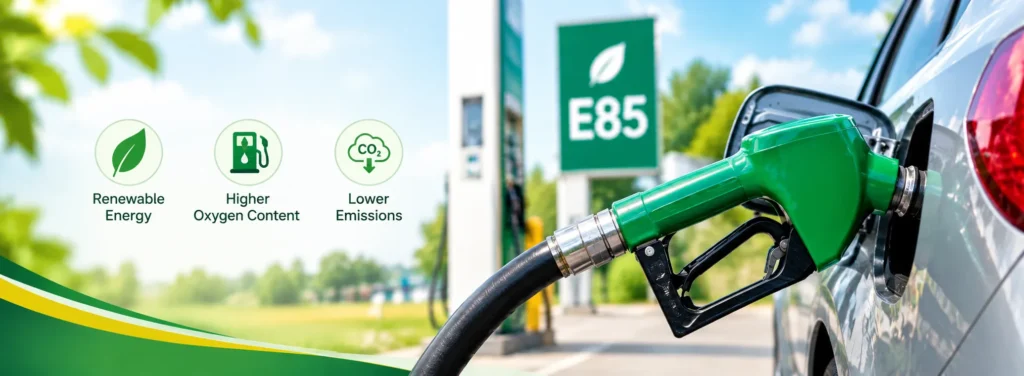
E85 fuel is a high-ethanol motor fuel made of roughly 85 percent ethanol and 15 percent petrol, designed only for flex-fuel vehicles. Standard petrol cars cannot use it, since the high ethanol content corrodes ordinary fuel-system parts.
E85 can reduce lifecycle greenhouse-gas emissions compared with petrol, but the size of that reduction depends substantially on the feedstock the ethanol is made from, the production pathway and the lifecycle-assessment method used to measure it. Because ethanol carries less energy per litre than petrol, E85 also generally delivers fewer kilometres per litre.
Important Note: ethanol’s lower energy density delivers about 20 to 35 percent lower mileage.
What E85 Fuel Is Made Of
The name E85 refers directly to its ethanol content. E85 fuel is a blend of approximately 85 percent ethanol and 15 percent petrol, though the ethanol share can range between 80 and 85 percent depending on seasonal and regional specification. The ethanol comes from domestic agricultural feedstock, which is the whole point of the fuel; it substitutes imported crude with an alcohol produced inside India.
Under the government’s Ethanol Blending Programme (EBP), the ethanol used in E85 fuel comes from three main feedstocks:
- Sugarcane and sugarcane molasses, the dominant source drawn from India’s sugar sector
- Maize and damaged grains, expanded rapidly since 2022 to reduce sugarcane dependency
- Second-generation cellulosic feedstock, an emerging category that uses agricultural waste
To understand where E85 sits, it helps to see all the ethanol blends on one ladder. Every “E” number is simply the ethanol percentage:
| Blend | Ethanol content | Where it fits |
| E10 | 10% | The petrol most outlets sold before 2025 |
| E20 | 20% | India’s national petrol standard from 2025 |
| E85 | Up to about 85%, within a specified range | For flex-fuel vehicles only |
| E100 | 100% | Pure ethanol, for FFVs built for it |
E20 and E85 are not interchangeable. E20 is calibrated to work in regular petrol engines with only minor material upgrades. E85 fuel requires a fundamentally different fuel system.
Who Can Use E85 Fuel
E85 fuel is designed exclusively for flex-fuel vehicles, and putting it into any other petrol car can cause serious mechanical damage. A flex-fuel vehicle, or FFV, is engineered specifically to handle high ethanol concentrations. Its engine uses corrosion-resistant fuel-system parts, upgraded injectors calibrated for ethanol’s different burn characteristics, and an engine-management system that adapts to varying ethanol concentrations, so the engine can run on different blends without any adjustment by the driver.
Standard petrol cars and E20-compatible cars cannot use E85. The high ethanol concentration corrodes ordinary rubber seals and aluminium components, damages the fuel pump over time, and confuses the engine’s fuel map because the sensors expect a much lower ethanol reading.
According to the Ministry of Road Transport and Highways, only vehicles certified as flex-fuel compatible are cleared to use E85 fuel. The safest checks are the “Flex Fuel” badge on the vehicle body, the owner’s manual, or written confirmation from the manufacturer. E20 compatibility does not extend to E85.
The current list of E85-compatible vehicles in India is short but growing. The Maruti Suzuki WagonR Flex Fuel launched as India’s first mass-market passenger car for this fuel, alongside two-wheelers such as the Hero Splendor+ Flex Fuel, Hero HF Deluxe Flex Fuel, and the Suzuki Gixxer SF flex-fuel variant. Beyond these launched cars, several manufacturers have flex fuel vehicles at prototype stage, awaiting wider E85 availability before series production.
E85 Fuel Cost and Mileage Compared to Petrol
E85 fuel is cheaper per litre than petrol but delivers lower mileage, so the real question is not the pump price but the cost per kilometre driven. This is the calculation most coverage of E85 gets wrong.
The pump-price advantage
According to IndianOil’s launch announcement, E85 fuel was introduced at the Pusa Road outlet in Delhi at around ₹82.12 per litre, roughly ₹20 below E20 petrol on that day. The pump-price gap is the base case for E85 economics.
The mileage penalty
Ethanol carries less energy per litre than petrol. According to the US Department of Energy’s Alternative Fuels Data Center, this energy-density gap translates into about 20 to 35 percent lower mileage on E85. A car that returns 20 kmpl on petrol will typically deliver 14 to 16 kmpl on E85 fuel.
The cost-per-kilometre maths
The real E85 economics depend on how the price gap compares to the mileage drop:
- If E85 is 20 percent cheaper per litre and mileage falls 25 percent, cost per kilometre is marginally higher on E85 than on petrol
- If the price gap widens, for instance if the reported GST cut from 18 percent to 5 percent goes through, the balance tips in E85’s favour
- If a particular FFV lands at the lower end of the mileage-drop range, E85 fuel becomes cheaper per kilometre at current prices
Beyond the wallet, E85 can significantly reduce particulate and certain other tailpipe emissions, and it can lower lifecycle greenhouse-gas emissions compared with petrol. The size of both benefits varies: tailpipe reductions depend on the vehicle’s technology and calibration, and lifecycle reductions depend on how the ethanol was produced, which together shape how far E85 reduces the carbon footprint of cars over their operational life.
E85 Fuel Availability and Rollout in India
E85 fuel was launched in India on 5 June 2026, World Environment Day, at an IndianOil retail outlet on Pusa Road in New Delhi. The launch was announced by the Union Minister for Petroleum and Natural Gas as part of India’s green mobility push, which has moved ethanol blending from about 1.5 percent in 2014 to 20 percent by 2025 as documented in the NITI Aayog Ethanol Roadmap.
The rollout is scheduled in three phases:
- Phase 1 (June to December 2026): around 48 public-sector oil-company outlets across metros, expanding toward 500 outlets by December 2026, per the Ministry of Petroleum and Natural Gas
- Phase 2 (2027): targeted expansion to roughly 5,000 outlets by December 2027, prioritising Delhi-NCR and the Mumbai-Pune-Nagpur corridor before Tier-2 cities
- Phase 3 (post-2028): rural and highway coverage, with proximity to E100 dispensing infrastructure
Two strategic drivers sit behind the rollout. India imports roughly 85 percent of its crude oil, per the Ministry of Petroleum, so ethanol substitution directly reduces foreign-exchange outflow. Ethanol demand supports farm income through domestic feedstock procurement.
For readers planning to buy a flex fuel vehicle in India, availability outside the metros is still thin. Check IndianOil, Bharat Petroleum, or Hindustan Petroleum outlet listings before committing to a flex-fuel purchase in a Tier-2 or Tier-3 city.
Conclusion
E85 fuel is a high-ethanol blend built for flex-fuel vehicles, and it sits at the centre of India’s strategy to cut oil imports, back farm-sector income, and reduce transport emissions. It costs less per litre than petrol and is cleaner across its lifecycle, but the lower energy density delivers noticeably lower mileage, so the real saving depends on the price gap staying wider than the mileage drop.
The single most important safety rule is that E85 fuel is only for FFVs. Using it in a standard petrol car, even one certified for E20, will damage the fuel system. With the rollout still concentrated in metros, treat E85 today as an early-adopter fuel that will make more sense as outlets multiply and the case to reduce automotive carbon emissions shapes mainstream buying decisions.
FAQs
Can I put E85 in a normal petrol car?
No. E85 fuel is designed only for flex-fuel vehicles. Its high ethanol content corrodes standard rubber and aluminium fuel-system parts and can cause serious engine damage in a regular petrol car or even an E20-compatible car. Check the “Flex Fuel” badge before filling.
Is E85 cheaper to run than petrol?
It depends on the price gap versus the mileage drop. E85 fuel is about ₹20 per litre cheaper than E20 petrol at launch, but FFVs run 20 to 35 percent fewer kilometres per litre. If the discount stays bigger than the mileage penalty, E85 works out cheaper per kilometre.
What is the difference between E20 and E85?
E20 is 20 percent ethanol mixed with 80 percent petrol and is safe in most modern petrol cars. E85 fuel is 85 percent ethanol and 15 percent petrol and can only be used in flex-fuel vehicles. The two blends are not interchangeable.
How much mileage does E85 give?
E85 generally delivers fewer kilometres per litre than petrol, because ethanol contains less energy per litre. How much lower depends on the ethanol concentration in the fuel and on the vehicle’s engine calibration, with driving conditions adding further variation, so the useful comparison is between figures for the specific vehicle on each fuel.
Where is E85 available in India?
E85 fuel launched at IndianOil’s Pusa Road outlet in Delhi in June 2026. Rollout targets around 500 public-sector outlets by December 2026 and 5,000 by December 2027, per the Ministry of Petroleum and Natural Gas, prioritising Delhi-NCR and the Mumbai-Pune-Nagpur corridor.
Does E85 damage the engine of a flex-fuel car?
No, provided the vehicle is FFV-certified. Flex-fuel vehicles are built with corrosion-resistant fuel lines, upgraded injectors, and an ethanol sensor. What damages the engine is using E85 fuel in a car not designed for it, such as a standard petrol car or an E20-only car.
Is E85 better for the environment?
Yes. According to the US Department of Energy, E85 fuel cuts lifecycle greenhouse-gas emissions by up to 61 percent compared with petrol, and particulate emissions are close to zero. It also reduces India’s crude-oil imports and supports domestic ethanol-feedstock farmers.
What is the price of E85 fuel in Delhi?
At its June 2026 launch, E85 fuel was priced at around ₹82.12 per litre in Delhi, roughly ₹20 below E20 petrol on the same date. Prices may shift, particularly if the proposed GST cut from 18 to 5 percent is implemented, so verify locally.