
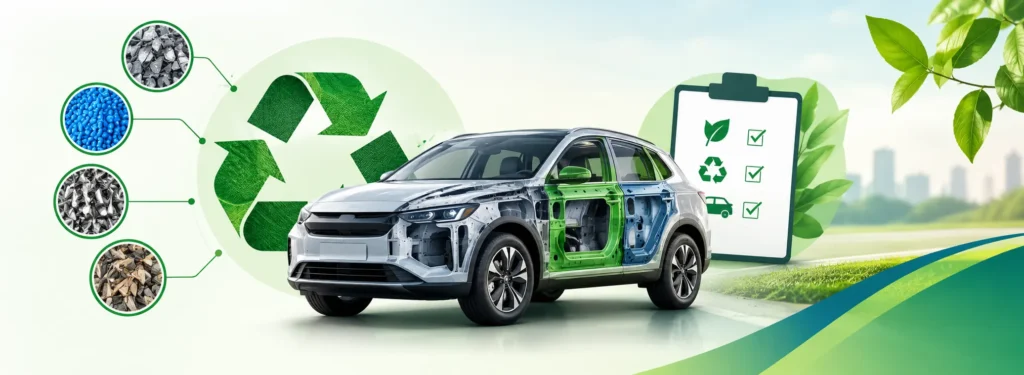
Recycled content requirements for vehicles set a minimum share of recycled material that must go into a new vehicle. They are separate from recovery obligations, which govern how much material a producer must pull out of old vehicles.
The European Union has moved first with binding recycled plastic figures under Regulation (EU) 2026/1738. India’s obligation remains a steel recovery target under ELV Rules 2025, with a recycled steel provision sitting in a draft amendment.
What Are Recycled Content Requirements for Vehicles?
A recycled content requirement fixes a minimum percentage of recycled material inside a new product. Applied to vehicles, it governs what goes into the car. Extended producer responsibility targets govern what comes out of the old one. Producers can meet one and miss the other.
The reason regulators reach for both is a supply and demand mismatch. Recovery targets generate recycled material without securing anyone to buy it, so it can be stockpiled, exported or sent to lower-grade uses. A content mandate creates the demand side.
Plastics have generally come first, because plastic recovery from vehicles has historically run low. Metals and critical raw materials follow. Some rules go further and require part of the recycled share to come from end-of-life vehicles rather than any recycled source, which is closed loop recycling written into law.
Verification travels with the obligation. A producer must document the origin and share of recycled material rather than assert it. That turns supplier data systems into compliance infrastructure before any percentage bites.
What Recycled Content Do EU Rules Require in New Vehicles?
Regulation (EU) 2026/1738 sets plastics figures at type approval and defers metals to later acts. The plastics obligation carries a sourcing condition inside it, which is the provision that matters commercially to recyclers rather than to procurement teams alone.
- Plastic thresholds: at least 15 percent post-consumer recycled plastic by weight for new vehicle types type-approved from 1 September 2032, rising to at least 25 percent from 1 September 2036, per the European Commission.
- Closed-loop condition: 20 percent of the recycled plastic counted toward each target must come from end-of-life vehicles, or from parts removed during the use phase, per recital 29.
- Exclusions: elastomers, and thermosets other than polyurethane foams used for cushioning, sit outside the calculation.
- Third-country material: recycled material processed outside the EU is reported as ineligible until 14 August 2030, and subject to equivalence and audit conditions thereafter.
- Metals and critical raw materials: the Commission must set targets for recycled steel, aluminium, magnesium and critical raw materials, expected to be established by September 2033.
|
Requirement |
Figure |
From |
|
Recycled plastic, new vehicle types |
15% by weight |
1 September 2032 |
|
Recycled plastic, new vehicle types |
25% by weight |
1 September 2036 |
|
Share sourced from end-of-life vehicles |
20% of each target |
With each target |
|
Reusable or recyclable by mass |
85% |
Retained threshold |
|
Reusable or recoverable by mass |
95% |
Retained threshold |
Depth on the wider instrument sits in the EU ELV Regulation explainer rather than here.
What Are India’s Recycled Content Requirements for Vehicles?
India has no notified recycled content requirement for vehicles. What exists is a recovery obligation. The Environment Protection (End-of-Life Vehicles) Rules, 2025 measure producer duties by the weight of steel recovered from scrapped vehicles.
The recovery obligation as it stands
Targets run at 8 percent of the steel equivalent for FY26 through FY30, then 13 percent to FY35, then 18 percent from FY36, per the Schedule to the Rules. The denominator is a lookback rather than current-year sales, taking sales 20 years earlier for private vehicles and 15 for commercial ones.
Year one did not go well. Against a requirement of about 7.62 lakh vehicles for FY26, roughly 2.42 lakh reached scrapping centres, a shortfall of around 70 percent, per Business Standard reporting of May 2026. Producers meet targets by buying ELV EPR certificates generated against recovered material.
What the draft amendment would change
MoEFCC issued a draft amendment on 27 March 2026 containing a new Rule 9A on recycled steel use in new vehicles, which would be India’s first vehicle content obligation. It remains a draft, and no percentage has been confirmed.
The same draft narrows certificate eligibility so that steel from other scrap sources would stop counting toward producer targets. Read together, the two changes would tighten both ends: more recovered vehicle steel required in, and fewer substitutes permitted.
What Makes Recycled Steel Targets Difficult to Meet?
Steel is recyclable many times over, yet automotive uses little recycled input. Transport and Environment’s April 2025 study put secondary steel from post-consumer scrap at 11.3 percent in internal combustion vehicles and 5.3 percent in electric vehicles across the EU fleet.
The copper problem
The constraint is metallurgical rather than commercial. Copper dissolves into molten steel and cannot practically be removed, so contaminated scrap is diverted to lower-grade applications.
- The specification: automotive steel generally requires copper below 0.1 percent, and below 0.06 percent for certain body components, per Transport and Environment.
- The reality of shredded scrap: copper in shredded end-of-life vehicle scrap can range from 0.23 percent to 0.7 percent, per the same study.
- Where the copper sits: roughly 60 percent of the copper in a vehicle is in the wire harness and the engine, per Transport and Environment.
- What changes it: dismantling the main wire harness and electric motor before shredding, with mechanical processing after the shredder, is reported by the same study to cut copper from about 0.4 percent to 0.06 percent.
What that implies for target-setting
Quality is decided at the dismantling bench rather than the furnace, which is why regulators pair content mandates with design for disassembly requirements. Transport and Environment has argued a 30 percent recycled steel target for 2030 and 40 percent for 2035 could be achievable if dismantling practice improves.
Aluminium carries a parallel constraint. Mixed alloy streams limit where recovered aluminium can go unless alloys are separated during dismantling rather than after shredding.
What Do Recycled Content Rules Mean for Automakers and Recyclers?
The obligation lands on producers, but the capability that satisfies it sits with recyclers. Both face the same shift: recycled material stops being a cost-saving option and becomes a specified input with documented origin.
For automakers and suppliers
- Feedstock security: qualifying recycled material is a limited pool, and long-term supply arrangements are becoming a procurement priority.
- Specification lead time: qualifying grades have to be designed into components, which affects material selection, tooling and supplier qualification years ahead.
- Market access: in the EU, recycled content sits inside type approval, so it conditions the right to sell rather than a voluntary metric.
For recyclers and scrap processors
- Structural demand: content mandates give qualifying recycled material a buyer, which can improve the investment case for higher-quality processing.
- Quality premium: material meeting automotive specifications may command more than mixed or contaminated scrap, rewarding careful separation over volume shredding.
- Documented origin: producers need evidence of where material came from, so traceability capability becomes commercial rather than administrative.
Indian suppliers to European vehicle programmes may meet content and documentation expectations contractually before any domestic rule binds them. At MoRTH-authorised Registered Vehicle Scrapping Facilities (RVSFs), end-of-life vehicles are depolluted and dismantled with components separated before processing. MMCM’s AutoLoop platform is the operating system RVSFs use to record what was recovered.
Conclusion
Recycled content requirements for vehicles are the demand-side half of a policy pair that has, until now, carried a supply side alone. Recovery targets pulled material out of old vehicles without securing anywhere for it to go. Content rules give it a destination.
The percentages are the visible part and the easier part. What decides whether a 30 or 40 percent recycled steel figure is reachable is whether wire harnesses come out before the shredder, and whether anyone can prove where the material came from. Both are settled years before the compliance date.
FAQs
What is the difference between recycled content and EPR targets?
Recycled content governs material going into a new vehicle. EPR targets govern material recovered from old ones. A producer can satisfy one and miss the other.
How much recycled plastic will cars need to contain?
At least 15 percent by weight for new vehicle types type-approved from 1 September 2032, rising to at least 25 percent from 1 September 2036 in the EU.
Are there recycled steel targets for vehicles yet?
Not as binding figures. The European Commission must set them for steel and other materials, expected by September 2033. India’s provision sits in a draft amendment.
What is closed-loop recycled content?
Recycled material sourced from the same product category, rather than any recycled source. The EU requires 20 percent of the recycled plastic target to come from end-of-life vehicles.
Why does copper contamination affect recycled steel?
Copper cannot practically be removed from molten steel. Shredded vehicle scrap can carry 0.23 to 0.7 percent copper against an automotive specification generally below 0.1 percent.
How do manufacturers prove recycled content?
Through documented supplier data and chain-of-custody records establishing the share and origin of recycled material. The EU is setting a calculation and verification methodology by implementing act.
What are the 85 percent and 95 percent vehicle thresholds?
Vehicle types must be reusable or recyclable to 85 percent by mass and reusable or recoverable to 95 percent by mass, thresholds retained under the EU regulation.
How do Indian scrapping facilities evidence recovered steel for producer targets?
Recovered weight is logged per vehicle before a certificate is issued. MMCM’s AutoLoop platform applies AIS-129 checks and dMRV capture at MoRTH-authorised RVSFs for OEMs with steel recovery obligations.