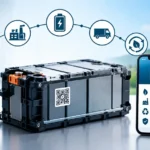

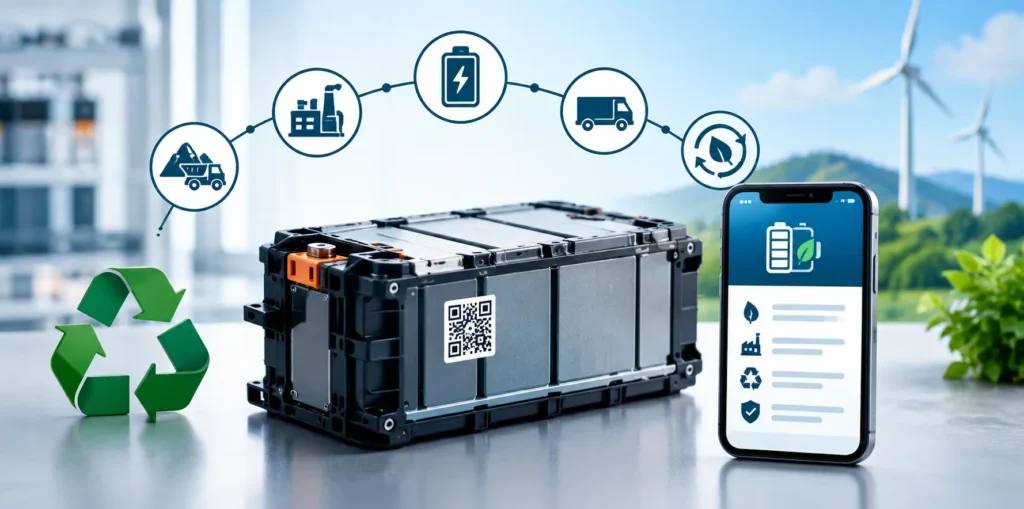
A digital product passport (DPP) for batteries is a structured digital record that tracks a battery’s full lifecycle, from raw material extraction through manufacturing, use, and recycling. Linked to the physical battery by a QR code, it holds data on material composition, carbon footprint, state of health, supply-chain due diligence, and end-of-life instructions.
The digital product passport requirement is becoming mandatory globally. Reports indicate the EU requires it for larger batteries from February 2027 under the EU Battery Regulation. In India, battery traceability is being developed through the regulatory framework, with a battery passport for EV batteries forming part of the broader policy discussion.
What Is a Digital Product Passport for Batteries
A digital product passport for batteries is a structured digital record of a battery’s full lifecycle, accessible by scanning a QR code on the physical battery. Stakeholders across the value chain (manufacturers, regulators, recyclers, and consumers) get on-demand access to the battery’s origin, composition, performance, and end-of-life information.
In plain terms: a battery passport is a scannable ID tag on the battery that opens up its full life story, from where the lithium came from to how it should be recycled.
Its purpose runs across four layers: improve transparency, enable due diligence on sourcing, support safe recycling and reuse, and advance the circular economy outcomes. Batteries are the first product group globally for which a DPP is becoming a legal requirement, which makes them the pilot case for wider product-passport rollouts.
Data access sits in three layers. A public layer carries general information anyone can view by scanning the QR code. A restricted layer holds due-diligence data available only to authorities and authorised parties. A dynamic layer holds continuously updated performance data such as charging cycles and state of health, refreshed during the battery’s operational life.
What Data a Battery Passport Contains
The battery passport data QR code links to structured information across six categories that together describe the battery from cradle to grave. Reports suggest a full battery passport can hold up to around 100 data points across these categories.
|
Category |
Example Data |
| Provenance and raw materials | Origin and sourcing of lithium, cobalt, nickel; responsible-sourcing due diligence |
| Carbon footprint | Verifiable GHG emissions across the production lifecycle |
| Composition and health | Chemistry, hazardous substances, expected cycle life, state of health |
| Manufacturing identity | Manufacturer, model, batch, unique battery identifier |
| Usage and performance | Charging cycles, thermal history, operating conditions (dynamic layer) |
| End-of-life instructions | Safe dismantling guidance, recycling routes, second-life repurposing |
The end-of-life category is where battery lifecycle traceability becomes operationally critical. Recyclers use these records to route batteries to the correct dismantling process, identify hazardous materials before opening the pack, and decide whether the battery should be repurposed for second-life storage or sent directly for material recovery.
The rule to remember: a battery passport is not a certificate. It is a live data record that updates through the battery’s life and stays useful long after it leaves the factory.
EU Battery Regulation and the Battery Passport Mandate
The EU battery regulation DPP makes a digital battery passport mandatory for electric vehicle (EV), light means of transport (LMT), and industrial batteries with capacity above 2 kWh sold in the EU market. According to European Commission communications, the requirement becomes mandatory from February 2027.
The regulation applies regardless of where the battery is manufactured. Any battery sold in the EU market must comply, which directly affects exporters worldwide including Indian battery makers who supply EU-bound EVs, industrial equipment, and stationary storage.
Responsibility sits with the economic operator placing the battery on the EU market. That operator must ensure passport data is complete, accurate, and updated across the battery’s life. Data comes from across the value chain: raw-material suppliers, cell manufacturers, battery producers, vehicle OEMs, BMS providers, and recyclers.
The EU DPP aligns with the Ecodesign for Sustainable Products Regulation (ESPR) and is often underpinned by blockchain or cloud infrastructure for tamper-proof records. Initiatives like the Global Battery Alliance are standardising battery-passport data across regions.
India Battery Passport and Traceability Rules
India is introducing its own India battery passport, described in policy communications as an “Aadhaar for EV batteries” that assigns a unique digital identity to every EV battery sold in India. This is the differentiator most global coverage of the DPP topic misses.
The mechanism is a proposed unique alphanumeric identification number paired with a QR code assigned to EV batteries. Both link to a national database holding origin, chemistry, carbon footprint, performance, safety certification, and recycling status. Reports indicate CPCB has proposed the framework, with phased implementation from 2026 starting with commercial 2-wheeler and 3-wheeler fleet batteries.
The battery waste rules 2022, with 2025 amendments, add a second traceability layer. They mandate QR or barcode traceability on all battery packs, linking each pack to a national battery registry for full lifecycle tracking from manufacture to recycling. Supporting standards include BIS certification (IS 17890, IS 16893) and AIS 156 for traction batteries, alongside EPR obligations administered through the CPCB portal.
Important note: Indian battery passport rollout dates and coverage thresholds are evolving. Confirm current status on official CPCB and MoRTH communications before making manufacturing or export decisions.
Why the Battery Passport Matters for Manufacturers and Recyclers
The digital product passport batteries mandate reshapes what manufacturers, recyclers, and regulators can do with battery data. Each stakeholder group faces a distinct impact.
For manufacturers and producers
Compliance becomes a market-access condition. Manufacturers selling into the EU from 2027 must ship a compliant DPP. In India, similar traceability requirements are becoming enforcement conditions under CPCB. A verified passport also supports ESG and BRSR sustainability reporting, providing sourced records of carbon footprint and responsible sourcing.
The operational cost is real: coordinated data collection across suppliers, investment in digital systems, and QR-code integration into manufacturing lines. Early investors build competitive advantage; late movers face parallel EU and India compliance.
For recyclers and the circular economy
End-of-life data enables safer, more efficient dismantling and higher material-recovery rates. Recyclers no longer open packs blind to their chemistry or hazardous content. Second-life battery applications (grid storage, backup power) become viable because battery health history is transparent.
Traceability of critical minerals recovery keeps recovered lithium, cobalt, and nickel in the domestic supply chain rather than lost to informal channels.
Avoid: treating the battery passport as a static compliance document. The dynamic layer must be updated across the battery’s operational life. Missing updates render the passport non-compliant even if the initial issuance was correct.
For consumers and regulators
Consumers gain transparency on sourcing, safety, and recyclability, and typically better resale value on batteries with verified histories. Regulators gain on-demand visibility to verify compliance and recycling, replacing paperwork audits with data queries.
Conclusion
The digital product passport for batteries is set to become a global standard for battery transparency and circularity. The EU leads with a mandatory passport for larger batteries from 2027, and India is following with its own battery passport and Battery Waste Management Rules traceability from 2026.
For manufacturers, the DPP is a condition of market access and a proof of sustainability. For recyclers, it is the key to safer, more efficient material recovery. Businesses that build robust battery data and traceability systems now will be best placed as passport rules move from proposal to enforcement, and the DPP will feed directly into every serious net zero roadmap in the sector.
FAQs
Is the battery passport mandatory in India?
Reports indicate CPCB has proposed a mandatory Indian battery passport for EV batteries, with phased rollout from 2026 starting with commercial 2-wheeler and 3-wheeler fleet batteries.
What is the difference between the EU and India battery passport?
The EU DPP covers EV, LMT, and industrial batteries above 2 kWh from February 2027. India’s version, CPCB-proposed for EV batteries, starts with fleet 2W and 3W batteries from 2026.
Which batteries need a digital product passport?
Under the EU regulation, EV batteries, light means of transport batteries, and industrial batteries above 2 kWh capacity require a digital product passport. In India, EV batteries are the initial focus.
How do you access a battery passport?
Battery passports are accessed by scanning the QR code on the battery. The QR links to the national or regional database holding the battery’s full lifecycle record, with tiered access levels.
Who is responsible for creating a battery passport?
Responsibility sits with the economic operator placing the battery on the market, typically the battery manufacturer or the vehicle OEM. Data must be sourced from suppliers, cell makers, BMS providers, and recyclers.
Does the battery passport apply to Indian battery exporters?
Yes. Any battery sold into the EU market from February 2027 requires a compliant EU DPP regardless of manufacturing origin. Indian exporters to the EU must comply or lose market access.
How does a battery passport help recycling?
The end-of-life data category tells recyclers the battery’s chemistry, hazardous content, and recommended dismantling route. This enables safer dismantling, higher material-recovery rates, and reliable routing to second-life or EV battery recycling.
When does the EU battery passport become mandatory?
Reports indicate the EU DPP becomes mandatory for EV, LMT, and industrial batteries above 2 kWh from February 2027 under the EU Battery Regulation. Verify current implementation dates before acting.