
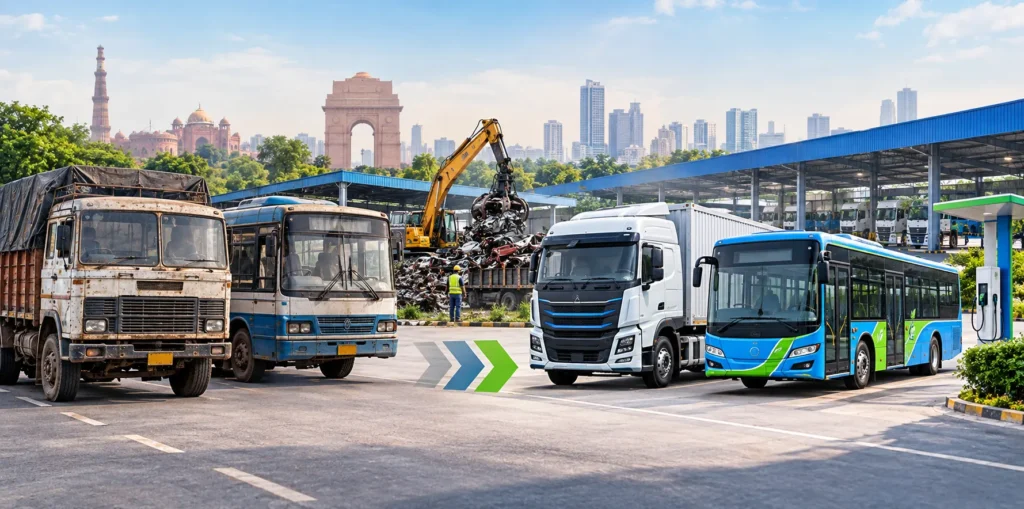
The Centre’s ₹9,585 crore PARIVARTAN scheme aims to replace older commercial trucks and buses across Delhi NCR with cleaner vehicles. However, the benefits available to an owner depend on the several factors, including the vehicle’s emission norm and registration location, how it exits the scheme, whether the replacement is new or used and runs on diesel, CNG or electricity, and whether the Certificate of Deposit is traded.
BS III and older vehicles must be scrapped at a Registered Vehicle Scrapping Facility (RVSF). BS IV vehicles can either be scrapped or sold outside NCR, but only to towns outside the National Clean Air Programme list, excluding most major cities. Owners may also receive interest subvention, fuel vouchers, tax and registration concessions, and a manufacturer discount. These benefits are part of the wider vehicle scrapping benefits available under regulated scrappage frameworks, rather than replacing the benefits that already apply when a vehicle is scrapped at an authorised facility.
The Cabinet release estimates that around 2.07 lakh vehicles are covered, including 1.91 lakh trucks and 16,329 buses. For most owners, the key question is therefore how the scheme’s benefits apply to their replacement vehicle and whether they choose to trade the Certificate of Deposit .
What Is the PARIVARTAN Scheme?
PARIVARTAN stands for Programme for Accelerated Renewal and Incentivization of Vehicle Assets for Reducing Transport Air Pollution and Network Emissions. According to the Cabinet release of 3 June 2026, the scheme is funded through the National Capital Region Planning Board under the Ministry of Housing and Urban Affairs. Implementation is led by the Ministry of Road Transport and Highways, while the Ministry of Petroleum and Natural Gas handles the fuel voucher component.
The scheme covers the National Capital Territory of Delhi and the NCR districts of Haryana, Rajasthan and Uttar Pradesh. This means eligibility is based on where the vehicle is registered, not where the owner lives. A truck registered in Jaipur or Lucknow, for example, does not qualify simply because its owner operates or resides in the NCR.
The scheme has a total outlay of ₹9,585 crore. According to the Cabinet release, this includes ₹5,041 crore of central government funding and an estimated ₹1,601 crore in state tax concessions, with the manufacturer discount and other participant contributions making up the rest of the package.
Enrolment remains open for two years from the date the scheme begins. Central benefits, however, continue for five years from the date the replacement vehicle is registered. Therefore, enrolling late does not shorten the five year benefit period, but enrolling after the two year window is not permitted.
Which Vehicles and Owners Qualify?
Eligibility depends on both the vehicle’s emission norm and its registration location. The scheme covers commercial trucks and buses registered in Delhi NCR that comply with BS IV or an earlier emission standard. The guidelines include Pre BS, BS I, BS II, BS III and BS IV vehicles within this group.
The following conditions determine whether a vehicle qualifies for the scheme:
- Emission norm: The vehicle must comply with BS IV or an earlier standard. BS VI vehicles are the replacement target and are not covered as vehicles being retired under the scheme.
- Registration location: The vehicle must be registered in the National Capital Territory of Delhi or an NCR district of Haryana, Rajasthan or Uttar Pradesh.
- Vehicle category: Benefits are tiered by vehicle size, from light goods and passenger vehicles to medium and heavy vehicles. This determines the fuel voucher and lump sum amount each owner receives.
- Ownership: Government vehicles are excluded, regardless of their emission norm.
According to the Press Information Bureau release of 3 June 2026, the scheme is expected to benefit “approximately 2.07 lakh (1.91 lakh trucks and 16,329 buses) owners” in Delhi NCR. Fleet operators holding several vehicles will therefore account for more than one vehicle each within that total.
BS III and BS IV Vehicles Follow Different Exit Rules
The exit route is set by the vehicle’s emission norm. BS III and older vehicles must be scrapped at a Registered Vehicle Scrapping Facility, with no sale option. BS IV vehicles can be scrapped or sold outside NCR to a town not on the National Clean Air Programme list. Either way, purchase-linked benefits require registering an eligible replacement vehicle inside NCR.
BS III and older vehicles
For BS III and older vehicles, scrapping at a Registered Vehicle Scrapping Facility is mandatory. These vehicles cannot be sold or relocated under the scheme.
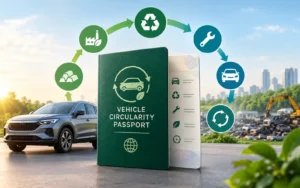
When the vehicle is handed to an authorised scrapping facility, the owner receives a Certificate of Deposit (CD). The CD is what the purchase-linked benefits are claimed against, and it can be held, used against a replacement purchase, or traded within its validity period.
BS IV vehicles
BS IV vehicle owners have more flexibility. They can either scrap the vehicle at a Registered Vehicle Scrapping Facility or sell it outside NCR.
However, selling outside NCR does not mean that the vehicle can be sold anywhere outside the region. The scheme specifies that the vehicle can only be sold to towns outside the National Clean Air Programme list. It covers cities identified as not meeting national ambient air quality standards, which is where most of the larger resale markets sit. An owner planning a sale should confirm the destination town’s status before agreeing a price, because a buyer in a listed city cannot take the vehicle under the scheme.
What must the replacement vehicle be?
The replacement vehicle must be registered within NCR and must meet the emission or fuel requirements specified by the scheme.
Owners can generally register a BS VI or stricter compliant vehicle or an electric vehicle. Delhi adds its own conditions. According to the Press Information Bureau release, Light Goods Vehicles purchased under the scheme in Delhi must be electric, while buses must be BS VI CNG or electric only.
What Benefits Does PARIVARTAN Provide?
Three parties pay for different parts of PARIVARTAN. The Centre carries the financing and fuel support. Participating states give up tax and fee revenue. Participating manufacturers discount the replacement vehicle. What an owner collects depends on which of the three they qualify for, and on whether they buy a replacement or trade the certificate instead.
Central government benefits
The Centre carries the financing and fuel side. Eligible loans attract a 5 percent interest subvention for five years. A monthly fuel voucher runs alongside it, tiered by vehicle class14.
A separate one-time incentive applies where the owner buys an electric replacement or trades the Certificate of Deposit instead of buying. It is the largest single amount in the scheme and it is the same either way, which is what makes the trading route worth costing rather than treating as a fallback.
| Vehicle class | Monthly fuel voucher | One-time incentive, where an electric replacement is bought or the CD is traded |
| Light goods and light passenger | ₹1,200 | ₹64,000 |
| Medium goods and medium passenger | ₹2,500 | ₹1.28 lakh |
| Heavy goods and heavy passenger | ₹4,800 | ₹2.56 lakh |
Both columns are reported from the MoHUA guidelines.
State government benefits
Participating states provide concessions associated with the replacement vehicle and the old vehicle.
These include a waiver of registration fees for the replacement vehicle and a waiver of pending liabilities on the old vehicle. The motor vehicle tax concession also forms part of the state level benefit package.
Participating states waive the registration fee on the replacement vehicle and write off pending liabilities of more than one year on the old one. The motor vehicle tax concession runs up to 100 percent for new vehicles and 50 percent for used, for ten years. All four participating governments have been notified.
Manufacturer discount
Participating manufacturers give around 8 % discount on the ex-showroom price of eligible replacement vehicles, which the July guidelines describe as a minimum rather than a cap. This is a scheme commitment, not the discretionary discount a manufacturer may separately offer against a scrapping certificate under the national scrappage framework.
Where Has PARIVARTAN Reached Since Cabinet Approval?
The Union Cabinet approved PARIVARTAN on 3 June 2026. Four things had to happen before owners could use it: operational guidelines, state tax notifications, manufacturer agreements, and a delivery platform connecting vehicle, scrapping, financing and benefit records
Operational guidelines approved
MoHUA (Ministry of Housing and Urban Affairs) approved the detailed guidelines on 16 July 2026. The ministry described the scheme as ready to be operationalised at that stage.
State notifications issued
Rajasthan, Haryana, Uttar Pradesh and the National Capital Territory of Delhi have each notified the ten year motor vehicle tax concession and registration fee waiver.
Haryana notified first, on 24 June 2026, at 100 percent on new BS VI compliant vehicles and 50 percent on used, for ten years from first registration
Manufacturer agreements signed
Manufacturers accounting for more than 95 percent of the commercial vehicle market have signed Memoranda of Understanding with MoRTH, extending the discount to eligible beneficiaries. Eleven had signed when the guidelines were issued in July 2026, rising to fifteen by late August alongside 42 banks and non-banking financial companies onboarded for the subvention
Delivery platform specified
The PARIVARTAN portal on parivahan.gov.in connects with VAHAN and V Scrap for vehicle and scrapping records. It also connects with the Public Financial Management System, participating lenders and fuel voucher systems for benefit disbursal.
An Empowered Committee chaired by the Cabinet Secretary oversees implementation, while District Collectors monitor implementation at the district level. This means the July operational guidelines are particularly relevant to owners planning a replacement, because they provide the framework through which the scheme is to be delivered.
Why Does PARIVARTAN Target Trucks and Buses?
PARIVARTAN focuses on trucks and buses because their contribution to transport emissions is disproportionately high compared with their share of the vehicle fleet.
The source apportionment study cited by the Cabinet release was published by the Automotive Research Association of India and The Energy and Resources Institute in August 2018. It examined the contribution of different sources to regional emissions and the contribution of heavy vehicles within the transport sector.
|
Measure |
Share |
|
Transport sector, PM 2.5 |
14 percent |
|
Transport sector, carbon monoxide |
40 percent |
|
Transport sector, nitrogen oxide |
63 percent |
| Trucks and buses, of transport PM 2.5 |
36 percent |
| Trucks and buses, of total fleet |
3 percent |
The Cabinet release also carries two vehicle-level comparisons. A single pre-BS heavy duty vehicle emits as much as 14 BS VI compliant vehicles, and a BS IV vehicle emits 2.7 times more than a comparable BS VI vehicle.
What happens to the Certificate of Deposit?
A vehicle deposited at an authorised RVSF generates a Certificate of Deposit for the owner. For a fleet operator retiring several vehicles at once, that produces multiple certificates, and they do not all have to be used the same way.
The replacement cycle may not always happen vehicle by vehicle. A fleet operator may retire several older vehicles while replacing them in phases, depending on procurement schedules, financing and operational requirements. In such cases, the Certificate of Deposit provides a recognised record of the vehicle entering the authorised scrappage system.
Where a certificate is not being used against an immediate replacement purchase, it can be traded within its validity period. Fleet owners and other commercial vehicle operators can sell a scrap certificate through the authorised digital system, subject to the applicable rules.
This makes Certificate of Deposit trading relevant to the wider fleet transition ecosystem. It connects vehicle retirement with the next stage of the end of life process, rather than treating scrapping as the final transaction.
The PARIVARTAN delivery platform is designed to interface with DigiELV, the MoRTH authorised Certificate of Deposit trading platform operated by MMCM, alongside VAHAN and V Scrap. The integration is particularly relevant as the scheme brings 2.07 lakh commercial vehicles into a structured replacement cycle, creating demand across fleet operators, OEMs and the authorised scrapping ecosystem.
FAQs
What is the PARIVARTAN scheme?
PARIVARTAN is a vehicle replacement scheme that has an enrolment window of two years from 14 July 2026. It encourages owners of BS IV and older commercial trucks and buses in Delhi NCR to replace them with eligible BS VI or stricter norm compliant diesel/CNG vehicles or electric vehicles. Certain central benefits, including interest subvention and fuel vouchers, continue for up to 5 years after the replacement vehicle is registered.
PARIVARTAN is a two year programme designed to encourage owners of BS IV and older commercial trucks and buses in Delhi NCR to replace them with eligible cleaner vehicles, including BS VI compliant, CNG and electric vehicles.
Which vehicles must be scrapped rather than sold?
BS III and older vehicles must be scrapped at a Registered Vehicle Scrapping Facility. BS IV vehicles can instead be sold outside NCR, but only subject to the condition that the destination town is outside the National Clean Air Programme list.
Does the scheme cover all of Haryana, Rajasthan and Uttar Pradesh?
No. The scheme covers the National Capital Territory of Delhi and the NCR districts of Haryana, Rajasthan and Uttar Pradesh. Eligibility is based on the vehicle’s registration location, not the owner’s state of residence.
Why does the scheme target trucks and buses rather than cars?
The ARAI and TERI source apportionment study cited by the government found that trucks and buses account for 36 percent of transport PM 2.5 emissions while representing 3 percent of the total vehicle fleet.
How is PARIVARTAN different from the Vehicle Scrappage Policy 2021?
The Vehicle Scrappage Policy 2021 is a national framework that is voluntary and linked to vehicle fitness. PARIVARTAN is a regional programme focused on specified emission norms and adds financing, fuel and manufacturer benefits for eligible commercial vehicles.
Have the states notified the tax concessions?
Yes. Rajasthan, Haryana, Uttar Pradesh and Delhi have issued notifications covering the ten year motor vehicle tax concession and registration fee waiver.
What happens to my Certificate of Deposit if I do not buy a replacement?
Purchase linked benefits require an eligible replacement registration. If you do not purchase a replacement, the Certificate of Deposit can be traded within its validity period instead of being left unused.
Where is Certificate of Deposit trading handled under the scheme?
DigiELV, the MoRTH authorised Certificate of Deposit trading platform, interfaces with the PARIVARTAN delivery platform. It serves ELV owners, fleet operators, dealers and other participants involved in Certificate of Deposit trading across NCR.