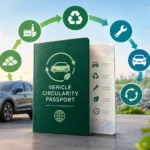

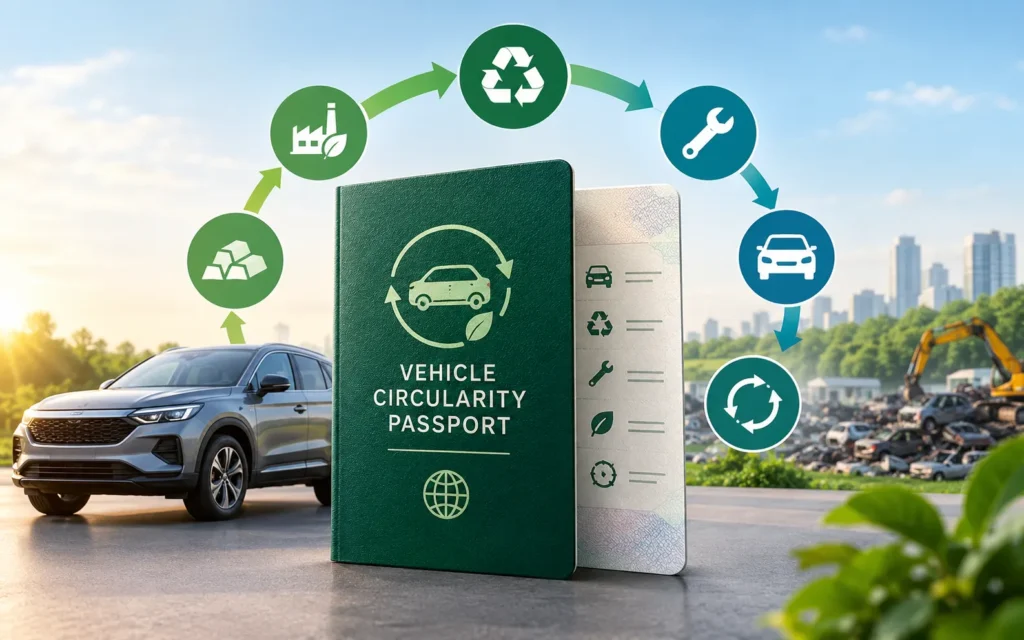
The vehicle circularity passport, formally the Digital Circularity Vehicle Passport, is a digital record introduced by the EU End-of-Life Vehicles Regulation (EU) 2026/1738. It becomes mandatory for vehicles placed on the EU market from 1 September 2032.
It carries circular-economy information about the vehicle, including material composition, recycled content and instructions for removing and replacing parts, so repairers and recyclers can work from records rather than assumptions.
What Is the Vehicle Circularity Passport?
The Digital Circularity Vehicle Passport is a data obligation rather than a document. It is a structured digital record tied to a vehicle and reached through an identifier, and the European Commission’s end-of-life vehicles framework establishes it alongside an electronic certificate of destruction.
The problem it addresses is specific. Dismantlers have historically opened vehicles without reliable information about which materials were used or where hazardous components sit. That guesswork slows depollution, which is the most safety-critical stage, and it lowers the quality of what comes out.
Timing is the part most coverage compresses. The passport arrives four years after the EU ELV Regulation generally applies, and technical specifications are reported as due around August 2030. The data architecture behind it therefore has to be built well before the obligation date.
It belongs to a wider movement toward product-level digital records:
- Batteries first: the EU Batteries Regulation introduced a battery passport ahead of the vehicle instrument.
- Products generally: the Ecodesign for Sustainable Products Regulation (EU) 2024/1781 provides for product passports across a widening set of categories.
- Vehicles: the EU’s vehicle-specific circularity passport follows the earlier battery-passport framework and introduces a significantly broader vehicle-level data requirement covering material composition, recycled content, removal and replacement information, and other lifecycle data.
What Data Does the Vehicle Circularity Passport Contain?
Exact data fields are being specified through implementing acts, so the useful framing is categories rather than a definitive list. Four groups are visible from the regulation and from the Commission’s description: composition, recycled content, removal instructions, and a record maintained across the vehicle’s life.
Composition and recycled content
These two categories serve different readers. Composition data serves the dismantler standing in front of the vehicle. Recycled content data serves verification of the content obligations that apply from the same date.
- Material composition: the materials and substances used in the vehicle, including their identification and location.
- Parts and components: information on the parts and components fitted to the vehicle, including their identification through standardised coding.
- Regulated substances and components: information needed to identify relevant substances and components and support their safe removal and treatment..
- Declared recycled shares: the recycled material used in manufacturing, supporting verification of recycled content obligations.
Removal instructions and the life record
The lifecycle element is what separates a passport from a specification sheet, and it is the part with the most practical value at the dismantling bench.
- Removal and replacement instructions: for parts and components, during the use phase and at end of life.
- What has changed: which parts, components and materials have been removed and replaced over the vehicle’s life, per legal analysis of the regulation.
- Anti-duplication: information already accessible through another vehicle-related passport is reported as excluded from the circularity passport where systems interoperate.
How Does It Differ from the Environmental Vehicle Passport?
Two vehicle passports exist in EU law and coverage frequently merges them. The Digital Circularity Vehicle Passport sits under the End-of-Life Vehicles Regulation and carries circular-economy data. The Environmental Vehicle Passport sits under the Euro 7 Regulation (EU) 2024/1257, at Article 3(68).
Different instruments, different purposes
The circularity passport serves repair, dismantling and material recovery. The environmental passport serves environmental and emissions-related performance transparency. A third instrument, the digital battery passport, sits under the EU Batteries Regulation and applies from 18 February 2027.
For an electric vehicle, several passports may therefore apply at once, covering the vehicle, its battery and its environmental performance. Building them as separate systems would duplicate data and cost, which is why interoperability is reported as a requirement rather than an option.
| Passport | Instrument | Covers | From |
| Digital Circularity Vehicle Passport | Regulation (EU) 2026/1738 | Materials, recycled content, removal and replacement | 1 Sep 2032 |
| Environmental Vehicle Passport | Euro 7 Regulation (EU) 2024/1257 | Environmental performance data | Per Euro 7 phase-in |
| Battery passport | Regulation (EU) 2023/1542 | LMT, industrial above 2 kWh, EV batteries | 18 Feb 2027 |
Who Benefits from the Vehicle Circularity Passport?
The regulation’s stated purpose is facilitating end-of-life treatment, which makes recyclers a primary intended user rather than a secondary beneficiary. Manufacturers carry the build obligation, and repairers and owners gain access to information that has previously sat inside factory systems.
For recyclers and dismantlers
Depollution planning improves most. Knowing where hazardous substances and fluids sit removes guesswork from the stage where the safety risk concentrates, and knowing material location supports cleaner separation.
- Cleaner streams: separation guided by composition data can support material quality, which determines whether recovered material returns to demanding applications.
- Better reuse decisions: component data helps identify parts worth recovering intact rather than shredding.
- Lifecycle updates: records can be introduced, modified and updated over the vehicle’s life, including information provided by parties other than the manufacturer. The detailed mechanism for maintaining these updates is still to be defined.
For manufacturers, repairers and owners
Passport data must be assembled across the supply chain and integrated with product data systems, which is a multi-year build rather than a reporting exercise. Documented material data also underpins recycled content claims that apply from the same date.
Repairers gain removal and replacement instructions, which supports repairability and longer vehicle life. Owners gain visibility of materials, recycled content and replaced parts, which feeds into used-vehicle decisions.
Content targets and design for disassembly rules depend on the people taking a vehicle apart knowing what is inside it. In India, Registered Vehicle Scrapping Facilities (RVSFs) depollute and dismantle end-of-life vehicles, and MMCM supplies the digital infrastructure those facilities use to record what was removed and recovered at each stage.
Does India Have a Vehicle Circularity Passport?
India has no mandatory vehicle circularity passport equivalent to the EU instrument. It has record-keeping at the treatment stage and registration records at the vehicle level, which answer a different question: they establish that a vehicle was scrapped rather than what it contained.
- Treatment records: under ELV Rules 2025, authorised facilities maintain digital records of vehicles received and material recovered, with applicable certificates and records maintained through the relevant regulatory framework.
- Vehicle-level records: the VAHAN database and the Certificate of Deposit process record registration and deregistration, tracking legal status rather than material composition.
- Batteries move first: the Battery Waste Management Rules, including the 2025 amendment, provide for digital labelling and QR/barcode-based identification and traceability within the EPR framework..
- Why the gap matters: NITI Aayog’s January 2026 report estimated roughly 98 million tonnes of steel recoverable from vehicles manufactured between 2005 and 2023, and material at that scale is hard to verify without structured composition data.
- Capacity context: the same report put formal volumes at about 72,000 end-of-life vehicles handled in FY 2024-25 against an informal sector processing far more, so each registered vehicle scrapping facility currently sees a small share of the fleet.
- The export route: Indian suppliers selling into European vehicle programmes will contribute passport data through customer requirements regardless of domestic rules.
Conclusion
The vehicle circularity passport turns a vehicle into a documented material inventory, and that is a bigger change than the compliance date suggests. Much of the rest of the circularity agenda leans on it. Content targets need verified material origin, and efficient dismantling needs reliable information about what is inside the vehicle in front of the operator.
India’s position is not absence so much as a different question answered. Its systems record that a vehicle reached an authorised facility and how much material came out, rather than what the vehicle was made of. Batteries look likely to carry India’s first product passport, and exporters will build the capability for European customers first.
FAQs
When does the vehicle circularity passport become mandatory?
From 1 September 2032 for vehicles placed on the EU market, four years after Regulation (EU) 2026/1738 generally applies on 1 September 2028.
What is the difference between the circularity passport and the battery passport?
Different instruments. The circularity passport sits under the ELV Regulation and covers vehicle materials. The battery passport sits under the Batteries Regulation and applies from February 2027.
Who is responsible for creating the vehicle passport?
The manufacturer placing the vehicle on the EU market, which requires assembling data across the supply chain rather than from final assembly alone.
Does the passport track parts replaced during the vehicle’s life?
Yes. The regulation provides rules for the introduction, modification and updating of passport information during the vehicle’s life, including information provided by parties other than the manufacturer. The detailed mechanism for maintaining these lifecycle updates is still to be defined.
Will non-EU manufacturers need to provide passport data?
Manufacturers placing vehicles on the EU market carry the obligation, and suppliers into those programmes will be asked for the underlying data contractually.
Is the vehicle circularity passport the same as a digital product passport?
It is a vehicle-specific instrument under the ELV Regulation. The Ecodesign for Sustainable Products Regulation provides for product passports across other categories.
What records does India require when a vehicle is scrapped?
Registered Vehicle Scrapping Facilities maintain digital records of vehicles received and material recovered, with certificates issued through the CPCB portal under ELV Rules 2025.
How do Indian scrapping facilities capture vehicle-level material data today?
Indian RVSFs capture material data mainly during dismantling and recovery, using AIS-129 requirements and manufacturer-provided dismantling information. Digital systems such as MMCM’s AutoLoop add vehicle-level inventory, compliance and 40-plus dMRV data points, improving traceability across scrapping outputs.
Last Updated on: September 22, 2026