
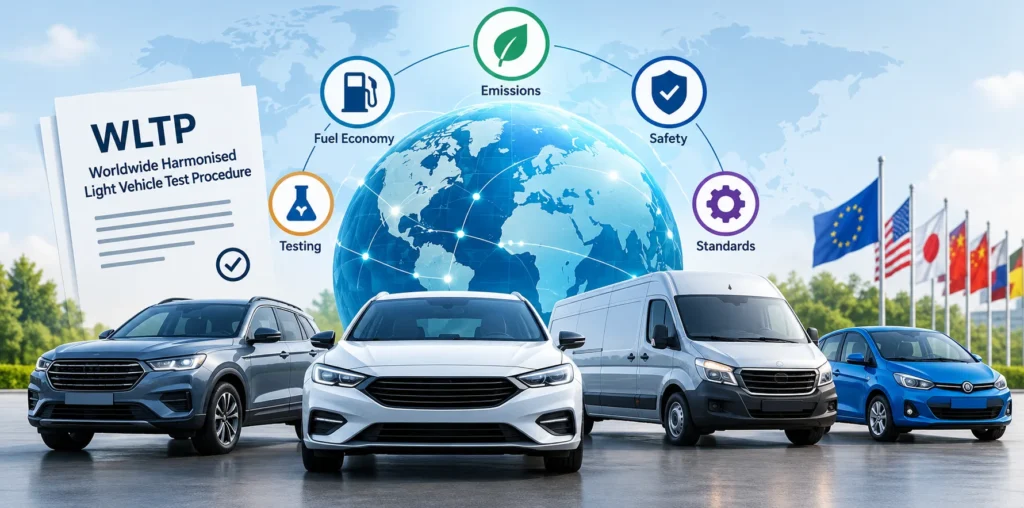
WLTP stands for Worldwide Harmonised Light Vehicle Test Procedure, a laboratory testing standard used to measure a vehicle’s fuel consumption, pollutant emissions, carbon dioxide output and electric driving range. The test is conducted on a chassis dynamometer under defined driving phases and accounts for factors such as vehicle weight, aerodynamics and optional equipment. In India, the AIS-175 implementation uses a specified three-phase cycle for the relevant vehicle categories.
It was introduced to provide test results that better reflect real world driving than the older New European Driving Cycle (NEDC). India is set to transition to WLTP from 2027, starting with emission testing.
India is adopting WLTP in two separate steps. Emission testing under WLTP is notified from April 2027, while the proposed shift to WLTP based fuel economy compliance remains a draft proposal. This means the 2027 change will initially affect how vehicle emissions are tested, rather than replacing the existing fuel economy compliance requirements.
What Does WLTP Stand For and Why Did It Replace NEDC?
WLTP is a globally developed laboratory standard for measuring fuel consumption, carbon dioxide, pollutant emissions and electric range in passenger cars and light vehicles. It replaced the New European Driving Cycle (NEDC), whose urban cycle dates to 1970 with the extra-urban phase added in 1990 and was widely criticised for producing figures well above real-world results.
The European Union introduced WLTP for new vehicle types from September 2017 and for all new registrations from September 2018. NEDC based values continued to be used for certain carbon dioxide regulatory calculations until the end of 2020, which is why NEDC figures still appear in older vehicle specifications and comparisons.
WLTP uses a wider range of speeds and driving conditions and takes factors such as vehicle configuration and optional equipment into account, making its results more representative than those from NEDC.
Important note: Real Driving Emissions (RDE) testing is a separate part of vehicle emissions testing. It measures pollutant emissions on public roads using portable measurement equipment and complements the WLTP laboratory test rather than replacing it.
How Does the WLTP Test Actually Work?
The vehicle is tested indoors on a rolling road, technically a chassis dynamometer, so conditions stay identical and repeatable for every vehicle. The cycle runs roughly 30 minutes across about 23 kilometres, with a top speed near 131 km/h and a higher average speed than NEDC.
| Phase | Simulates | Duration and distance, WLTC Class 3b |
| Low | Urban driving | 589 seconds, 3,095 m |
| Medium | Suburban driving | 433 seconds, 4,756 m |
| High | Rural roads | 455 seconds, 7,162 m |
| Extra High | Motorway | 323 seconds, 8,254 m |
The WLTC officially divides the test into Low, Medium, High and Extra High phases. Descriptions such as urban, suburban and motorway are simplified explanations of the driving conditions represented by these phases, not their official names. The durations and distances shown apply to WLTC Class 3b, which covers most passenger cars
Several aspects of WLTP make it more demanding than the NEDC it replaced. The test includes more frequent changes in speed, higher speeds and stronger acceleration, creating driving conditions that place greater demands on the vehicle and generally produce higher fuel consumption and emissions than the older cycle.
The test also accounts for the individual car’s weight, aerodynamics, tyres and optional equipment. Different trims of the same model can therefore carry different official figures.
For electric vehicles the same cycle determines official range and energy consumption, with the battery run down under controlled conditions. Because every vehicle faces an identical procedure, buyers can compare models across brands on a like-for-like basis.
How Accurate Are WLTP Fuel Economy and EV Range Figures?
WLTP figures land closer to real driving than NEDC produced, but they remain laboratory results. Actual outcomes still vary with driving style, traffic, terrain, weather, load and use of air conditioning.
Expect lower headline numbers than NEDC gave. Because the test is tougher, WLTP fuel-economy and range figures are generally less flattering and WLTP carbon dioxide figures are higher.
That reflects better measurement rather than worse vehicles, a distinction worth holding onto when comparing a new figure against an older one for the same model. For electric and plug-in hybrid vehicles, WLTP supplies the official advertised range.
Real-world range is often lower, particularly at sustained motorway speeds and in cold weather. Because options and trim affect weight and aerodynamics, the figure for a specific configuration can differ from the model’s headline number, so buyers checking a particular specification should look for the figure that matches it.
Any laboratory cycle works better as a benchmark than as a guarantee, which is why carbon footprint measurement for a specific vehicle usually draws on more than the type-approval figure. A lifecycle view adds the manufacturing and end-of-life stages the cycle never touches.
When Is WLTP Coming to India and What Happens to MIDC?
India has historically used the Modified Indian Driving Cycle (MIDC) to test both fuel efficiency and emissions. MIDC is a milder, less dynamic cycle, so its figures fall further from real-world driving than WLTP results do. Two separate transitions are now under way, and they are at different stages.
Emission testing, notified
WLTP has been notified for Bharat Stage 6 emission testing under AIS-175, for M1 vehicles and M2 vehicles with gross vehicle weight up to 3,500 kg, applying to models manufactured on or after 1 April 20271. The change was made by G.S.R. 112(E), the Central Motor Vehicles (Fourth Amendment) Rules 2026, which added AIS-175 to Rule 115.
Fuel efficiency testing, still draft
The Ministry of Power released a revised draft of the third phase of Corporate Average Fuel Economy norms on 16 July 2026, proposing application from 1 April 2027. CAFE II lapses on 31 March 2027, the same point at which the draft proposes moving type approval to WLTP.
Public comments closed on 6 August 2026 and the norms have not been finalised. Anything quoted from the draft should therefore be treated as a proposal rather than a requirement.
| Aspect | CAFE II | Draft CAFE III |
| Test cycle | MIDC | WLTP-based testing proposed from 1 April 2027, subject to finalisation of CAFE III |
| Applies to | Passenger vehicles | M1 category, 2027-28 to 2031-32 |
| Compliance period | Shorter cycles | Five-year block |
| Fleet target | 113 gCO2/km, measured on MIDC | 94.76 gCO2/km in FY2028, tightening to 78.90 gCO2/km by FY2032, measured on WLTP |
Two cautions apply to that table. A widely quoted 91.7 gCO2/km target comes from an earlier draft, which the revised July 2026 version relaxed. And the CAFE II and CAFE III figures are measured on different cycles, so the gap between them is not a like-for-like measure of how much the target tightens.
Transition mechanics and what changes for buyers
Manufacturers report fuel efficiency data under both MIDC and WLTP during the transition. The conversion methodology for WLTP-based compliance is to be notified separately, after the reported data has been analysed.
The draft also proposes compliance credits that manufacturers may trade or buy from the Bureau of Energy Efficiency. Super credits are weighted toward electric, plug-in hybrid and strong hybrid vehicles, and manufacturers selling fewer than 1,000 passenger vehicles annually would be exempt from fleet-average obligations.
Because WLTP uses more dynamic driving conditions, it can result in higher measured fuel consumption and CO₂ emissions than the older NEDC or MIDC cycles. However, the effect on pollutants such as NOx can vary depending on the vehicle, engine and emissions-control technology. Manufacturers therefore face recalibration and recertification work ahead of the switch.
Buyers should expect official mileage and electric range figures on Indian cars to look lower under WLTP. That again reflects more honest measurement rather than reduced performance, and it arrives alongside broader green mobility developments reshaping the market.
Conclusion
WLTP is the standard that made official vehicle figures more honest. It runs every car through the same demanding four-phase laboratory cycle to measure fuel consumption, carbon dioxide, pollutant emissions and electric range, India is moving from MIDC-based testing toward WLTP-based procedures, but the transition is taking place through separate regulatory measures for emissions and fuel-efficiency compliance.
India’s position divides in two. WLTP for Bharat Stage 6 emission testing from April 2027 is notified and settled.
WLTP for fuel-efficiency compliance under CAFE III is proposed and still moving, with targets revised once already. Treat WLTP as a reliable benchmark for comparing vehicles while remembering that real-world results depend on how and where a vehicle is driven, and check the notified position before relying on any Indian target or date.
FAQs
What is the full form of WLTP?
WLTP stands for Worldwide Harmonised Light Vehicle Test Procedure, the laboratory cycle used to measure fuel consumption, carbon dioxide, pollutant emissions and electric driving range.
Is WLTP range accurate in real driving?
It is closer than earlier cycles but still a laboratory figure. Real-world range varies with speed, weather, load and driving style, and it drops further on motorways.
What is the difference between WLTP and NEDC?
WLTP uses sharper acceleration, higher average speeds and accounts for optional equipment. NEDC was gentler, so it produced figures well above real-world results.
What is the difference between WLTP and MIDC?
MIDC is India’s older, milder cycle used for both emissions and fuel efficiency. WLTP is more dynamic and produces higher measured carbon dioxide for the same vehicle.
When does WLTP apply in India?
WLTP is notified for Bharat Stage 6 emission testing of M1 and M2 vehicles from April 2027. Fuel-efficiency application under CAFE III remains in draft.
Why is WLTP range lower than advertised NEDC range?
The test is more demanding, so measured consumption rises and range falls. The vehicle has not changed; the measurement has become more representative.
Does WLTP apply to electric vehicles?
Yes. The same four-phase cycle determines official electric range and energy consumption, with the battery discharged under controlled laboratory conditions rather than on the road.
What is RDE testing and how is it different?
Real Driving Emissions testing measures emissions on public roads using portable equipment. It complements the WLTP laboratory cycle rather than replacing it.