
Market access in India’s regulated product categories is not determined solely by manufacturing or import approval. Environmental compliance clearance has become an independent requirement linked to post-sale accountability. Authorities now maintain dedicated registration systems that track obligated entities separately from production licences.
An EPR certificate exists within this compliance layer. It formally recognises a company under India’s waste governance framework and connects its commercial operations to environmental regulatory supervision. Businesses operating without this recognition risk regulatory action, sales restrictions, and platform delisting in controlled sectors.
What Is an EPR Certificate in India?
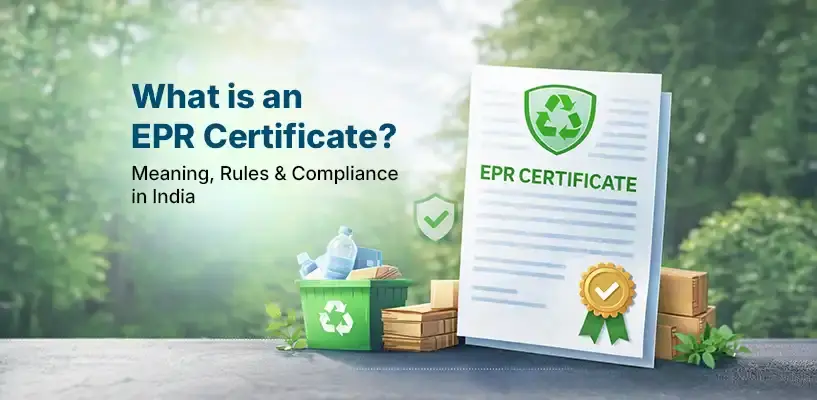
An EPR certificate is the formal registration issued under India’s waste management rules that authorises an obligated entity to operate in regulated product categories. Approval is granted subject to defined recycling targets and reporting requirements set by pollution control authorities. Without valid registration, regulated products cannot be lawfully sold or distributed in India. Compliance is monitored through digital reporting, recycler verification, and annual disclosures.
Why the EPR Certificate Exists
India’s EPR framework was introduced to correct systemic waste mismanagement by transferring responsibility to product owners and enabling measurable recycling outcomes. It addresses structural, regulatory, and resource efficiency gaps.
- Waste Escalation: India generates about 1.39 million tonnes of e-waste annually, while plastic waste continues rising. Municipal
infrastructure cannot handle complex materials, causing landfill overflow, contamination, and unsafe informal recycling practices. - Producer Responsibility Shift: Waste management responsibility has moved to Producers, Importers, and Brand Owners under the polluter-pays principle. Businesses must finance, execute, and verify compliant collection, recycling, and end-of-life disposal operations.
- Circular Economy Alignment: EPR connects producer obligations with recycling performance. It promotes recyclable product design, strengthens material recovery systems, and reduces dependence on virgin raw materials through structured reuse and recycling channels.
Regulatory Foundation of the EPR Certificate
The EPR certificate framework operates under notified waste management rules that define how EPR compliance works in India across regulated product categories. These rules establish registration eligibility, recycling accountability, and compliance verification enforced by pollution control authorities.
1. E Waste Management Rules
Electronic equipment manufacturers must obtain EPR registration for producers and fulfil structured collection and recycling obligations.
2. Plastic Waste Management Rules
Producers and brand owners introducing plastic packaging into the market must meet defined recycling targets under EPR certificate India requirements.
3. Battery Waste Management Rules
Battery producers are required to ensure environmentally sound disposal and recycling of lead-acid and lithium-ion batteries.
4. Tyre Waste Management Rules
Tyre manufacturers and importers must recover and recycle waste tyres equivalent to quantities introduced in the market.
Who Is Required to Obtain an EPR Certificate?
The applicability of what is EPR certificate is determined by market participation rather than manufacturing location.
1. Producers
Domestic manufacturers placing regulated goods into the Indian market must obtain EPR registration for producers before sale.
2. Importers
Entities importing regulated products into India must secure EPR certificate India authorisation before distribution. Waste generated within India establishes regulatory jurisdiction.
3. Brand Owners
Companies selling products under their own brand name must obtain an extended producer responsibility certificate, even if production is outsourced.
The responsibility structure reinforces lifecycle governance principles, also reflected in frameworks such as vehicle scrappage policy in india and regulated recycling through registered vehicle scrapping facility networks.
Industries Covered Under EPR
| Industry | Key Compliance Requirements |
| Electronics | • Governed by E-Waste Rules 2022 across 106 categories including Solar PV • Recycling targets replace collection targets • Producers must purchase E-waste credits from authorised recyclers |
| Plastic Packaging | • Covered under Plastic Waste Rules 2016 (4 categories: rigid, flexible, multi-layered, compostable) • Minimum recycled content mandate (30% for some categories by 2025) • QR codes and EPR registration numbers required |
| Batteries | • Applies to lithium-ion, lead-acid, and other battery types • Recovery targets include 90% lithium and cobalt by 2026-27 • Recycling and refurbishment credits allowed |
| Tyres | • Liability based on tyres sold two years earlier (Y-2 formula) • Includes recycling, pyrolysis, and retreading systems • Output converted to crumb rubber or recovered materials |
FAQs About EPR Certificate
1. Is an EPR certificate mandatory in India?
Yes, an EPR certificate is mandatory in India for producers, manufacturers, importers, and brand owners dealing in regulated waste categories such as end-of-life, e-waste, plastic packaging, batteries, and tyres under applicable environmental management rules.
2. Who issues the EPR certificate?
The EPR certificate is issued by the Central Pollution Control Board or respective State Pollution Control Boards through official regulatory portals after verification of registration documents and compliance declarations under relevant waste management rules.
3. Which industries require EPR compliance?
Industries involved in manufacturing, importing, or branding electronic equipment, plastic packaging, end-of-life vehicle (ELVs), batteries, and tyres require EPR compliance in India, as these categories fall under regulated waste management frameworks notified by environmental authorities.
4. How long is an EPR certificate valid?
The validity of an EPR certificate depends on regulatory approval terms and compliance performance. Renewal timelines are defined by pollution control authorities and require continued fulfilment of annual recycling obligations.
5. Is EPR applicable to importers and brand owners?
Yes, EPR applies to importers and brand owners in India. Responsibility is triggered by the market introduction of regulated products, regardless of manufacturing location, under Extended Producer Responsibility regulations.