
For years, sustainability in the automotive sector was discussed mostly in terms of fuel efficiency and emission norms. That conversation is changing.
The question is no longer limited to how clean a vehicle runs. It now includes what happens after that vehicle is no longer on the road.
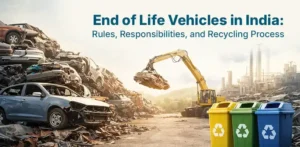
Old vehicles are dismantled, recycled, or, in many cases, handled improperly. Each outcome carries environmental and economic consequences. Steel, plastics, fluids, and components either re-enter the value chain or are lost as waste.
As the number of aging vehicles increases across India, end-of-life management is moving to the centre of the sustainability discussion. The issue is practical. It affects air quality, material recovery, regulatory compliance, and long-term resource use.
Sustainability, in this context, begins where the vehicle’s active life ends.
What Does Sustainability Mean in the Automotive Industry?
Sustainability in the automotive industry refers to integrating environmental, social, and governance principles across the entire vehicle value chain. It extends beyond fuel efficiency and electric mobility into responsible sourcing, ethical supply chain management, emissions transparency, and circular resource flows.
From raw material extraction to vehicle disposal, every stage contributes to the environmental footprint. Manufacturers must evaluate scope 1 emissions from direct operations, scope 2 emissions from purchased energy, and scope 3 emissions from supply chains and vehicle usage.
Incremental efficiency gains are no longer sufficient. True sustainability in the automotive industry requires systemic transformation supported by a clear net-zero roadmap and alignment with long-term climate commitments.
Key Pillars of Automotive Sustainability
Sustainability in the automotive industry is shaped by multiple interconnected pillars that redefine how vehicles are designed, manufactured, and managed throughout their lifecycle.
1. Electric Vehicle Transition
Electrification is a central component of sustainability in the automotive industry. Electric vehicles eliminate tailpipe emissions, contributing directly to decarbonisation goals. However, true sustainability requires addressing battery production emissions, renewable energy integration, and end-of-life battery management.
The EV transition reshapes manufacturing processes, supplier networks, and infrastructure development. Battery sourcing and lifecycle emissions must be considered in planning to reduce scope 3 emissions in the automotive industry, ensuring that electrification reduces total lifecycle impact rather than shifting emissions upstream.
2. Circular Economy and Material Recovery
Circularity is fundamental to sustainable automotive practices. Rather than relying solely on virgin materials, manufacturers are increasingly adopting recycling, remanufacturing, and reuse models.
End-of-life vehicle processing plays a crucial role in sustainability in the automotive industry. Structured dismantling through authorised systems such as registered vehicle scrapping facility networks ensures responsible recovery of metals, plastics, and critical materials.
Policy frameworks like the vehicle scrappage policy in India strengthen circular implementation by formalising end-of-life management. Circular models are further explained in the circular economy in the automotive industry, which highlights material recovery as a strategic decarbonisation tool.
3. Green and Low-Carbon Manufacturing
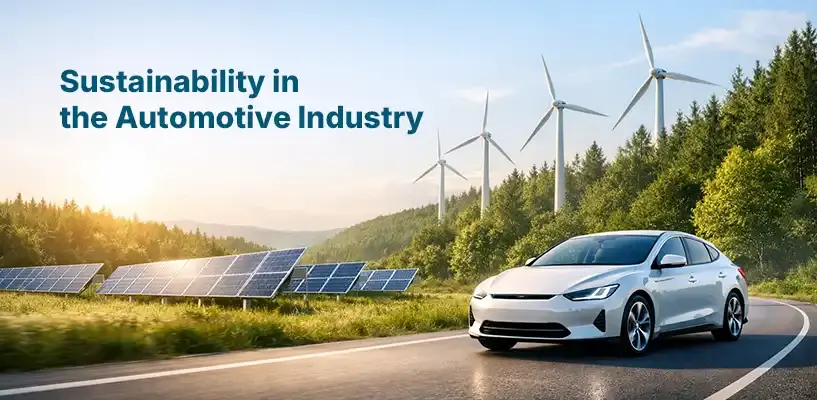
Manufacturing emissions represent a significant portion of the sustainability challenges in the automotive industry. Transitioning to renewable energy, improving energy efficiency, reducing industrial waste, and conserving water are central to green production strategies.
Automotive companies are investing in solar- and wind-powered facilities, electrified production lines, and advanced waste management systems. Green manufacturing also strengthens ESG reporting transparency and supports alignment with climate disclosure frameworks.
4. Sustainable and Ethical Sourcing
Responsible sourcing is critical for sustainability in the automotive industry, particularly for battery materials such as lithium, cobalt, and nickel. Supply chain traceability, ethical mining practices, and supplier ESG compliance are essential components.
Automakers must ensure transparency across global supply chains to reduce environmental and social risks. These efforts support structured emissions accounting under scope 3 emissions and contribute to improved governance disclosures.
Sustainable sourcing also reduces exposure to reputational risk and strengthens long-term supply chain resilience.
Challenges in Achieving Sustainability in the Automotive Industry
Despite strong global momentum, achieving sustainability in the automotive industry faces deep structural and operational barriers.
1. Cost pressures during transition
The shift toward electric mobility, renewable energy integration, and low-carbon manufacturing requires significant upfront capital investment. Battery technology, renewable power procurement, plant upgrades, and supplier decarbonisation programmes increase short- to medium-term costs. For many manufacturers, balancing sustainability targets with profitability expectations remains a critical challenge.
2. Supply chain complexity and traceability gaps
Automotive supply chains are globally distributed and multi-tiered. Critical minerals such as lithium, cobalt, and nickel often pass through multiple intermediaries, making traceability difficult. Ensuring ethical sourcing, emissions transparency, and regulatory compliance across tier 1, tier 2, and tier 3 suppliers demands advanced monitoring systems and strong governance frameworks.
3. Infrastructure limitations
The adoption of sustainable automotive practices is directly influenced by ecosystem readiness. Charging infrastructure gaps slow electric vehicle penetration. Similarly, limited recycling facilities and insufficient end-of-life vehicle processing capacity restrict circular economy implementation. Without parallel infrastructure development, sustainability progress remains uneven.
4. Data and ESG reporting challenges
Accurate emissions reporting under ESG frameworks requires reliable Scope 1, Scope 2, and especially Scope 3 emissions data. However, data fragmentation, inconsistent methodologies, and verification challenges complicate disclosure processes. Companies face growing scrutiny from regulators and investors, increasing the need for standardized and auditable reporting systems.
5. Technology readiness and scalability constraints
While battery recycling, green hydrogen, and advanced material recovery technologies show promise, large-scale deployment is still evolving. Electric vehicle battery recycling systems, in particular, require regulatory clarity, standardized collection mechanisms, and economic viability to scale effectively.
Addressing these challenges requires coordinated industry collaboration, policy support, financial incentives, and long-term capital allocation. Sustainability transformation in automotive is not a single initiative but a systemic transition.
How MMCM Helps in Achieving Sustainability in the Automotive Industry
Achieving sustainability in the automotive industry requires integrated lifecycle solutions that connect regulatory compliance, emissions reduction, and circular material management. This is where structured systems such as MMCM play a critical role.
1. Lifecycle-based material accountability
Through organized end-of-life vehicle processing and material recovery systems, MMCM supports circular resource flows. Structured mechanisms connected to end-of-life vehicles in India enable responsible dismantling, recycling, and reuse of automotive materials, reducing landfill impact and conserving natural resources.
2. Circular material recovery and emissions reduction
Material recovery reduces dependence on virgin raw materials, lowering embedded carbon intensity across the supply chain. Circular recovery systems directly contribute to emissions reduction strategies while strengthening resource security for manufacturers.
3. Automotive-specific carbon frameworks
In automotive contexts, structured mechanisms such as carbon credits for the global automobile industry and ELV-based frameworks like end-of-life vehicle ELV carbon credits demonstrate how end-of-life material recovery and emissions reduction activities can be quantified within carbon markets. This bridges regulatory compliance with financial sustainability incentives.
4. Regulatory alignment and risk mitigation
By integrating lifecycle accountability, emissions monitoring, and an end-to-end solutions for RVSF, Meta Materials Circular Markets strengthens regulatory compliance while reducing reputational and operational risk. It enables organizations to move beyond isolated sustainability efforts toward measurable, auditable impact.
When implemented effectively, sustainability in the automotive industry evolves from a compliance obligation into a strategic advantage.
Conclusion
Sustainability in the automotive industry is no longer optional. Regulatory pressure, climate commitments, investor expectations, and evolving consumer demands are accelerating transformation across the vehicle lifecycle.
From electrification and circular economy integration to green manufacturing and responsible sourcing, sustainable automotive practices require systemic change rather than incremental improvement.
Lifecycle-based approaches, emissions transparency, structured material recovery, and alignment with global climate goals will define the future of the industry. Companies that embed sustainability in automotive industry strategies today are better positioned to build resilient, compliant, and future-ready ecosystems.
FAQs
Sustainability in the automotive industry is critical for regulatory compliance, emissions reduction, investor confidence, and long-term competitiveness in a climate-constrained global economy.
Electric vehicles reduce tailpipe emissions and support decarbonisation targets, particularly when powered by renewable energy and integrated into lifecycle emissions management strategies.
Circular economy models reduce waste, recover materials, and lower reliance on virgin resources, strengthening sustainability in the automotive industry through lifecycle material efficiency.
Green manufacturing reduces direct and indirect emissions by adopting renewable energy, improving energy efficiency, and implementing waste reduction strategies in production facilities.
Sustainable sourcing ensures ethical extraction, traceability, and ESG compliance for raw materials, particularly battery minerals and metals used in vehicle production.
Vehicle scrappage enables responsible material recovery, reduces landfill waste, and strengthens circular economy implementation within sustainability in automotive industry frameworks.
Key challenges include supply chain traceability, emissions measurement accuracy, infrastructure gaps, regulatory complexity, and scaling low-carbon technologies.
Sustainability in the vehicular industry increases supplier accountability, requires emissions transparency, and promotes responsible sourcing and recycling integration.
The future of sustainability in the auto industry will be defined by electrification, circular production models, emissions transparency, and alignment with global net-zero commitments.