
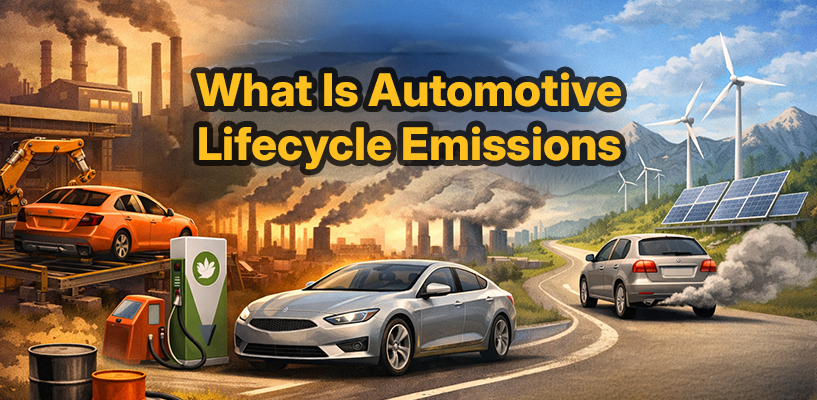
Automotive lifecycle emissions refer to the total greenhouse gas emissions generated across a vehicle’s entire lifespan. This includes emissions from raw material extraction, manufacturing, vehicle usage, and end of life treatment. Instead of looking only at tailpipe emissions, this approach measures the full carbon footprint of a vehicle from start to finish.
Earlier, most discussions focused on fuel efficiency and exhaust emissions. Today, the same conversationals also involve the total impact including the emissions locked into materials, production processes, and disposal. As electric vehicles enter the market, this broader view has become essential to understand real environmental impact.
What Are Automotive Lifecycle Emissions?
Automotive lifecycle emissions, also called vehicle lifecycle emissions or car lifecycle emissions, represent the total emissions generated from the moment a vehicle begins production to the point it is dismantled and recycled. This is often referred to as a cradle to grave approach. It tracks emissions across every stage of a vehicle’s life instead of focusing on just one part.
Key points to understand:
- Lifecycle emissions include all greenhouse gases measured in CO2 equivalent
- They cover production, usage, and disposal stages
- They provide a more accurate picture than tailpipe emissions alone
Tailpipe vs Lifecycle Emissions
- Tailpipe emissions only measure what comes out of the exhaust
- Lifecycle emissions include hidden emissions from manufacturing, energy use, and recycling
Key Stages of Automotive Lifecycle Emissions
Automotive lifecycle emissions are spread across four main stages. Each stage contributes differently to the total carbon footprint, and together they define the overall impact of a vehicle.
1. Material Extraction and Component Production
The lifecycle begins with sourcing and processing raw materials. This includes mining metals such as iron, aluminum, and copper, along with materials used in batteries and electronics like lithium and cobalt. These activities require large amounts of energy, often from fossil fuels, which increases emissions at the very start.
Processing these materials into usable components also adds to the footprint. Battery production, in particular, is energy intensive and contributes significantly to early-stage emissions in electric vehicles.
2. Vehicle Manufacturing
Once materials are ready, they move into manufacturing. This stage includes producing vehicle parts, assembling components, and running large-scale manufacturing plants. Energy is used across multiple processes such as welding, painting, and assembly.
There are also emissions linked to transporting parts between suppliers and moving finished vehicles to markets. These combined activities make manufacturing a key contributor to automotive lifecycle emissions.
3. Vehicle Use Phase
The use phase depends on how the vehicle is powered. For gasoline and diesel vehicles, emissions come from fuel combustion during driving. There are also additional emissions from producing and transporting that fuel.
For electric vehicles, emissions depend on electricity consumption. The overall impact varies based on how that electricity is generated. Cleaner energy sources reduce emissions, while fossil fuel-based grids increase them.
4. End of Life and Recycling
The final stage begins when the vehicle is no longer in use. Vehicles are dismantled and materials such as metals and plastics are recovered. Recycling reduces the need for new raw material extraction, which helps lower overall emissions. When done through structured systems, this stage supports circular automotive practices by bringing materials back into the production cycle instead of treating them as waste.
EV vs ICE Lifecycle Emissions
Electric vehicles and internal combustion engine vehicles have different emission patterns across their lifecycle. Electric vehicles typically have higher emissions during manufacturing due to battery production. However, they produce much lower emissions during the use phase. Internal combustion vehicles have lower production emissions but continue to emit throughout their usage.
Lifecycle Comparison
| Vehicle Type | Manufacturing Emissions | Use Phase Emissions | Overall Lifecycle Impact |
| ICE Vehicles | Lower | High | Higher total emissions |
| Hybrid Vehicles | Moderate | Moderate | Lower than ICE |
| Electric Vehicles | Higher | Very Low | Lowest lifecycle emissions |
Key takeaway
Electric vehicles start with a higher carbon footprint but offset it over time through lower usage emissions. The overall benefit depends on how clean the electricity supply is.
Why Vehicle’s Lifecycle Emissions Matter
Looking at lifecycle emissions changes how vehicles are evaluated.
- It provides a complete view of a vehicle’s environmental impact
- It supports better policy decisions and emission regulations
- It helps manufacturers design more efficient and sustainable vehicles
- It allows consumers to make more informed choices
Lifecycle analysis is also becoming important for reporting and compliance. Emissions from suppliers and disposal fall under scope 3 emissions, which are now a major focus for most producer and manufacturing companies. With climate change is reshaping automotive sector, lifecycle emissions are becoming central to how the industry measures impact.
How Automakers Are Reducing Lifecycle Emissions?
Reducing automotive lifecycle emissions requires changes across multiple stages, not just during vehicle use.
1. Manufacturing Improvements
Automakers are shifting to renewable energy in plants and improving production efficiency. Lower energy use, reduced waste, and better water management help cut emissions at the manufacturing stage.
2. Vehicle Design Changes
Design decisions now focus on efficiency and end of life outcomes. Lightweight materials improve fuel or energy efficiency, while better design makes vehicles easier to dismantle and recycle later.
3. Battery and Material Management
Battery recycling and reuse are becoming standard as electric vehicles grow. This reduces dependence on new raw materials and lowers emissions from mining and processing.
4. Circular Systems and Scrappage
Structured scrappage systems ensure proper dismantling and material recovery. Reusing metals and components reduces the need for fresh resources and supports compliance with EPR targets. Together, these steps reduce emissions across the full vehicle lifecycle.
Conclusion
Automotive lifecycle emissions provide a complete view of a vehicle’s environmental impact. They include emissions from production, usage, and end of life handling. Focusing only on tailpipe emissions is no longer enough. The industry now looks at total impact across the lifecycle to understand real environmental performance.
As vehicles and technologies evolve, lifecycle analysis will continue to play a central role in shaping decisions. It helps manufacturers, regulators, and consumers move toward solutions that reduce emissions across the entire system.
FAQs
1. How are lifecycle emissions different from tailpipe emissions?
Lifecycle emissions cover total emissions from production, use, and disposal, while tailpipe emissions only measure exhaust released during driving, ignoring upstream and end of life impacts.
2. What stages are included in vehicle lifecycle emissions?
Vehicle lifecycle emissions include material extraction, component production, manufacturing, vehicle use, and end of life recycling or disposal, covering the full journey from creation to scrapping.
3. Why do electric vehicles have higher manufacturing emissions?
Electric vehicles have higher manufacturing emissions mainly due to battery production, which requires energy intensive extraction and processing of materials like lithium, cobalt, and nickel.
4. What is vehicle lifecycle assessment (LCA)?
Vehicle lifecycle assessment is a method used to measure total emissions across all stages of a vehicle’s life, helping compare overall environmental impact between different vehicle technologies.
5. How can automakers reduce lifecycle emissions?
Automakers can reduce lifecycle emissions by using renewable energy, improving manufacturing efficiency, adopting lightweight designs, recycling materials, and building circular supply chains across the vehicle lifecycle.
5. What role does recycling play in lifecycle emissions?
Recycling reduces lifecycle emissions by recovering materials from old vehicles, lowering the need for new raw material extraction, and cutting energy use and emissions in production processes.
7. Why are lifecycle emissions important for climate policy?
Lifecycle emissions provide a complete view of a vehicle’s environmental impact, helping policymakers design accurate regulations and incentives based on total emissions rather than just tailpipe performance.