
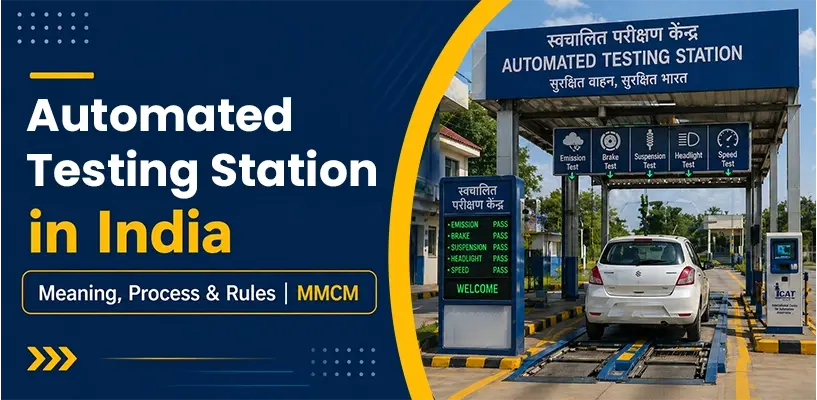
An Automated Testing Station (ATS) in India is a government-authorized facility that uses calibrated automated systems to assess vehicle fitness through tests such as braking, emissions, suspension, and steering, with minimal human intervention. Traditional manual inspections lacked consistency and were susceptible to manipulation. ATS removes inspector subjectivity entirely, producing tamper-resistant digital records that both the vehicle owner and regulator can reference. It is now a central component of India’s vehicle scrappage policy and fitness certification framework.
What Is an Automated Testing Station (ATS)?
An Automated Testing Station is a facility authorized by MoRTH to conduct mechanized fitness evaluations of motor vehicles. Every test parameter is measured by a dedicated instrument and transmitted directly to a centralized digital system linked to VAHAN, creating a record that cannot be altered after the test is completed. The station determines whether a vehicle meets the safety and emission standards under the Central Motor Vehicles Rules and issues a fitness certificate on the basis of system-generated results rather than inspector discretion.
ATS facilities are purpose-built inspection lanes where a vehicle moves sequentially through dedicated measurement stations, and no test can be skipped before the next begins. This architecture ensures every fitness certificate reflects a complete statutory assessment, directly addressing the selective inspections that manual processes permitted in practice.
How Automated Testing Stations Work
A vehicle entering an ATS facility moves through a sequential inspection lane where each station captures a specific measurement automatically. The process eliminates discretionary intervention from identification through to certificate issuance:
- Vehicle identity is confirmed through VAHAN integration, pulling registration records, insurance status, fitness history, and regulatory flags before the physical inspection begins.
- The vehicle proceeds station-by-station at a controlled pace, with each instrument capturing its measurement automatically as the vehicle reaches the designated position.
- Each result is transmitted to the ATS management system in real time, where readings are automatically compared against permissible limits under the Central Motor Vehicles Rules.
- The ATS operator monitors but does not intervene in measurement; the role is facility management and safety oversight only.
- The system generates a consolidated fitness report mapping each measured parameter against its permissible threshold with the actual value recorded alongside.
- The fitness certificate is issued or withheld on the basis of the system report. Failed vehicles receive a failure record specifying which parameters exceeded permissible limits.
Tests Conducted at an ATS
An ATS conducts a standardized battery of tests covering the primary safety and emission systems of a motor vehicle, each using a dedicated instrument to detect specific deficiencies.
Brake and Suspension Testing
Braking efficiency is measured using a roller brake tester, which applies controlled resistance to each wheel independently and calculates braking force as a percentage of the vehicle’s gross weight. This identifies both axle-level deficiency and left-right imbalance, both of which cause steering instability under emergency braking.
Suspension performance is evaluated using a resonance plate that oscillates at a controlled frequency and calculates a damping coefficient for each shock absorber. A low score indicates wear that reduces wheel-to-road contact under dynamic load. Steering geometry is assessed with a side slip tester that measures lateral deviation in millimetres per metre.
Emission and Structural Assessment
Petrol and CNG exhaust is measured with a gas analyzer for carbon monoxide and hydrocarbon concentrations against BS6 thresholds. Diesel exhaust opacity is measured with an opacimeter, making ATS vehicle testing compliance essential for commercial operators maintaining fitness certification. Speedometer accuracy is tested by spinning driven wheels at a calibrated speed and comparing the instrument cluster reading. A joint play detector quantifies wear in suspension and steering joints during underbody inspection, and corrosion severity, frame deformation, and fluid leaks are recorded and classified in the fitness report.
Key Equipment Used in ATS
MoRTH specifies the instrumentation required for ATS authorization. Each instrument must hold a valid calibration certificate from an approved metrology laboratory at the prescribed frequency before the facility can issue fitness certificates.
Primary Lane Instruments
Mandatory for facility authorization under ATS rules india:
- Roller Brake Tester: measures individual wheel braking force and axle imbalance; output is a digital force trace per axle.
- Suspension Tester (Resonance Plate): quantifies shock absorber damping through controlled oscillation; produces a damping coefficient per wheel.
- Side Slip Tester: measures lateral deviation in millimetres per metre; identifies steering geometry misalignment.
- Gas Analyzer: measures CO and hydrocarbon concentrations in petrol and CNG exhaust against BS6 thresholds.
- Opacimeter: measures diesel exhaust opacity; output expressed as percentage opacity.
Supporting Instruments
Required alongside primary instruments to complete the statutory assessment:
- Speedometer Tester: compares instrument cluster reading against a known drive speed; identifies both under-reading and over-reading.
- Joint Play Detector: quantifies suspension and steering joint wear in millimetres under controlled applied force.
- Headlamp Tester: measures beam alignment, intensity, and cut-off line position against vehicle class standards.
Role of ATS in Vehicle Scrappage Policy
ATS functions as the primary diagnostic filter in India’s organized vehicle scrappage ecosystem, creating the documented basis on which unfit vehicles are routed into formal end-of-life processing.
ATS Failure and the Scrappage Pathway
When a vehicle fails its fitness test and repair costs are disproportionate to residual value, the ATS failure record provides system-verified grounds for formal scrappage. Vehicles processed through an authorized registered vehicle scrapping facility receive a Certificate of Deposit on completion, which carries monetary value that the informal scrap market cannot provide.
- The Certificate of Deposit serves as a rebate instrument on a replacement vehicle, reducing the ex-showroom price in the same category.
- Owners not purchasing immediately can trade the certificate through authorized platforms at a market-determined price.
ATS Records and Carbon Credits
RVSFs using digital management systems capture 40 or more data points per vehicle, feeding dMRV frameworks that support ELV carbon credits issuance from verified scrappage events. This connects the ATS fitness record to the voluntary carbon market through a traceable custody chain.
- Verified scrappage data supports OEM Scope 3 emissions accounting tied to end-of-life vehicle stewardship.
- Carbon credits from dMRV-verified events create an additional revenue stream for RVSFs in the formal workflow.
Benefits of Automated Testing Stations
The shift from manual to automated vehicle fitness testing produces measurable outcomes across vehicle owners, regulators, and the environment:
- Elimination of measurement subjectivity: calibrated instruments produce consistent results regardless of operator, removing the variability and manipulation risk that characterized manual inspection.
- Tamper-resistant digital records: results transmitted directly to the VAHAN-linked system cannot be modified after capture, creating an auditable enforcement trail.
- Faster throughput: a fully equipped ATS lane completes the statutory test sequence significantly faster than manual inspection, reducing downtime for commercial operators.
- Precise pollution control: instrument-measured emission testing identifies vehicles exceeding BS6 thresholds with accuracy that visual exhaust assessment cannot match.
- Documented scrappage basis: ATS failure records give vehicle owners objective grounds for the financial decision to scrap rather than repair.
Challenges in ATS Implementation in India
The number of authorized ATS facilities currently operating in India is insufficient to serve the full vehicle fleet within accessible distance outside major urban centres. MoRTH’s objective of making automated testing station in india the universal fitness certification standard requires a facility network matching the geographic spread of the vehicle fleet.
You can read up on vehicle scrappage policy in india to get an all-round context on how ATS fits into the broader regulatory architecture for vehicle retirement.
High capital costs for imported precision instruments restrict entry for smaller operators in less commercially attractive locations, reinforcing the coverage gap. Awareness among private vehicle owners about ATS requirements and the financial benefits of the post-failure scrappage pathway also remains uneven outside metros.
Automated Testing Stations are transforming vehicle fitness evaluation in India by introducing accuracy, transparency, and efficiency that manual inspection could not deliver. By identifying unfit vehicles through calibrated measurement and routing them into the formal scrappage chain, ATS supports both road safety and India’s automotive circularity objectives. Expanding ATS infrastructure across smaller cities and rural markets will be essential to realizing the full policy benefits that the framework was designed to deliver.
FAQs
Is vehicle testing mandatory at ATS?
ATS testing is mandatory for government-owned commercial vehicles above 15 years of age and for private commercial vehicles at fitness certification renewal after the same age threshold. Private passenger vehicles are currently subject to voluntary ATS testing in most states, with mandatory coverage expected to expand as the ATS facility network grows.
What tests are conducted at an ATS?
An ATS conducts braking efficiency tests using a roller brake tester, suspension performance tests using a resonance plate, steering geometry assessment using a side slip tester, emission testing using a gas analyzer or opacimeter depending on fuel type, speedometer accuracy testing, and underbody structural inspection using a joint play detector.
How is ATS different from manual vehicle inspection?
Manual inspection relied on the visual judgment of individual inspectors, producing inconsistent results and creating scope for manipulation. ATS replaces inspector judgment with calibrated instruments that generate objective, digitally recorded measurements for every parameter. Results are transmitted directly to a VAHAN-linked management system and cannot be altered after the test is completed.
Who regulates Automated Testing Stations in India?
ATS facilities are regulated by the Ministry of Road Transport and Highways (MoRTH) at the national level and authorized by the relevant State Transport Authority at the facility level. MoRTH specifies the equipment standards, calibration requirements, and data reporting obligations that each facility must meet to obtain and maintain authorization.
What is the role of ATS in vehicle scrappage?
ATS identifies vehicles that fail statutory fitness standards through instrument-based testing. An ATS failure record provides the documented basis for initiating the formal scrappage process through an authorized RVSF. Vehicles scrapped through this pathway receive a Certificate of Deposit, which has monetary value as a rebate on a new vehicle purchase.
What happens if a vehicle fails the ATS test?
A vehicle that fails the ATS fitness test is issued a failure record specifying which parameters exceeded permissible limits. The vehicle is ineligible for a fitness certificate until the identified deficiencies are repaired and the vehicle passes a re-test. If the owner decides not to repair, the failure record supports initiating formal scrappage through an RVSF.
Are ATS tests required for private vehicles?
Private passenger vehicles are not yet subject to mandatory ATS testing in most states under the current phased implementation schedule. MoRTH’s long-term objective is to extend mandatory ATS testing to private vehicles as the facility network reaches sufficient geographic coverage to serve the full vehicle population.
Where can I find an Automated Testing Station in India?
Authorized ATS facilities can be located through the MoRTH and Parivahan portal, which lists facilities by state. ATS stations are currently more concentrated in larger cities and industrial corridors, though the network is expanding progressively. Checking the nearest RVSF or state transport office can also provide guidance on the closest authorized facility.