

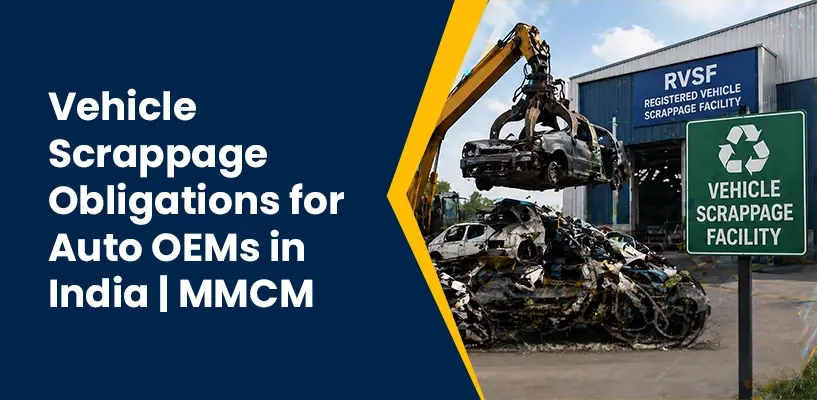
Vehicle manufacturing is no longer limited to production and sales. Responsibility now extends across the entire lifecycle of a vehicle, including its final stage of disposal. This shift is driven by circular economy models, extended producer responsibility, and increasing regulatory pressure on sustainability.
Policies around scrappage are emerging as a direct response to how climate change is reshaping the automotive sector, pushing manufacturers to manage environmental impact beyond the showroom. For auto OEMs, this means aligning operations with structured recycling systems, compliance frameworks, and lifecycle accountability.
What Are Vehicle Scrappage Obligations for Auto OEMs?
Vehicle scrappage obligations for auto OEMs refer to the responsibility of manufacturers to manage vehicles even after they reach the end of their usable life. This marks a shift from a linear production model to a lifecycle based approach.
At the core of these obligations lies extended producer responsibility. Under this framework, manufacturers are accountable for the environmental impact of their vehicles from production to disposal. A detailed understanding of what is epr helps explain how this responsibility is structured across industries.
What these obligations include
- Ensuring vehicles are dismantled through authorized systems
- Preventing disposal in informal scrap yards
- Supporting safe recycling and material recovery
- Aligning with national end of life vehicle regulations
OEM responsibilities vehicle scrappage also involve working within defined targets. These are governed by compliance benchmarks such as recovery rates and recycling efficiency. Manufacturers must align with structured frameworks such as epr targets, which define measurable obligations.
This approach ensures that vehicles do not become long term environmental liabilities and instead re-enter the production cycle as reusable material.
Regulatory Framework Governing Vehicle Scrappage
Vehicle scrappage policy obligations in India are guided by a combination of regulatory standards, environmental policies, and industry specific guidelines.
Key regulatory pillars
1. National scrappage policy
India has introduced structured frameworks to phase out older vehicles and promote responsible disposal. The vehicle scrappage policy in India defines how vehicles are deregistered, dismantled, and recycled.
2. AIS 129 standards
Automotive Industry Standard 129 outlines guidelines for collection, dismantling, and recycling of vehicles. It sets technical and operational benchmarks for scrappage facilities.
3. MoRTH guidelines
The Ministry of Road Transport and Highways regulates the setup and functioning of Registered Vehicle Scrapping Facilities. These guidelines ensure safe handling of hazardous materials and proper documentation.
4. Environmental compliance
Automotive recycling regulations also align with waste management laws, ensuring that fluids, metals, and hazardous substances are handled responsibly.
Global alignment is also visible. India is gradually moving toward international standards similar to European ELV directives, improving trade compliance and sustainability reporting.
Key Responsibilities of Auto OEMs in Vehicle Scrappage
Vehicle scrappage obligations are operational in nature. They require manufacturers to actively participate in disposal systems rather than remain passive stakeholders.
Supporting Authorized Scrapping Facilities
OEMs are expected to collaborate with certified facilities for dismantling and recycling vehicles.
- Partnership with registered scrapping facilities
- Ensuring safe dismantling and depollution
- Compliance with government approved systems
Recycling and Material Recovery
Material recovery is central to automotive scrappage obligations.
- Recovery of steel, aluminum, plastics, and components
- Reduction in use of hazardous materials
- Design for disassembly to improve recycling efficiency
This directly supports circular production models and reduces dependency on raw material extraction.
Compliance and Reporting
Regulatory compliance requires structured data systems and reporting mechanisms.
- Tracking vehicles reaching end of life
- Monitoring recycling and recovery rates
- Maintaining audit ready documentation
Digital platforms and lifecycle tracking systems are increasingly used to ensure traceability and transparency across scrappage operations.
Consumer Awareness and Incentives
OEMs also play a role in influencing consumer behavior.
- Informing customers about scrappage programs
- Supporting incentives for vehicle replacement
- Encouraging formal disposal channels
Scrappage incentives often include discounts on new vehicles, linking old vehicle disposal with new vehicle demand.
Importance of Vehicle Scrappage for Auto Manufacturers
Vehicle scrappage is not just a compliance requirement. It directly impacts cost structures, sustainability goals, and long term competitiveness.
Where scrappage creates value
1. Environmental impact reduction
Proper disposal reduces pollution from abandoned vehicles and prevents hazardous leakage into soil and water.
2. Resource efficiency
Recovered materials reduce dependence on virgin resources. Recycled steel and aluminum require significantly less energy to process.
3. Regulatory compliance
Meeting automotive recycling regulations reduces the risk of penalties and operational disruptions.
4. Sustainability positioning
Manufacturers can align with ESG frameworks and improve brand perception.
5. Circular economy integration
Scrappage supports a shift from linear production to circular automotive systems. This aligns with circular economy in automotive industry practices where materials are reused across production cycles.
Scrappage also plays a role in reducing lifecycle emissions. Recycling materials lowers production energy requirements, contributing to broader emission reduction strategies.
How OEMs Can Meet Vehicle Scrappage Obligations
Meeting scrappage obligations requires integration across operations, design, and supply chains. It is not a single process but a coordinated system.
Practical approaches for OEMs
1. Partnering with authorized facilities
Collaboration with certified scrapping facilities ensures compliance and operational efficiency.
2. Designing for recyclability
Vehicle components should be designed for easy dismantling and material separation.
3. Take back programs
Manufacturers can create systems where customers return old vehicles through dealership networks.
4. Lifecycle tracking systems
Digital platforms help track vehicle ownership, scrappage status, and material recovery rates.
5. Material innovation
Research into recyclable materials and battery recovery improves long term sustainability outcomes.
Strategic advantage
Scrappage systems also contribute to emissions reduction across supply chains. Optimizing material recovery supports strategies around how to reduce scope 3 emissions in automotive, where upstream and downstream emissions are addressed.
Manufacturers that integrate scrappage into core operations gain better control over costs, compliance, and sustainability reporting.
The Cost of Non Compliance
Ignoring vehicle scrappage obligations creates operational and financial risks. A comparison highlights the difference between proactive and reactive approaches.
| Obligation | Proactive OEM | Reactive OEM |
| Raw material sourcing | Uses recycled inputs | Depends on virgin materials |
| Regulatory standing | Meets compliance requirements | Faces penalties |
| Customer engagement | Offers scrappage incentives | Limited participation |
| Sustainability goals | Aligns with ESG targets | Struggles with emissions |
This contrast shows that scrappage is not just a regulatory burden. It is a strategic lever for efficiency and growth.
Conclusion
Vehicle scrappage obligations for auto OEMs are no longer optional. They are becoming a core part of how the automotive industry operates within a regulated and sustainability driven environment.
Manufacturers that actively manage end of life vehicles, support recycling systems, and integrate lifecycle responsibility into production will be better positioned for long term success.
As policies evolve and sustainability expectations increase, scrappage will move from compliance activity to a central business function. Alignment with structured strategies such as a net zero roadmap will define how effectively OEMs transition toward a circular and low emission automotive ecosystem.
FAQs
What are vehicle scrappage obligations for auto OEMs?
They are responsibilities requiring manufacturers to manage vehicle disposal, recycling, and compliance with environmental regulations.
Why are OEMs responsible for end of life vehicle management?
Extended producer responsibility frameworks require manufacturers to manage the lifecycle impact of their products.
What role do registered vehicle scrapping facilities play?
They ensure safe dismantling, depollution, and recycling of vehicles under regulated conditions.
How does the vehicle scrappage policy affect auto manufacturers?
It requires compliance with disposal systems, reporting standards, and recycling targets.
What regulations govern vehicle recycling in India?
Policies include AIS standards, MoRTH guidelines, and environmental waste management laws.
How can OEMs support sustainable vehicle disposal?
By partnering with authorized facilities, improving vehicle design, and implementing take back programs.
Why is vehicle recycling important for the automotive industry?
It improves resource efficiency, reduces environmental impact, and supports circular economy practices.