
In the race toward net zero, few frameworks have influenced corporate climate action as much as the GHG Protocol’s system for categorizing company emissions. By classifying greenhouse gases into Scope 1, Scope 2, and Scope 3, the framework clarifies where emissions come from and who is responsible for managing them.
Understanding these scopes is not merely an accounting task. It affects climate strategy, ESG disclosures, supply chain flows, and moreover, the investment decisions. It also impacts how solutions like ELV (End-of-Life Vehicle) Carbon Credits fit into corporate decarbonization strategies.
Why Emissions Are Categorised Into Three Scopes?
The GHG Protocol categorized the greenhouse gas emissions by source and operational boundary into scope 1 2 3 emissions, to avoid double counting, assign responsibility, and ensure transparency across value chains. Modern businesses operate in complex ecosystems, where a direct emission for one company might be an indirect emission for another.
Thus, by classifying emissions into three scopes, companies can:
- Identify controllable versus value-chain emissions
- Design targeted reduction strategies
- Report consistently under global ESG frameworks
- Meet regulatory and investor expectations
Without this structure, reporting would be fragmented, inconsistent, and likely to overlap.
What Are Scope 1 Emissions? (Direct Emissions)
Scope 1 emissions are “direct emissions” from sources owned or controlled by a company.
Examples include:
- Fuel combustion in company-owned boilers or furnaces
- Emissions from company vehicles
- Industrial process emissions
- Refrigerant leakage
For instance, if an automobile manufacturer runs a paint shop that burns natural gas, or if a Registered Vehicle Scrapping Facility (RVSF) uses diesel in forklifts or diesel generator sets; those emissions are Scope 1.
What Are Scope 2 Emissions? (Purchased Energy)
Scope 2 emissions are “indirect emissions” from the purchased electricity, steam, heating, or cooling consumed by the company. While the emissions arise at the power generation facility, they are accounted for by the consuming entity.
Examples include:
- Electricity used in manufacturing facilities
- Purchased steam for industrial processes
- Grid electricity used in offices
Companies often address Scope 2 emissions through procuring renewable energy, entering power purchase agreements (PPAs), or improving their energy efficiency.
What Are Scope 3 Emissions? (Value Chain Emissions)
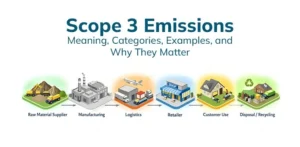
Scope 3 emissions are all other indirect emissions that occur throughout the value chain, both upstream and downstream. They usually frame the largest chunk, often representing 70 to 95% of total corporate emissions.
Examples include:
- Raw material extraction
- Purchased goods and services
- Transportation and logistics
- Use of sold products
- End-of-life treatment
In the automotive sector, emissions from steel production, battery manufacturing, fuel combustion during vehicle use, and vehicle disposal are all accounted under Scope 3.
This is where ELV Carbon Credits become significant. When end-of-life vehicles are properly dismantled and materials like steel, aluminum, and copper are recovered, recycled materials can replace carbon-intensive virgin production. The emissions avoided from primary metal extraction and processing lead to real Scope 3 emission reductions, especially in Category 12 (End-of-Life Treatment of Sold Products) and Category 1 (Purchased Goods and Services).
By integrating ELV Carbon Credits in decarbonization strategies, companies can effectively address upstream and downstream emissions, while reinforcing their circular economy commitments.
How Emissions Scopes Connect to Net Zero and ESG Reporting?
Net zero commitments require companies to reduce emissions in all three scopes, not just their operational emissions. Investors, regulators, and rating agencies are demanding complete transparency throughout the value chain. ESG reporting frameworks and sustainability disclosures now require:
- Quantified Scope 1 and 2 emissions
- Material Scope 3 disclosures
- Science-based targets
- Credible reduction pathways
Ignoring Scope 3 is no longer an option, especially in industries with carbon-intensive supply chains. As climate risk turns into financial risk, emissions transparency becomes strategically imperitive.
Role of Traceability in Managing Scope 1, 2, and 3 Emissions and How MMCM Supports This?
Traceability is essential for credible carbon accounting. Without robust data systems, the estimates behind scope 1 2 3 emissions are unreliable and cannot withstand audits.
For Scope 1 and 2, traceability ensures accurate tracking of energy and fuel use.
For Scope 3, traceability becomes even more critical, as emissions occur across suppliers, recyclers, logistics providers, and end users.
In the context of ELV Carbon Credits, traceability ensures:
- Verified vehicle dismantling records
- Transparent material recovery data
- Prevention of double counting
MMCM (Meta Materials Circular Markets) supports this by integrating digital monitoring systems, verifying material flow, and providing structured documentation that meets global carbon standards. MMCM builds confidence in Scope 3 emission reductions and improves ESG reporting integrity.
In a carbon market subject to increased scrutiny, traceability is fundamental rather than discretionary.
Conclusion
The classification of emissions into Scope 1, 2, and 3 is essential for corporate climate responsibility. While Scope 1 and 2 focus on direct emissions, Scope 3 reveals the broader impacts embedded in the global value chains.
As companies aim for net zero, reducing carbon emissions must go beyond their direct operations. Circular solutions like ELV Carbon Credits pave a way to measure and verify Scope 3 reductions by replacing virgin material production and strengthening end-of-life management.
In the end, effective climate leadership relies on complete scope coverage of scope 1 2 3 emissions, its clear reporting, and strong traceability. These are the key elements of moving toward a low-carbon, circular economy.
FAQs
Scope 1, 2, and 3 emissions are categories defined by the GHG Protocol to help companies measure their total greenhouse gas footprint.
Scope 1 covers direct emissions from owned or controlled sources.
Scope 2 includes indirect emissions from purchased electricity, heat, or energy.
Scope 3 captures all other value-chain emissions, such as raw materials, transport, product use, and end-of-life treatment.
Companies have direct control over Scope 1 emissions because these come from their own operations, such as fuel combustion in machinery or company vehicles.
Scope 2 can be influenced through renewable energy procurement, while Scope 3 often requires collaboration across the value chain, where solutions like MMCM’s ELV recycling-based carbon credits support measurable reductions, since they specifically address to the category 1 (Purchased Goods and Services) and category 12 (End-of-Life Treatment of Sold Products)
Scope 3 emissions typically represent the majority of a company’s carbon footprint because they include upstream suppliers, logistics, product use, and disposal.
For sectors like automotive and materials, end-of-life vehicle (ELV) recycling is a significant reduction opportunity. For the automotive sector,this is where MMCM’s ELV carbon credit projects create real climate impact and traceable Scope 3 benefits.
Scope 3 reporting is not always legally mandatory, but it is increasingly required under ESG frameworks, investor disclosures, and net-zero commitments. High-quality, traceable carbon credits;such as those generated throughMMCM’s ELV project; help companies address difficult-to-reduce Scope 3 emissions while maintaining credible sustainability reporting.
Scope 1: Direct emissions from sources a company owns or controls.
Scope 2: Indirect emissions from purchased electricity or energy.
Both are operational emissions, while Scope 3 extends beyond company boundaries, where climate solutions like MMCM’s ELV recycling carbon credits play a key role.
The GHG Protocol is the global standard for measuring and managing greenhouse gas emissions. It defines Scope 1, 2, and 3 categories and guides corporate climate reporting worldwide. MMCM aligns its ELV carbon credit methodology and traceability approach with internationally recognized carbon accounting principles, supporting credible ESG and net-zero strategies.