
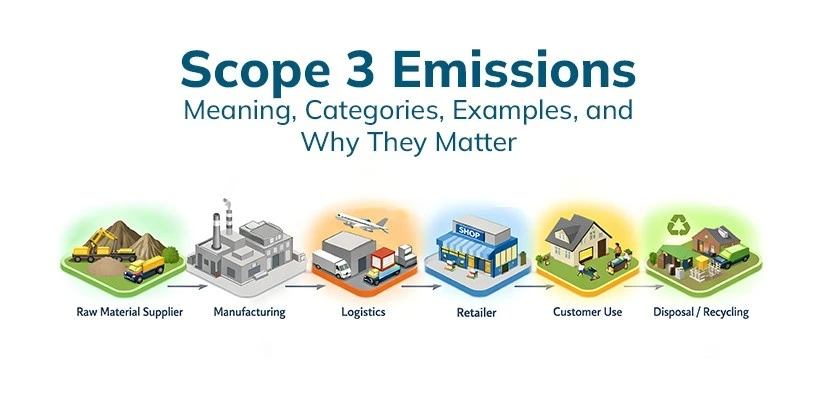
Scope 3 emissions are the indirect greenhouse gas (GHG) emissions that occur across a company’s value chain. Under the GHG Protocol, emissions are divided into three scopes – Scope 1 (direct emissions from owned or controlled sources), Scope 2 (indirect emissions from purchased electricity/steam), and Scope 3 (indirect emissions from the supply chain).
Scope 3 covers emissions that a company does not directly produce but influences through its activities. These can include emissions from suppliers, product use by customers, waste disposal, etc. In many cases, Scope 3 emissions contribute to the largest portion of the total GHG emissions of a company.
Upstream vs Downstream Scope 3 Emissions
Scope 3 emissions are further classified as upstream and downstream activities:
1. Upstream emissions occur before a company’s own operations. These include emissions from purchased goods and services, capital equipment, transportation of raw materials, employee commutes, etc.
2. Downstream emissions occur after a company’s product or service leaves its periphery of control. These include transportation of sold products or goods, products or goods used by customers or consumers, end-of-life disposal, leased assets, etc.
For an automobile OEM, upstream emissions include the production of steel, aluminium, plastics, glass, and other components sourced from the manufacturer, while downstream emissions constitute fuel combustion during vehicle use, maintenance-related emissions, end-of-life disposal of vehicles, etc.
15 Scope 3 Emission Categories (GHG Protocol)
The GHG Protocol identifies 15 Scope 3 emissions categories –
Upstream Categories
1. Purchased Goods & Services
2. Capital Goods
3. Fuel- and Energy-Related Activities
4. Upstream Transportation and Distribution
5. Waste Generated in Operations
6. Business Travel
7. Employee Commute
8. Upstream Leased Assets
Downstream Categories
9. Downstream Transportation and Distribution
10. Processing of Sold Products
11. Use of Sold Products
12. End-of-Life Treatment of Sold Products
13. Downstream Leased Assets
14. Franchises
15. Investments
Not every category is relevant to every company. Businesses are expected to assess materiality and focus on categories that significantly contribute to their overall emissions.
Why Scope 3 Emissions Matter for Companies
- They usually represent the largest share of emissions: for many sectors such as oil and gas, automotive, retail, food, and finance, Scope 3 emissions account for the majority of total emissions. In this scenario, addressing only operational emissions provides an incomplete picture.
- They are increasingly required in disclosures: investors, lenders, and regulators are asking companies to disclose value chain emissions. Several climate disclosure frameworks refer to Scope 3 accounting, especially when emissions are material.
- They are essential for credible net-zero targets: Organizations seeking to set science-based targets under the SBTi (Science Based Targets Initiative) are required to include Scope 3 targets if these emissions form a significant portion of their footprint.
- They drive supply chain engagement: Measuring Scope 3 emissions helps companies work with suppliers to reduce carbon intensity, improve procurement strategies, and identify risks linked to high-emission inputs.
- They influence circular strategies: understanding downstream emissions can lead to better management of end-of-life products, which in turn could play a vital role in framing the corresponding circular strategies.
In the automobile sector, Scope 3 emissions often exceed 95% of total GHG emissions due to supply chain and vehicle use impacts. Addressing them strengthens the supply chain resilience, drives low-carbon innovation, and improves market competitiveness.
Conclusion
Scope 3 emissions remind the organizations that climate impact does not cease at the factory gate. The real footprint of the businesses also lies across their suppliers, customers, and products throughout their lifecycle. Taking responsibility for those emissions demonstrates transparency and long-term commitment. In a rapidly evolving climate economy, addressing Scope 3 is no longer optional but fundamental to responsible environmental contribution.
FAQs
Scope 3 emissions are indirect emissions that occur across a company’s value chain and are not directly owned or controlled by the company.
There are 15 categories defined under Scope 3 by the GHG Protocol, 8 under upstream, and 7 under downstream sources.
They include emissions from suppliers, product use, and end-of-life treatment.
Requirements vary by jurisdiction and framework. In many cases, companies must report Scope 3 emissions if they are material.
Upstream emissions occur before a company’s operations, while downstream emissions occur after a product or service is sold.
Industries such as automobiles, oil and gas, aviation, consumer goods, agriculture, and financial services often report high Scope 3 emissions due to supply chain, product use, or financial activities.